Planning an event in Orlando means thinking about the stage and the sound together, not as two separate line items. We've seen too many well-built stages end up with muddy audio because speaker placement was an afterthought, and we've seen great PA systems underperform because nobody accounted for stage depth or room acoustics. This guide pulls together what our team has learned from hundreds of setups across Central Florida.
Whether you are booking a sound system rental in Orlando for a corporate keynote, a graduation ceremony, or a full concert, the way your audio integrates with your stage configuration makes a bigger difference than most planners expect.
Getting this right takes more than dropping speakers on either side of a stage and hoping for the best. Let us walk through what actually works, from stage depth and speaker placement to power requirements and venue-specific challenges.
Why Stage Size Directly Affects Your Audio Setup
The stage is not just a platform. It's a physical object that shapes how sound travels through your venue. A shallow 8-foot-deep stage in a hotel ballroom calls for a completely different audio approach than a 24-foot-deep concert stage at an outdoor festival site.
On shallower stages (8 to 12 feet of depth), performers and speakers are naturally closer together. The main tops can often be placed on stands at the front edges of the stage without creating feedback problems, and the shorter throw distance means you need less output power to fill the room evenly. An 8-foot-deep speaking stage in a corporate setting, for example, works well with a pair of 12-inch tops and a single subwoofer centered below the front lip.
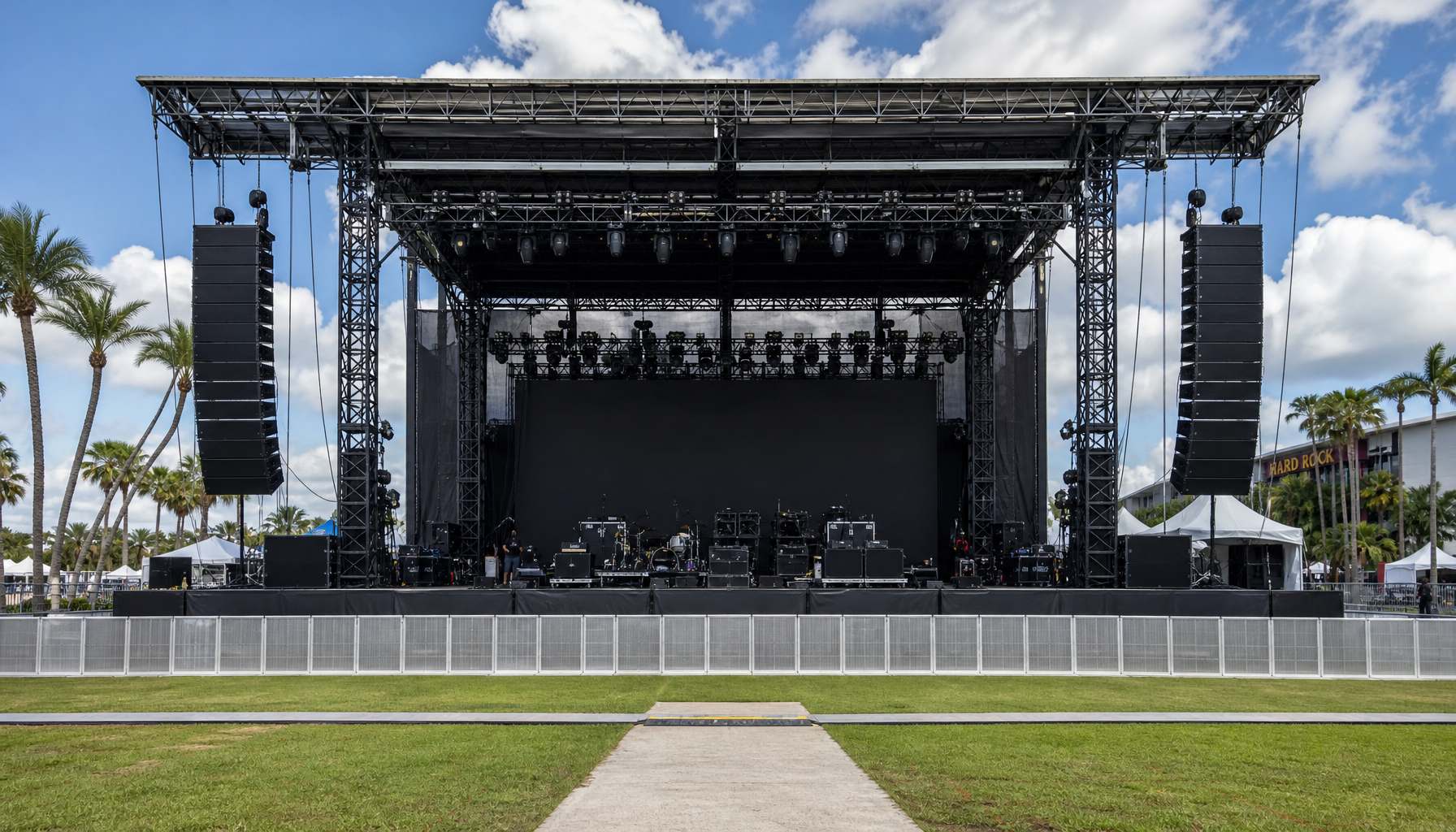
Deeper stages (16 to 24 feet) change the math. When performers stand 12 to 20 feet back from the front edge, speaker placement needs to account for that distance. You either push the main tops further from the stage, use delay stacks, or deploy a front-fill system along the downstage edge to cover the gap. For our concert stage rental configurations, we always discuss speaker positioning early in the planning conversation, because it shapes where we position the deck framing, stairs, and power drops.
Practical takeaway: Tell your audio provider the exact stage dimensions before they quote you a system. A 16×24 stage and a 24×40 stage are not the same audio job.
Hotel Ballrooms vs. Outdoor Sites: Two Very Different Audio Challenges
Two of our most instructive recent setups happened in very different environments, and the contrast shows exactly why venue type drives audio decisions as much as stage size does.
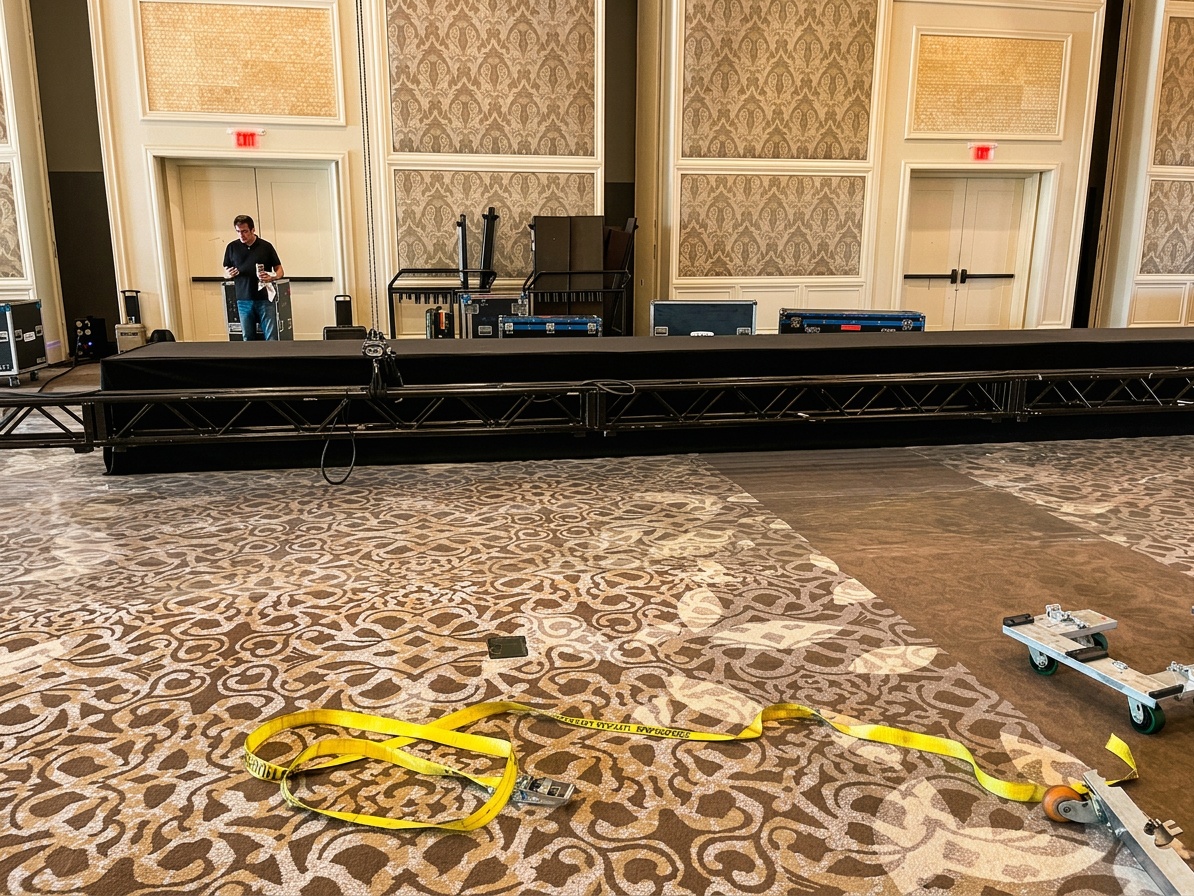
In early April 2026, our team installed a stage at the Gaylord Palms for the Patel event. The Gaylord Palms is a massive convention property, and its event spaces have the kind of high ceilings and hard reflective surfaces that can turn a clean PA signal into an echo chamber if the system isn't tuned properly. In large hotel convention spaces like this, cardioid subwoofer configurations (where the subs are arranged to reject sound toward the back of the room) and careful delay alignment between the main tops and any front fills make the difference between intelligible speech and a wall of reverb.
A few weeks earlier in February 2026, we ran a multi-day install and strike at the Celeste Hotel for the Mastoris event. Hotel ballrooms present their own wrinkles: ceiling height is often lower than a convention hall, the room shape may be irregular, and breakout walls can cause unexpected acoustic hotspots. On that setup, we paid close attention to how the stage height interacted with the first rows of the audience. A stage at 24 to 30 inches gets speaker tops closer to ear level for front-row attendees, which actually reduces the low-frequency build-up you sometimes get when tops are too high and angled too steeply down.
For outdoor sites, the entire equation flips. Sound disperses freely, which means you need more output to achieve the same perceived loudness, and wind becomes a real factor. In February 2026, our install for the Perry event in Apopka involved outdoor PA system setup, where we factored in the open-air environment when planning speaker coverage angles and gain structure. Florida weather also means thinking about moisture and sudden wind gusts, both of which affect how your crew secures speaker stands and cables.
The Ramjit corporate event in Lake Mary, also from February 2026, landed somewhere in between: a covered outdoor or semi-open venue where reflections from a roof or canopy can behave similarly to an indoor room. For those hybrid spaces, we recommend testing the system at low volume before the event starts to catch any frequency buildups early.
Practical takeaway: Share your venue type, ceiling height (if applicable), and whether the space is fully indoor, outdoor, or covered when you request a quote. It changes the recommended system significantly.
Speaker Placement on a Concert Stage: The Mechanics
Good speaker placement on a concert stage comes down to three things: coverage angle, height, and coupling with the subwoofers.
Most mid-size tops designed for live event use have horizontal coverage angles between 60 and 120 degrees depending on the cabinet design. If your stage is 24 feet wide and your tops are placed 10 feet above the stage deck on stands at each wing, the coverage fans out to cover the audience area evenly at mid-distance. The trouble starts when the tops are placed too close together (causing comb filtering in the center where coverage overlaps) or too far apart (leaving a dead zone in the middle of the room).
Subwoofer positioning deserves its own attention. A single sub placed asymmetrically creates uneven bass across the audience. For smaller setups on 16-foot-wide stages, we typically center a single sub below the front edge of the deck. For wider stages or higher-output requirements, a stereo-split subwoofer configuration (one sub per side) or a cardioid sub array delivers more even coverage. The stage deck itself can act as a boundary, reinforcing low-frequency output when the sub is coupled to the stage floor surface. That's actually a useful physics trick for outdoor events where you need more low-end from the same hardware.
Front-fill speakers (small format tops laid horizontally along the downstage edge) close the gap for the first few rows of the audience. On a deep concert stage, the main tops need to be angled to throw further back, which means the first 10 to 15 feet of audience in front of the stage can fall in a coverage gap. Front fills solve that problem cleanly, and they run at low levels so they don't cause feedback with the microphones on stage.
Power Requirements and Cable Routing for Event Audio
This is the piece most event planners don't think about until they're on-site and the venue electrician is asking questions nobody prepared for.
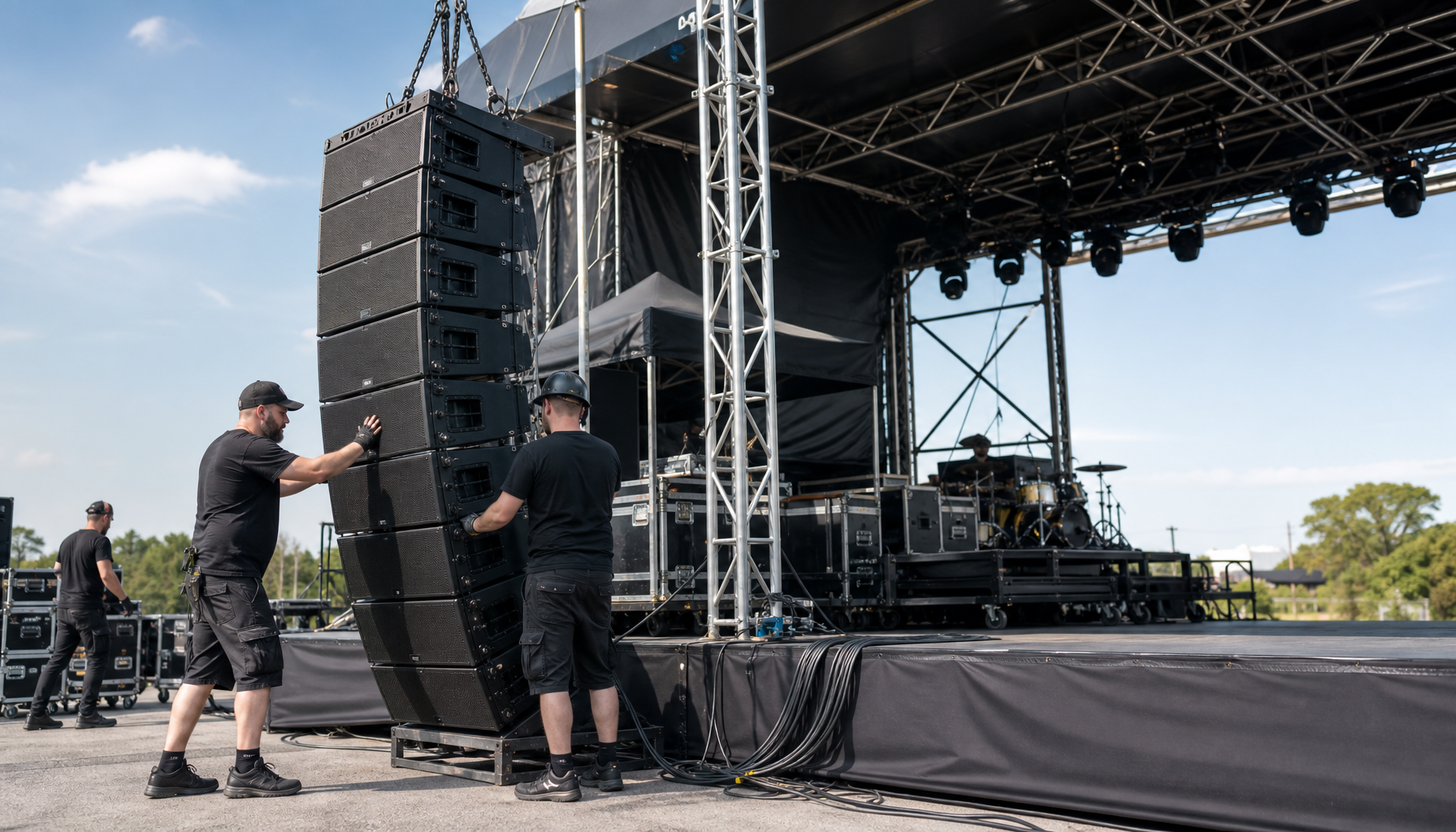
A typical small-format PA for a speaking stage (two tops, one sub) draws somewhere between 15 and 30 amps at full output. Scale up to a full concert rig with multiple subwoofers and amplifier racks, and you can be looking at 60 to 100 amps or more. Power requirements for event audio at large venues like the Gaylord Palms or Celeste Hotel are usually handled through the venue's house power distribution, but you need to know in advance whether you're tapping 120V or 208V circuits and how many dedicated circuits are available.
For outdoor events in Apopka, Lake Mary, or similar locations without permanent venue infrastructure, a generator is often the right call. We coordinate with our clients on generator sizing when we know the audio package going in, because underpowering a rig causes amplifiers to clip and can damage speakers.
Cable routing matters both for safety and for audio quality. Long unbalanced cable runs introduce noise. On a 24×40 stage, the run from the stage to the front-of-house mixing position might be 100 feet or more, and that distance should always use balanced XLR or TRS connections. We also make sure all cables are dressed properly along the stage deck edges and taped down across any pedestrian paths, both because it looks professional and because it's a genuine trip hazard if ignored. Our post on the stage safety inspection checklist for Orlando events covers the ground-level hazard piece in more detail.
Practical takeaway: Ask your venue contact for a one-line diagram of available power or, at minimum, the total amperage available and whether circuits are shared with lighting. We can help you bridge that conversation.
Matching Audio Packages to Your Stage Configuration
Our audio packages are structured to match common stage configurations, but the right system always depends on the specific combination of stage size, venue, and event type.
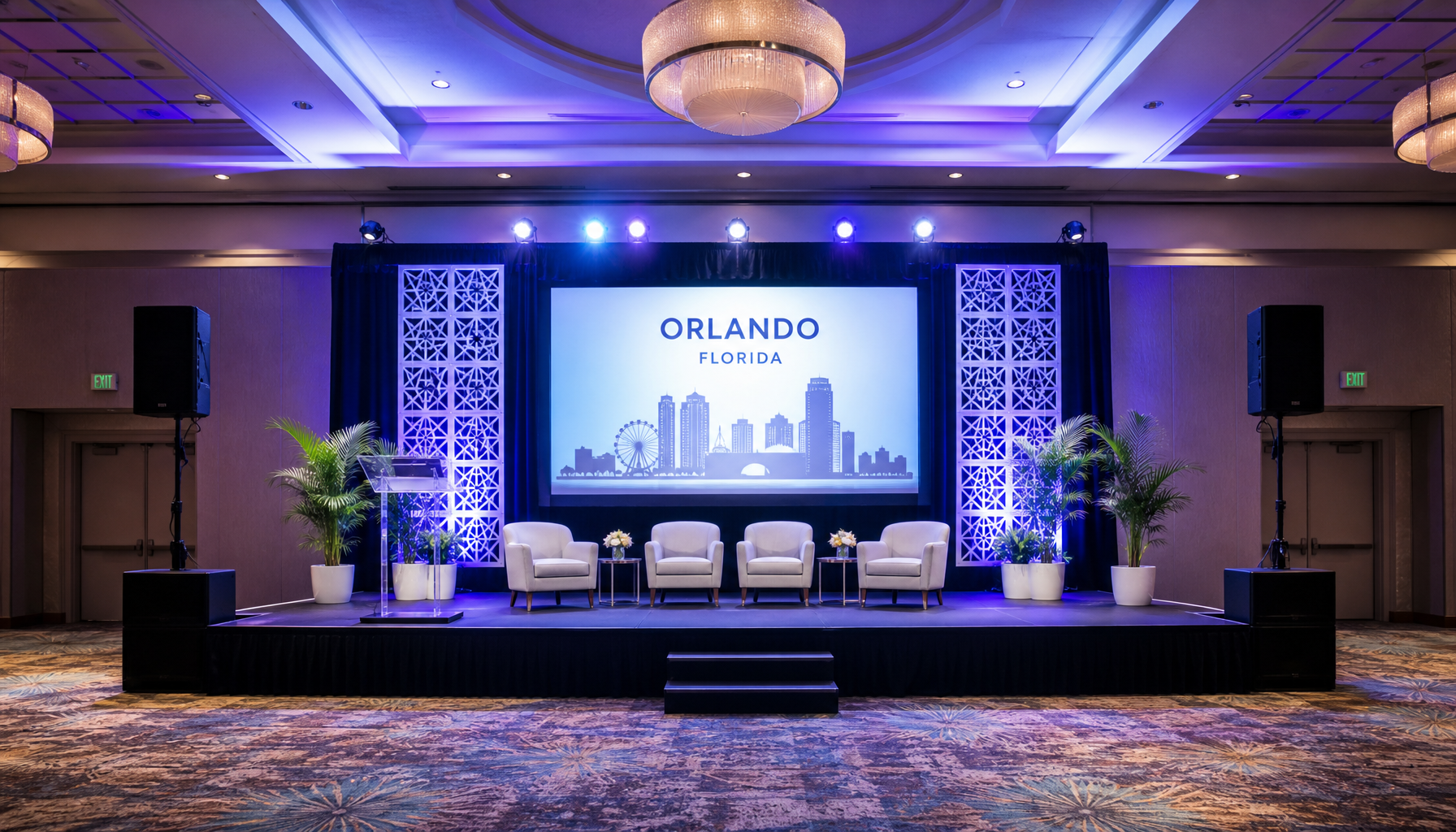
For speaking stages used in corporate events, award ceremonies, or graduation setups, a clean two-top-plus-sub system with a digital mixer handles most rooms up to roughly 500 to 600 attendees. Add a second sub and front fills for rooms above that, or for high-ambient-noise outdoor environments.
For performance staging with live bands or DJ setups, the subwoofer count typically doubles, and the main tops move up to 15-inch drivers or line array elements depending on the throw distance required. Our performance staging rental page shows configurations that pair naturally with these larger audio packages.
One thing planners often forget to include in the quote conversation: stage monitors. These are the speakers that face the performers on stage, not the audience. Singers, speakers, and musicians need to hear themselves clearly, and skipping monitors is one of the most common oversights we see. On a 16×24 stage, two to four wedge monitors placed at the downstage edge cover most needs. In-ear monitor systems are an option for more controlled stage environments.
When you're also adding stage lighting to the mix, talk to us early about DMX cable routing and how the lighting truss or trees will interact with speaker stand placement. We've shown up to jobs where the lighting and PA rigs were planned completely independently, and the truss leg ended up exactly where the sub was supposed to go. It's an easy problem to avoid when everyone is coordinating from the start. Check out our stage lighting options for a sense of how these systems coexist on the same stage footprint.
What to Do When You Are Sourcing Stage and Audio from Separate Vendors
Not every client books stage and sound through the same company, and that is completely fine. But if you're renting a stage from us and bringing in an outside audio vendor, there's a short list of information they'll need from you before they can plan their setup properly.
Give them the stage dimensions (length, width, and deck height), the location of any built-in power drops, and whether stairs are on the front, side, or rear of the platform. Deck height matters because it affects how speaker stands are rigged and whether sub placement at the front edge will work or create a sight-line problem. We're happy to share a spec sheet for any stage we're providing, so your audio company walks in knowing exactly what they're working with. Honestly, the more information that gets shared between vendors in advance, the smoother the day-of setup goes for everyone.
Audio Troubleshooting: What to Do Before It Becomes a Problem
Even a perfectly planned system runs into audio troubleshooting moments at live events. Most of the issues we see are preventable with a solid soundcheck protocol.
Run your soundcheck at least 90 minutes before doors open. The room sounds different when it's empty versus full, because human bodies absorb high frequencies and warm up the acoustic environment. Most mixers need a slight EQ adjustment once the audience is present, typically pulling a little brightness from the high-mid frequencies.
Feedback is almost always a placement or gain problem, not a broken speaker. Nine times out of ten when we see feedback during soundcheck, a mic has crept in front of a monitor. Reduce the gain on the offending mic first, then check whether it's positioned behind all the main tops when viewed from above. Those two steps fix the problem the vast majority of the time.
Wireless microphone frequency conflicts are a real issue in Orlando. The radio frequency environment near theme parks and large convention properties like the Gaylord Palms is dense. We coordinate frequencies in advance for wireless systems and recommend confirming frequency assignments with the venue's AV department if they have in-house systems running simultaneously.
If you need to figure out what stage size goes with your event format before getting into audio details, our how to choose the right stage size guide is a good starting point.
Practical takeaway: Build a 90-minute soundcheck window into your event timeline. It's the single biggest thing that separates events with great audio from events where people in the back can't understand the speaker.
Bringing It All Together
Pairing a sound system rental in Orlando with the right stage configuration is a logistics problem as much as it is a technical one.
Stage depth determines speaker placement strategy. Venue type shapes the acoustic approach. Power planning prevents on-site surprises. Cable routing and front fills are details that separate a professional setup from one that just barely works. When all of these pieces are coordinated from the start, the audio sounds the way it should, and the event runs smoothly from the first mic check to the final note.
At Stages Plus, we handle both the stage and the sound, which means none of these conversations happen in isolation. When we know the stage size, the venue, and the event type, we can match the right audio packages to the configuration and have everything ready to go when our crew arrives on site.
Ready to pair a sound system with your stage rental? Request a quote and tell us your stage size, venue type, and event date. We'll match the right setup to your space and take care of the rest.