Corporate planners often ask us what separates a smooth presentation from a chaotic one. Honestly, a lot of it comes down to what happens in the hours before anyone walks through the ballroom doors. A well-executed 20ft stage setup gives your speakers a polished platform, keeps your A/V team happy, and makes the whole room feel intentional.
Whether you are booking a Q3 leadership summit at the Gaylord Palms or a sales kickoff at a Lake Mary conference center, the 20ft stage setup process follows the same core sequence, and knowing that sequence helps you plan timelines, coordinate with your venue, and avoid last-minute surprises.
A 20×24 or 20×32 configuration is our most common request for corporate presentations in Central Florida hotel ballrooms and conference centers. It fits comfortably in most venues, gives a panel of three or four speakers room to breathe, and leaves enough depth behind the podium for backdrops, displays, or pipe and drape. Here is exactly how our crew builds it.
Why the 20ft Stage Works for Corporate Presentations
Most hotel ballrooms in the Orlando area run between 5,000 and 15,000 square feet. A 20ft wide stage occupies enough of the front wall to read as a real focal point without swallowing the room. You get 480 to 640 square feet of performance surface depending on depth, which is plenty for a single keynote speaker, a moderated panel, or a hybrid setup with a live audience and remote video presentation.
If you are still working out the right footprint for your event, our how to choose the right stage size guide walks through the math based on audience count and room dimensions.
The other reason corporate planners default to 20ft is flexibility. We can dress the same platform with speaking stage rental options that range from a clean minimal look to a fully skirted, lit, draped executive setup depending on your brand requirements.
Phase 1: Delivery and Site Prep
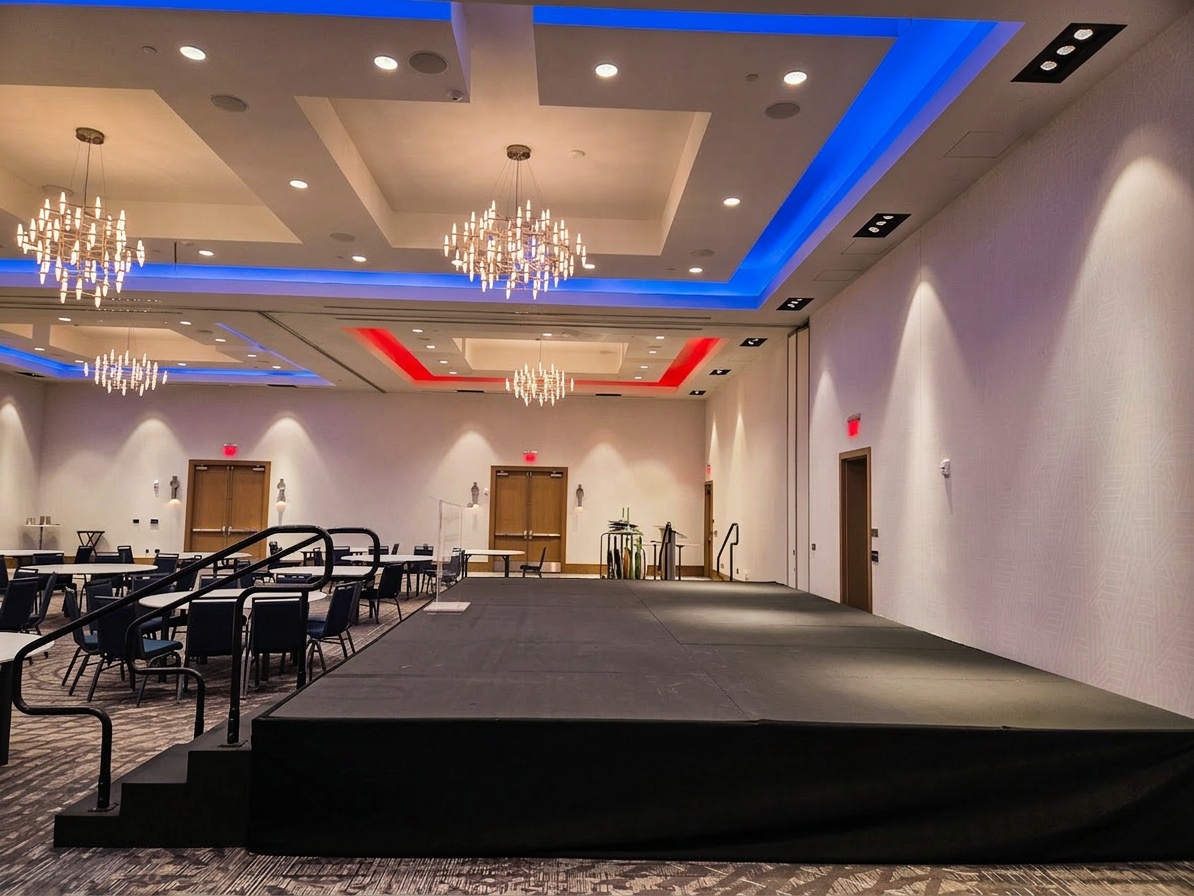
Our crew arrives at least two hours before doors open, sometimes earlier depending on venue load-in requirements. For our April 2026 install at the Gaylord Palms, we coordinated with the hotel's event services team to confirm freight elevator access and a dedicated load-in window. Large convention hotels like Gaylord often have strict move-in protocols, so we build that coordination time into every quote.
Floor protection comes first. Hotel ballrooms have hardwood or specialty flooring that venues take seriously. We lay down protection before any equipment touches the ground. Then we measure and mark the stage footprint using the venue floor plan dimensions we confirmed before the install date.
The marking step matters more than people expect. Getting the footprint centered and square relative to the room saves time on every phase that follows. A stage that is off-center by six inches looks wrong from the back row, and correcting it after the frame is up costs you an hour you don't have.
Practical takeaway: Share your venue's CAD drawing or floor plan with us when you book. We use it to pre-cut measurements and stage the equipment in unload order, which cuts delivery-to-frame time significantly.
Phase 2: Frame and Leg Assembly
With the footprint marked, we start on the frame. Our legs are height-adjustable, which matters in Central Florida venues where ballroom floors are rarely perfectly level. We set height first, lock each leg at the target elevation, then work across the frame checking level at every connection point.
Cross-bracing goes on before any deck panels. This is where stage load capacity for the corporate event gets established. A properly braced frame distributes weight evenly across all contact points. Skipping or loosening braces to speed up the install is how stages develop soft spots, and soft spots are something we simply don't allow.
For our February 2026 install at the Celeste Hotel in Orlando, the crew was working in a ballroom with a slight gradient toward the dance floor. We caught it during the leveling step and adjusted leg heights across the upstage row before any decks were placed. That kind of catch during frame assembly is invisible to your attendees, but it's what makes the stage feel rock solid when your CEO steps to the podium.
Practical takeaway: Every solo-crew situation we've walked into has cost the client time. Two people minimum on frame assembly, no exceptions.
Phase 3: Deck Installation
Once the frame is level and fully braced, we start laying deck panels. Our interlocking decks seat into the frame and lock so they can't shift under foot traffic. We always walk the full deck surface before adding any accessories or equipment, pressing down on every panel edge to confirm seating and listening for any movement or hollow sound that indicates an unseated connection.
Stage deck assembly goes faster with two people working from opposite corners toward the center. It keeps the panels square and prevents the frame from racking as weight gets added asymmetrically.
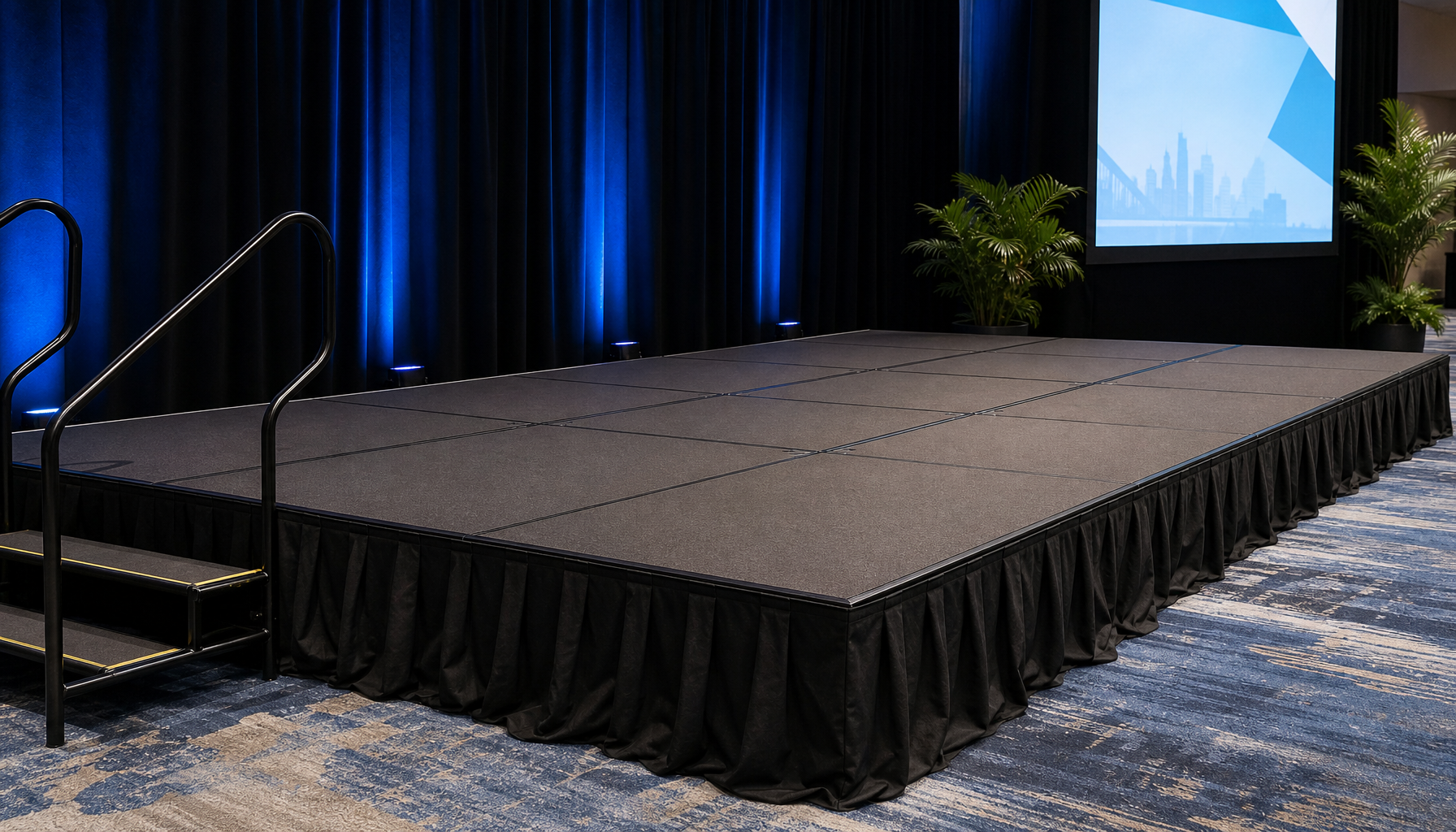
We finished the deck phase on the Celeste Hotel job in under 45 minutes. The Lake Mary install for a corporate client in late February 2026 ran similarly, with the entire frame and deck sequence wrapping before the venue's catering team needed access to the same entrance corridor. Timing those phases around venue activity is something our crew has gotten very good at.
Practical takeaway: Walk the full deck before calling it done. If any panel moves under your foot, reseat it and check the connection point on the frame below it.
Phase 4: Accessories, Stairs, and Skirting
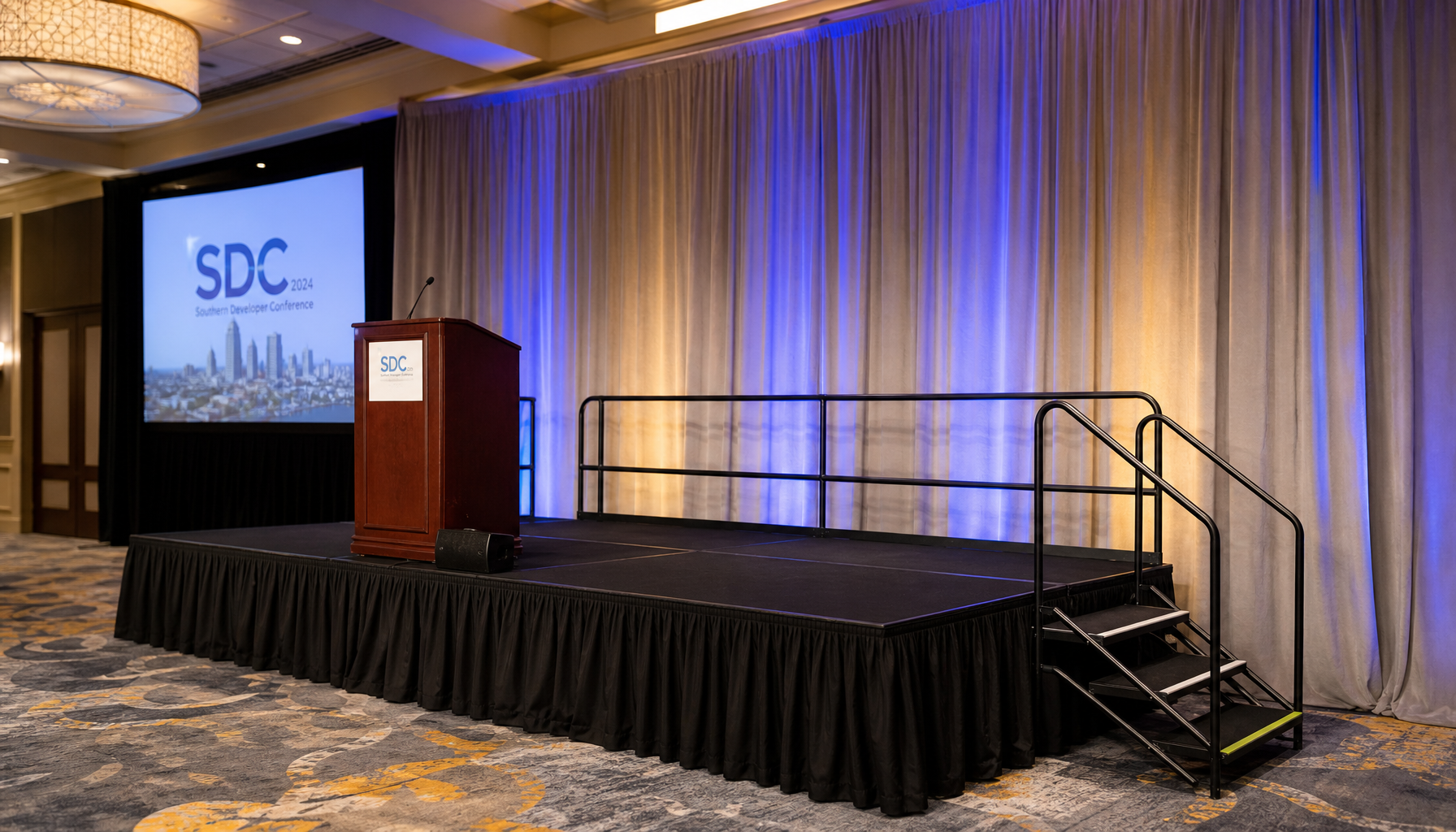
This is where the stage goes from a functional platform to a finished presentation environment. The order we follow: stairs first, guard rails second, skirting third, podium last.
Stairs get positioned based on where presenters will enter from. Most corporate setups use stair rental for stage access at stage right, but we sometimes add a second set at stage left when a panel has multiple speakers rotating on and off during a long session.
Guard rails are required on any stage surface above 30 inches. For corporate presentations, we often set stages at 24 to 32 inches of height depending on audience sightlines and room depth. When height pushes above 30 inches, rails go on the back and sides of the platform. Front rails are a conversation we have with each client depending on the visual aesthetic and presenter movement requirements.
Skirting goes on before the podium and A/V setup begins. We carry black velour skirting as our standard, which reads cleanly under stage lighting and doesn't distract from the presentation surface. One thing worth knowing: cable runs need to be finalized before skirting goes on, because pulling skirting back to route a cable you missed is nobody's favorite way to spend twenty minutes.
Podium placement depends on the presentation format. A single keynote speaker typically centers the podium rental for corporate events about one-third of the way back from the downstage edge. Panel formats usually push the podium offstage entirely and bring in a moderator's chair or a smaller lectern at the edge.
Practical takeaway: Confirm stair position with your A/V team before we lock it in. Cable runs from the stage to the front-of-house position often travel under or beside the stairs, and moving stairs after cables are laid is a hassle for everyone.
Phase 5: A/V and Lighting Prep
Our crew coordinates with your A/V vendor on power routing and cable management. The stage deck has to stay clean at the surface, which means any power runs for wireless receivers, confidence monitors, or stage lighting heads need to be routed through the frame interior or along the perimeter before skirting goes on.
Stage lighting for presentations typically means front wash, backlight for separation from the backdrop, and spot positions over the podium. We talk through power draw with A/V vendors before the install so there are no surprises when everything powers up during tech check.
If your event includes live streaming or video recording, camera riser placement relative to the stage matters a lot. As a starting point for a standard 75 to 100ft ballroom depth, the typical position is centered on the main aisle at roughly two-thirds of the room depth. That gives a clean sightline to the full stage width without a steep vertical angle. For tighter ballrooms, we sometimes run a secondary camera position at stage level or to the side.
Practical takeaway: Share your A/V vendor contact information with us before the install date. A five-minute call between our crew lead and their team lead before load-in prevents 90 percent of day-of coordination issues.
Phase 6: Final Safety Walkthrough
Before we hand the stage off to you and your A/V team, our crew runs a complete safety walkthrough. This is not a formality. It's a structured check of every connection point, rail torque, deck seating, and egress path.
Our checklist hits these points on every corporate install:
- Load test by walking the full deck perimeter and center under normal foot pressure
- Rail torque check at every connection point
- Stair stability confirmation at both top and bottom attachment points
- Egress path clear on both sides of the stage
- No exposed cable runs or trip hazards on the deck surface
- Skirting secured and not creating a trip hazard at stair access points
For a full breakdown of what a professional pre-event inspection covers, our stage safety inspection checklist for Orlando events goes through each phase in detail.
The Gaylord Palms install in April 2026 wrapped the safety walkthrough with time to spare before the hotel's event coordinator did their own venue inspection. Having that buffer built into the timeline is something we plan for intentionally, because venue coordinators at major convention hotels often have their own checklists, and you want your stage to sail through without a single flag.
Practical takeaway: Add 30 minutes of buffer between the end of stage setup and the start of your A/V tech rehearsal. That window covers the safety walkthrough and any minor adjustments before your production team takes over the room.
Setup Timeline: What to Expect
For a 20ft wide corporate stage in a hotel ballroom, here is a realistic phase-by-phase breakdown with a two to three person crew:
| Phase | Estimated Time |
|---|---|
| Delivery and site prep | 20-30 minutes |
| Frame and leg assembly | 30-45 minutes |
| Deck installation | 30-45 minutes |
| Accessories (stairs, rails, skirting) | 20-30 minutes |
| A/V and lighting coordination | 15-30 minutes |
| Safety walkthrough | 15-20 minutes |
| Total | 2 to 3 hours |
Book your load-in window with the venue to cover at least three hours before your first attendee arrives. For large convention venues or union house venues, add extra time for elevator and load dock coordination.
For summer and fall 2026 corporate conferences in Orlando, we're currently booking out four to six weeks in advance for hotel venue installs. Q3 is one of our busiest windows with sales kickoffs, leadership summits, and association conferences all stacking up through September.
Planning a corporate presentation in Orlando or Central Florida? Get a quote for your corporate stage and our crew handles the rest. We bring the equipment, the experience, and the crew that has set up hundreds of stages in Central Florida venues exactly like yours.