A rectangular stage works better for band or DJ setups with equipment and a backline, while a round stage creates a more dramatic, photo-friendly focal point for a first dance or sweetheart table display. At Stages Plus, most Central Florida couples choose based on guest flow and venue shape rather than personal preference alone, since a round stage needs 15-20% more floor clearance than a rectangular one to seat the same number of dancers.
Key takeaways
- A rectangular stage suits bands, DJ booths, and equipment-heavy layouts better because gear sits flush against straight edges.
- A round stage creates a striking 360-degree focal point for a first dance, cake cutting, or sweetheart table reveal.
- Round dance floors and stages need 15-20% more square footage than rectangular layouts to fit the same number of guests.
- Our round stage rental diameter options run 11ft, 17ft, and 29ft, and we regularly pair a round stage for dancing with a rectangular stage for the band.
- Tented receptions need extra clearance for a round shape; ballrooms and open lawns typically handle it more easily.
Sightlines during the first dance and toasts
A round stage gives every guest an unobstructed angle on the couple, while a rectangular stage favors guests seated in front of it over those to the sides. Because a round stage has no corners or back wall, guests seated at 180 degrees around it still get a clear view during a first dance or a champagne toast. A rectangular stage, by contrast, is built to be viewed from one primary direction, which works well when head tables or ceremony seating already face one way.
We've seen this play out at ballroom receptions where round tables wrap most of the room. A centered round stage lets every table have a real sightline instead of half the room craning around a straight edge. If your reception seating is more traditional, with rows or a clear "front" of the room, a rectangular stage's directional design matches the room better, and nobody loses out on a view.
Matching stage shape to your band, DJ, or sweetheart table
A rectangular stage is the more practical choice for a live band or DJ setup, since straight edges hold speakers, monitors, and equipment cases without wasted space. DJ booths, mixing boards, and band risers are almost always rectangular themselves, so a rectangular stage lets that gear sit flush to the back and sides with room to spare for movement.
A round stage shines as a display piece rather than a workstation. It's the shape we recommend most often for a sweetheart table centerpiece, a cake table with a 360-degree view, or a dedicated first-dance platform separate from where the music is coming from. Our reception band stage layout planning guide covers how to size and place a rectangular stage for a live band's gear footprint, mic lines, and monitor spacing.
Plenty of Central Florida couples end up booking both: a rectangular stage for the band and a smaller round stage for the couple's big moments. It's not an either/or decision if your venue has the floor space.
Dance floor flow and guest movement around each shape
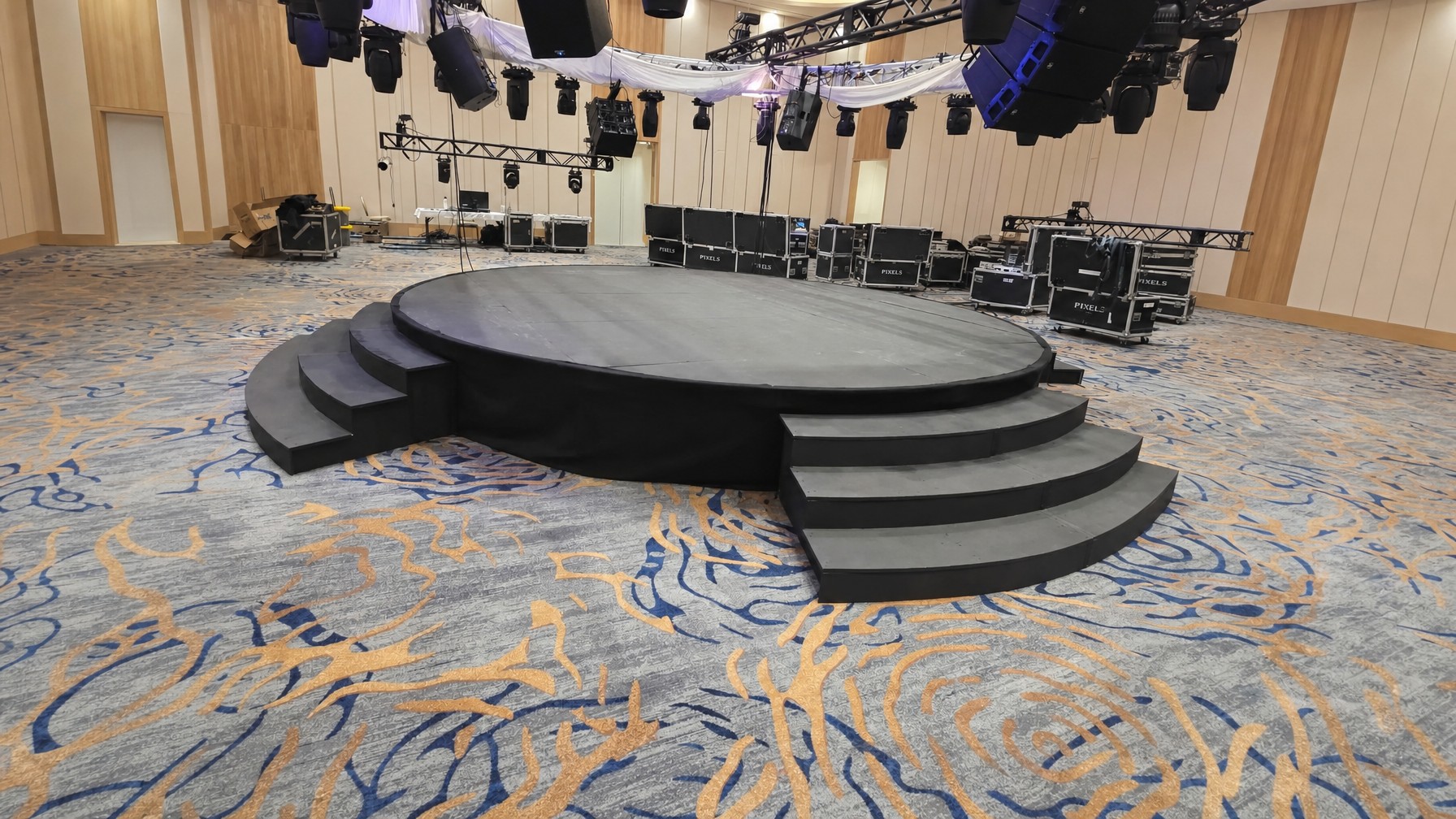
Round stages need noticeably more clearance around them than rectangular stages do, because guests naturally spread out in a circle instead of hugging a straight edge. Round dance floors require 15-20% more square footage to fit the same number of dancers as a rectangular layout, and that same math applies to the open space couples need around a round stage for guests to move freely.
Guest aisles matter here too. The U.S. Access Board recommends a minimum 36-inch clear width for accessible routes, and this is the same clearance standard we plan around when we set a stage mid-floor rather than against a wall. A rectangular stage pushed against one wall of a ballroom or tent frees up the rest of the room. A round stage placed in the center, which is where it looks best, eats into usable floor space on every side, so we always walk the venue's actual square footage before quoting a diameter.
Photography and video results for each shape
A round stage generally photographs better for wide, romantic shots because it has no hard corners to fight with in a frame, while a rectangular stage photographs better for tight, symmetrical shots of a band or head table lineup. Photographers shooting a first dance from a balcony or across the room tend to love a round stage because it reads as a soft, complete circle from almost any angle, day or night with uplighting underneath.
Rectangular stages are the better backdrop when the photo goal is a clean group shot, like the wedding party lined up for a toast or the band caught mid-set with instruments arranged symmetrically. Videographers working with two or three cameras also tend to find rectangular stages easier to frame consistently, since the straight lines give them a predictable reference point for wide and close shots alike.
Sizing options and matching a stage to your guest count
Our round stages come in 11ft, 17ft, and 29ft diameters, and the right size depends almost entirely on your total guest count and how you plan to use the stage. The average U.S. wedding now has 117 guests, according to The Knot's 2026 Real Weddings Study, with Gen Z couples averaging closer to 129 guests. For a reception in that range, we typically recommend:
- 11ft round stage: best as a sweetheart table or cake display platform, or an intimate first-dance stage for receptions under 75 guests.
- 17ft round stage: our most-booked size for a centered first-dance or performance stage at mid-size receptions, roughly 75 to 150 guests.
- 29ft round stage: sized for larger productions where the stage itself is a statement piece, or where a small ensemble performs on it alongside the couple.
- Rectangular stages (commonly 12×16 or 16×20 for receptions): sized to fit a full band, DJ booth, or head table setup, scaled up for larger guest counts and bigger sound systems.
Shape alone doesn't drive pricing in the Orlando market nearly as much as size, height, and add-ons like skirting, guard rails, or stairs do. A small round stage and a similarly sized rectangular stage typically land in the same price range. You can check wedding stage rental options for current package details or run your guest count through our stage size calculator.

Venue layout: ballroom, tent, or waterfront lawn
Your venue's shape usually decides this question for you before your personal preference even enters the conversation. We built a 17ft round stage at the Alfond Inn in Winter Park as a centered dance and first-dance platform inside their ballroom. The room's open, symmetrical layout made a round stage the natural fit, since guests were seated in rounds all the way around it. For a similar guest count at a different Central Florida venue with a straight banquet-style layout and a live band, we've built a rectangular 12×16 stage instead, positioned against one wall for the band and sweetheart table together.
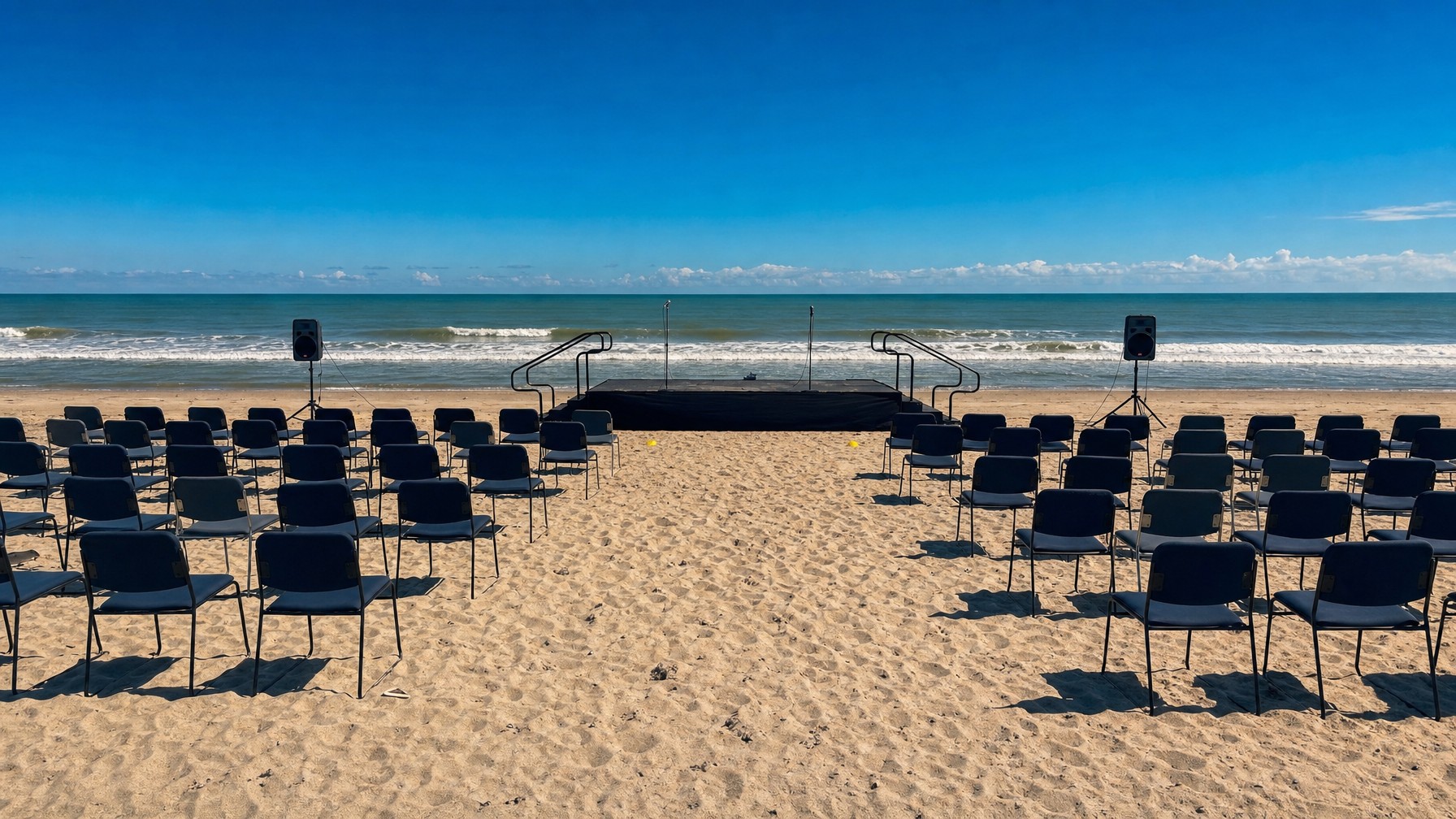
Tented receptions deserve extra caution. Tents commonly require a permit once they cross roughly 400 square feet, with an approved floor plan showing occupancy and egress. A round stage's wider clearance radius can quietly eat into the buffer you need for tables, walkways, and fire lane access. Waterfront lawns tend to give couples the most flexibility, since open grass rarely has the hard boundaries a tent or ballroom does.
The most common mistake we see is a couple falling in love with a round stage from a photo online without measuring their actual venue first. A shape that looked perfect in someone else's ballroom can crowd a smaller tent or an oddly shaped lawn. Walking the room with your stage vendor before booking, not after, avoids that entirely. Our round stage rental applications and when circular staging works best guide breaks down which venue types suit a round shape versus which ones don't.
Frequently asked questions
Is a round stage more expensive than a rectangular stage in Orlando?
Not inherently. Pricing depends more on size, height, and add-ons like skirting, guard rails, or stairs than on shape itself. A small round stage and a comparably sized rectangular stage typically cost about the same to rent in the Central Florida market.
Can we combine a round stage and a rectangular stage at one reception?
Yes, and we build this combination often. A rectangular stage handles the band or DJ setup while a round stage serves as a dedicated first-dance or sweetheart table platform, giving you the practical benefits of both shapes in one reception layout.
What size round stage do we need for around 150 guests?
For a reception near 150 guests, our 17ft round stage is usually the right fit as a centered dance or performance platform. If the stage will also host a small ensemble or additional seating, the 29ft round stage gives more breathing room.
Does a round stage work well inside a tent?
It can, but tented layouts need more planning since round stages require more clearance space than rectangular ones. Tents over roughly 400 square feet also typically need a permit with an approved floor plan, so we recommend confirming clearance before booking a round shape for a tented reception.
What is the biggest mistake couples make when choosing stage shape?
Picking a shape from inspiration photos before measuring their actual venue. A round stage that looks stunning in someone else's ballroom can crowd a smaller tent or an irregularly shaped lawn, so walking the space with your stage vendor first prevents layout surprises later.
Bottom line
Choose a rectangular stage if your reception centers on a live band or DJ setup, and choose a round stage if you want a dramatic, 360-degree focal point for your first dance or sweetheart table. Then let your venue's actual floor plan settle any remaining question. Not sure which shape fits your space? Get a free layout recommendation through our how to get a quote page, or pair your stage choice with a dancefloor rental sized to match.