Orlando Stage Rental

Bands, Runways, Speaking Engagements, Award Ceremonies, Schools

Call Now! 407-442-0254

  • About
    • Blog
  • Pricing
  • Packages
    • Audio Packages
    • Stage Lighting
  • Contact
  • Reserve
  • Stage Sizes
    • 8ft Stage Sizes
    • 12ft Stage Sizes
    • 16ft Stage Sizes
    • 20ft Stage Sizes
    • 24ft Stage Sizes
  • Stage Rentals
    • Speaking Stage Rental
    • Single Performer Stage Rental
    • Concert Stage Rental
    • Round Stage Rental
    • Performance Staging Rental
    • Graduation Stage Rental
    • Wedding Stages
  • Runway
  • Pipe / Drape
  • Audience Riser
  • Pool Cover
  • Tent Floor
  • Camera Riser
  • Stage Accessories
    • Stair Rental
    • Ramp Rental
    • Dancefloor Rentals
    • Barricade Crowd Control Rental
    • Podium Rental

Pipe and Drape Backdrops for Wedding Ceremonies: Design Ideas for Orlando Couples

August 27, 2026 by admin

On this page

  • Choosing the right drape color for Orlando’s light
  • How tall your ceremony backdrop needs to be
  • Fabric that holds up in Florida heat, humidity, and sudden rain
  • Wedding backdrop rental costs and how they compare to a floral wall or arch
  • Booking timeline for ceremony backdrop drape
  • Frequently asked questions

Choosing the right drape color for Orlando’s light

The most common mistake we see is couples picking pure white or ivory drape without accounting for Orlando’s late-afternoon sun. Bright, direct light washes out pale fabric in photos, turning what looked crisp in a sample swatch into a flat, overexposed haze on camera.

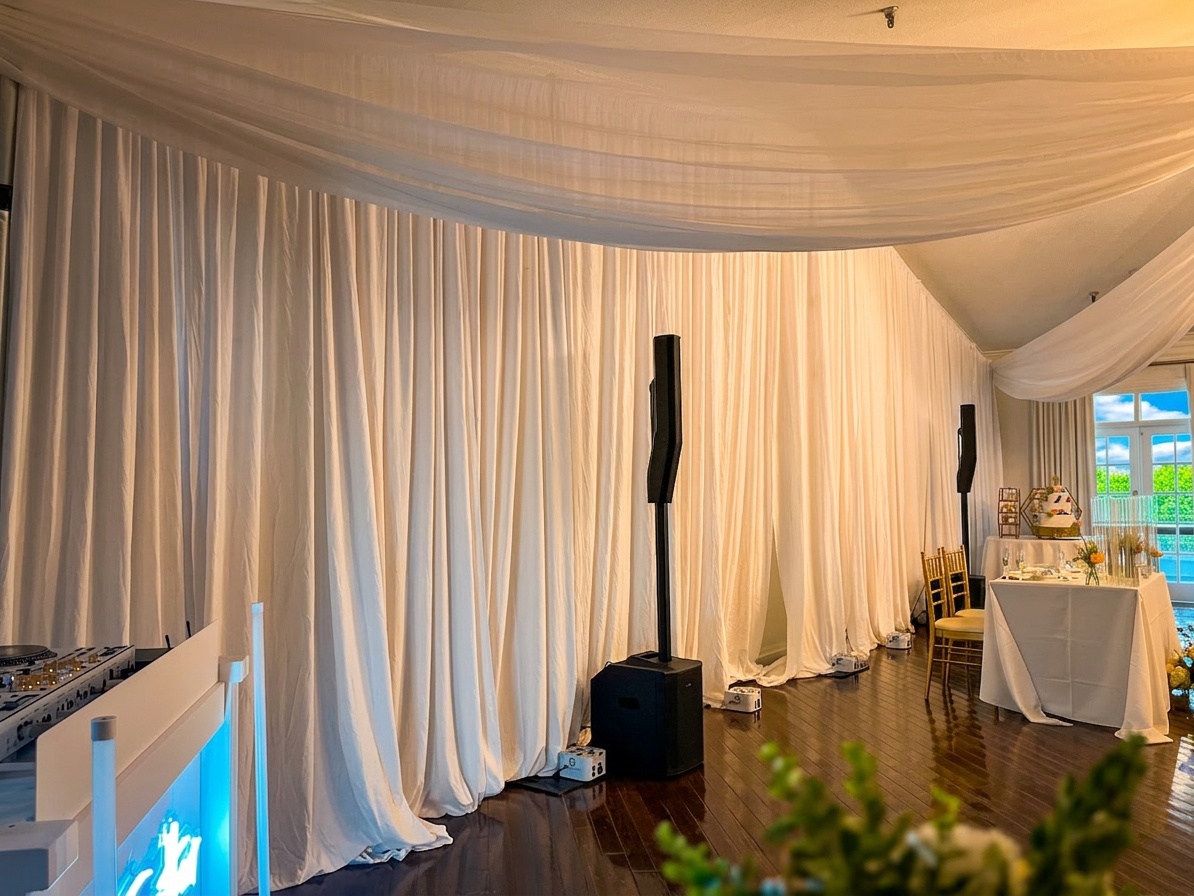
We learned this firsthand at a lakefront ceremony setup at Bella Collina. The couple had originally requested ivory drape to match their florals, but during our site walkthrough the week before the wedding, we noticed the ceremony spot faced west toward the lake, right into the path of the golden-hour sun. Our crew recommended swapping to a deeper champagne tone instead. On camera, the champagne held its color and depth against the light where the ivory would have blown out. That’s the kind of judgment call our installers make on site, not from a catalog.

For outdoor lakefront or garden ceremonies, we generally steer couples toward champagne, blush, or deeper jewel tones (navy, emerald, wine) that hold up against strong natural light. For ballroom or indoor ceremonies with controlled lighting, ivory, white, and soft pastels read beautifully because there’s no harsh sun to fight. This tracks with where wedding decor is heading in 2026 overall: The Knot’s trend report points to richer, more opulent tones and textured fabric replacing flat, minimalist palettes, which lines up with what we’re already recommending for outdoor Central Florida ceremonies.

How tall your ceremony backdrop needs to be

In our experience, most ceremony backdrops land somewhere between 10 and 12 feet tall, though we adjust based on the ceremony site line and photography angle. Stages Plus drape is adjustable from 8 to 18 feet, and the right height depends less on a fixed rule and more on what’s happening behind the couple.

If the ceremony spot has a parking lot, catering tent, or unfinished landscaping in the background, we go taller (14 to 18 feet) to fully block sight lines in wide photography shots. If the setting itself is the view, like a lake, a garden, or oak trees draped in Spanish moss, we’ll often go shorter (8 to 10 feet) so the backdrop frames the couple without competing with the scenery guests actually came to see. Officiants and their microphone stands also factor in, since a backdrop that’s too short can leave equipment or staff visible at the edges of the frame.

We always talk through backdrop height at the same time we’re discussing where the guest seating and aisle will sit, because photography sight lines change once chairs are placed. Our Pipe and Drape Rental page has more detail on the height ranges and configurations we offer for ceremony setups specifically.

Fabric that holds up in Florida heat, humidity, and sudden rain

Stages Plus uses 15oz IFR velour for ceremony drape because it holds its shape and color in Orlando’s humidity better than lighter, topically-treated fabric. Florida’s wet season runs roughly May through October and brings about 68% of the state’s annual rainfall, with near-daily afternoon storms, according to Gotta Go Orlando. Those storms are usually short, typically lasting 30 minutes to two hours per Orlando Informer, so a pop-up shower doesn’t have to derail an outdoor ceremony if the timeline has a little cushion built in.

Humidity is the bigger everyday factor. Summer humidity in Orlando averages around 74% and rarely drops below 50% (Orlando Informer), and lightweight polyester panels can go limp or wrinkle in that kind of moisture. The heavier 15oz velour we use holds its drape and finish through a humid Central Florida afternoon far better than thin party-store fabric.

Fabric safety matters too, especially at venues with strict fire marshal requirements. NFPA 701 is the governing standard for event drape flammability, and IFR fabric has flame resistance built into the fiber itself rather than sprayed on afterward, per Liba Fabrics. Topically-treated fabric can meet the standard when it’s new but lose that protection after repeated washing, which matters if you’re comparing rental vendors and one is using older, treated-only stock. Fire marshals do enforce this. PipeAndDrapeOnline.com notes that a fire marshal or venue authority can require compliant drape at any event and has the authority to shut down non-compliant setups. Our Pipe and Drape Combinations guide goes deeper into how we configure panels for different backdrop styles.

For a rainy-season outdoor ceremony, we always talk through a rain contingency alongside the drape order, whether that’s a nearby covered space or a shortened window before storms typically roll in.

Wedding backdrop rental costs and how they compare to a floral wall or arch

Pipe and drape backdrop pricing depends on width, height, fabric color, and any add-ons like lighting or a monogram, so we quote it after a quick conversation about the ceremony layout rather than a flat number online. Generic online pricing for backdrops is unreliable because most of what’s published covers DIY drop-shipped kits, not professional on-site installation with fire-code-compliant fabric.

Compared to a floral wall or a floral arch, pipe and drape gives couples more flexibility on size and color without the cost of fresh flowers, and it can be struck and reused in a way florals can’t. A floral wall or arch tends to be a fixed size and a fixed look. Drape can be widened, heightened, or recolored for the same ceremony space, and it pairs easily with other elements. We regularly combine ceremony drape with uplighting, greenery garlands from the couple’s florist, or a custom monogram projected or hung at center panel, giving couples a layered, personalized look rather than a plain fabric wall.

The most reliable way to get an accurate number is to walk through your ceremony site details, guest count, and desired look with our team through How To Get A Quote, which is also where fabric color and height get finalized together.

Booking timeline for ceremony backdrop drape

Ceremony backdrop drape should be booked 6 to 8 months before your wedding date, even if your venue and photographer were locked in earlier. Design and decor rentals, including drape, florals, and lighting, sit in a different booking category than the venue itself, according to Christofora Events, and they tend to get finalized closer to the middle of the planning timeline rather than at the very start.

Couples are engaged for about 15 months on average today, and more than a quarter are engaged 19 months or longer, per The Knot. That gives most couples plenty of runway, but specialty decor items do carry limited inventory in certain colors and configurations, as noted by Shutter & Sound, especially during Central Florida’s peak wedding months of November through April. If your date falls in that window, or you have your heart set on a specific fabric tone like the deeper champagne we used at Bella Collina, we’d rather lock it in early than have you settle for a substitute color two months out.

Frequently asked questions

What pipe and drape colors work best for outdoor vs. ballroom Orlando weddings?

Outdoor ceremonies, especially lakefront or garden settings, generally look best in champagne, blush, or deeper jewel tones that hold their color against strong Florida sun. Ballroom ceremonies with controlled lighting can carry ivory, white, or soft pastels without the washing-out effect direct sunlight causes outdoors.

Does pipe and drape hold up in Florida heat, humidity, and sudden rain?

Yes, when it’s the right fabric. Stages Plus uses 15oz IFR velour, which holds its shape and finish through Orlando’s average 74% summer humidity far better than lightweight party-store fabric, and Florida’s typical afternoon storms usually last 30 minutes to two hours, not all day.

How is a pipe and drape backdrop different from a floral wall or arch rental?

Pipe and drape offers more flexibility in width, height, and color, and it can be paired with uplighting, greenery, or a monogram for a custom layered look. A floral wall or arch is generally a fixed size and design, while drape can be adjusted to fit different ceremony layouts.

How far in advance should we book our ceremony backdrop?

Book design and decor rentals, including drape, about 6 to 8 months before your wedding date. Specialty colors and configurations have limited inventory, particularly during Central Florida’s November through April peak wedding season, so earlier booking protects your first-choice fabric tone.

Can drape be paired with uplighting, greenery, or a monogram?

Yes. We regularly combine ceremony drape with uplighting for depth, greenery garlands supplied by the couple’s florist, and a custom monogram at center panel. These combinations are one of the easiest ways to make a rented backdrop feel fully custom to your wedding.

The right wedding backdrop rental in Orlando comes down to matching fabric, color, and height to your actual ceremony site, not a photo from someone else’s wedding three states away. If you’re planning a ceremony anywhere from a ballroom in Winter Park to a lakefront lawn near Bella Collina, our team will walk the site with you and make the same kind of on-the-spot color and height calls we made there. Get started with our How To Get A Quote page, or browse our Wedding Stages options to see how drape pairs with a full ceremony stage setup.

Filed Under: Blog, Wedding Staging

Reception Band Stage Layout: Optimizing Music Performance Areas for Weddings

August 10, 2026 by admin

A wedding band stage should sit at a 90-degree angle to the dance floor, close enough that the band can see both the dancing crowd and the head table, with dedicated 20-amp power circuits run directly to the stage instead of shared through the venue's house power. At Stages Plus, we typically spec a 12x16ft stage with two dedicated 20-amp drops for a standard 6-piece Orlando wedding band, positioned so musicians never have to choose between watching the crowd or watching the newlyweds.

On this page

  • Position the Stage at a 90-Degree Angle to the Dance Floor
  • Stage Size Scales Directly With Band Size
  • Live Bands Require Dedicated Power Circuits DJs Don’t Need
  • Stage Height Depends on Guest Count and Room Depth
  • Indoor Ballrooms and Outdoor Tents Need Different Layout Approaches
  • Frequently asked questions

Key takeaways

  • A 4-piece band needs roughly a 12x20ft stage, a 5-piece dance band needs about 155-210 square feet, and a DJ booth fits comfortably in a 10x10ft footprint.

  • Live bands need two dedicated 20-amp circuits within 25 feet of the stage, never shared with catering or lighting.

  • Angle the stage 90 degrees to the dance floor, not head-on, so the band sees both the dance floor and the head table at once.

  • Outdoor stages need GFI-protected circuits, and performances pause the moment lightning is detected within 8 miles of the venue (NOAA Lightning Safety Toolkit).

  • Book your band stage 6 to 12 months ahead for popular Central Florida wedding dates.

Position the Stage at a 90-Degree Angle to the Dance Floor

A reception stage works best when it sits at a 90-degree angle to the dance floor, not facing it head-on. Face the band straight at the dance floor and they lose sight of the head table and the rest of the room. Angle the stage instead, and the band or DJ can watch dancers on one side and the wedding party on the other, adjusting tempo and song choice on the fly.

We keep a buffer zone of at least 3-4 feet between the stage edge and the dance floor so musicians have room to move without crowding dancers, and so speaker stacks never end up directly behind anyone's chair. Guest tables, especially the head table, should sit far enough back that conversation is still possible during dinner, but close enough that toasts and first dances feel personal rather than distant.

For ballroom receptions, we often position the stage along the room's long wall, which keeps sightlines open from every table. For tented outdoor receptions, the stage typically anchors one end of the tent, with the dance floor immediately in front and dining tables fanning out behind it. If you're still weighing overall stage placement against decor and photo angles, our wedding reception stage ideas guide covers the aesthetic side of this same question.

wedding band stage set at an angle beside a dance floor under string lights

Stage Size Scales Directly With Band Size

Stage size scales directly with band size, and guessing wrong is the single most common layout mistake we see. A solo DJ needs very little: roughly a 10x10ft footprint for a table, speakers, and equipment. A 4-piece band with amps typically needs a 12x20ft stage. A 5-piece dance band, the classic lead singer, drummer, keyboardist, bassist, and guitarist lineup, needs approximately 155 to 210 square feet, which works out to a minimum stage of about 16x12ft.

Break it down by instrument and the numbers add up, according to The Special Event Guru's stage sizing breakdown:

  • Guitar, bass, and keyboard players need 25-30 square feet each, including amps.
  • Horns and acoustic strings need 10-15 square feet each.
  • A drummer needs 50-70 square feet, usually on a small riser.
  • A lead vocalist needs 30-50 square feet to move around.

For a full 8-10 piece band with horns, we're usually looking at 16x20ft or larger once you factor in horn sections and extra monitors. That's why our concert stage rental options come in a range of footprints instead of one fixed package. If you're not sure where your lineup lands, our stage size calculator and our post on how to choose the right stage size for your event are both good starting points. Tell us your headcount and instrument list, and we'll match the stage to the band, not the other way around.

Live Bands Require Dedicated Power Circuits DJs Don't Need

Live bands need dedicated circuits that a DJ setup usually doesn't require.

Professional wedding bands typically need two dedicated 20-amp, 110-volt circuits run within 25 feet of the stage, and these circuits should never be shared with catering equipment, lighting, or anything else drawing power at the same time, per Murray Hill Talent's band electrical requirements guide. Larger bands need even more: Gulf Coast Entertainment notes that bigger acts with more gear typically require four to five isolated 20-amp outlets, with stage lighting run on its own separate circuit entirely.

A DJ booth is far simpler electrically. Most DJ setups run on a single standard circuit, since there's no amp stack, no drum kit monitors, and no horn section pulling power at the same time.

Our crews run dedicated power drops straight to the stage rather than daisy-chaining an extension cord through the dance floor, which is a tripping hazard and a good way to blow a breaker mid-song. Pairing the stage with our own audio packages means we already know the load requirements before the band's tour manager even asks. If you want the full electrical picture, including lighting circuits, our stage lighting safety guide covers best practices for Orlando events.

dedicated power drop cable running to a wedding band stage at an outdoor tent reception

Stage Height Depends on Guest Count and Room Depth

Stage height depends on how many rows of seated guests need a clear view over the heads in front of them. For an intimate reception where most guests sit within a few tables of the stage, a low platform, often just 16 to 24 inches, keeps the band visible and approachable without towering over the room. For larger receptions with 150-plus guests or a deep seating arrangement, we typically go higher, in the 24 to 36 inch range, so guests at the back tables aren't staring at the backs of heads during the first dance.

This is a judgment call our crew makes on site based on room depth, ceiling height, and whether there's a raised dance floor competing for sightlines.

Under international building code, guardrails aren't required on the audience-facing side of a performance stage even when the platform exceeds 30 inches (ICC guardrail guide via DataDrivenAEC), which keeps the front of the stage open and unobstructed for photos and dancing right up to the platform edge.

If your venue has a balcony or mezzanine seating section, factor that in early. Explore our wedding stages options to see height configurations that work for both ground-floor and multi-level venues.

Indoor Ballrooms and Outdoor Tents Need Different Layout Approaches

Indoor ballrooms give you fixed walls and controlled climate to plan sightlines around. Outdoor tents and marquees force you to plan around weather, ground condition, and available power at the same time. In a ballroom, we position the stage against a load-bearing wall, run power from the venue's existing house circuits when they meet the amperage the band needs, and rely on the room's own acoustics and ceiling height to guide speaker placement. Column obstructions and chandeliers are usually the only real sightline hazards to check before load-in.

Outdoor tented receptions add a second layer of planning. Ground condition matters as much as layout, since a stage set on grass or gravel needs a leveled sub-base before deck panels go down, and cable runs from the generator or shore power need to be trenched or ramped so nobody trips crossing from the dance floor to the bar. We always build in a weather contingency for outdoor stages: covered decking, tarps ready for a quick cover, and a plan for pausing the show if lightning shows up on radar.

Sightlines change too. A ballroom's flat floor means stage height does most of the sightline work, but a tent on uneven ground sometimes needs a taller platform just to compensate for a slope toward one side. Whichever setup you're working with, our tent flooring options pair with the stage to keep the whole reception floor level and stable from the entrance to the dance floor.

[IMAGE: outdoor wedding tent reception with a covered band stage and string lighting, dance floor in front]

Frequently asked questions

Do we need a stage for a small acoustic duo?

Not always. A duo with an acoustic guitar and a vocalist, or a keyboard and vocalist pairing, can often perform from ground level with just a small carpeted area, especially at intimate receptions under 75 guests. Once you add a cajon, amp, or a third musician, a small 8x8ft or 10x10ft platform helps with visibility and sound.

Can the band and DJ share one stage?

Yes, and it's common at Orlando receptions where a live band plays sets and a DJ takes over for the rest of the night. We build in extra footprint, usually an additional 4-6 feet of width, so the DJ booth and band gear can coexist without a mid-reception teardown.

What happens to the band stage if it rains outdoors?

Our outdoor stages use covered decking and GFI-protected circuits built for wet conditions, but live performances pause the moment lightning is detected within 8 miles of the venue, per NOAA lightning safety guidance. We plan a tented or indoor backup location with every outdoor wedding stage booking.

How far in advance should we book our band stage?

We recommend booking your band stage 6 to 12 months ahead for popular Central Florida wedding dates, in line with the booking windows Encore Musicians and Live Note Entertainment recommend for securing both talent and staging during peak spring and fall wedding season.

What size dance floor pairs with a band stage?

Dance floor size depends on guest count, but a good rule of thumb is roughly 3 square feet per person if you expect half your guests dancing at once. Our dancefloor rentals team can size the floor alongside your stage so the two footprints line up cleanly.

Getting the stage size, power, and angle right the first time saves you a frustrating mid-reception adjustment. It's the difference between a band that reads the room and one that's stuck staring at a wall. Reach out through our how to get a quote page and tell us your guest count, band lineup, and venue, and we'll spec the right stage for your Central Florida wedding.

Filed Under: Blog, Wedding Staging

Outdoor Wedding Ceremony Stages: Romantic Settings in Florida’s Natural Beauty

July 6, 2026 by admin

On this page

  • What stage size do you actually need for an outdoor ceremony?
  • Round stage vs. rectangular stage: which works better for an outdoor ceremony?
  • How do you handle Florida’s afternoon rain and heat at an outdoor ceremony?
  • Do guard rails ruin the look of a wedding ceremony stage?
  • What outdoor wedding stages look like across Central Florida: three recent installs
  • What flooring works on an outdoor ceremony stage in Florida’s humidity?
  • How far in advance should I book a wedding stage in Orlando for peak season?
  • Frequently asked questions

For an outdoor wedding ceremony in Florida, a rectangular stage in the 16×20 to 20×24 foot range works well for most wedding parties, while a round stage (11ft, 17ft, or 29ft diameter) creates a more intimate feel that photographs beautifully from every angle. Whatever shape you choose, plan for a shade cover or drape during rainy season (late May through September), schedule your setup to finish before noon, and book 12 to 15 months out for peak season dates in March, April, or May.

Key takeaways

  • Stage shape drives photography and sightlines: round stages give guests clear views from nearly every angle; rectangular stages pair best with a natural backdrop or pipe and drape framed from the front.
  • At Stages Plus, our round stage rental options (11ft, 17ft, and 29ft diameters) and custom rectangular configurations both work beautifully for outdoor ceremonies when matched to the right venue.
  • Florida’s afternoon thunderstorms typically form between 4 and 6 p.m., which means outdoor ceremony setups need to be complete and fully secured before noon during rainy season.
  • Guard rails are not OSHA-mandated below 48 inches of stage height, but Stages Plus recommends them above 30 inches. Stage skirting, pipe and drape, and twinkle drape panels can conceal standard rails without sacrificing safety.
  • Florida’s peak outdoor wedding months are March through May and October through December. Book staging vendors 12 to 15 months ahead for those windows.

What stage size do you actually need for an outdoor ceremony?

For most Florida wedding ceremonies, a 16×20 or 20×24 rectangular stage comfortably fits two officiants, the couple, and a wedding party of six to eight. A solo couple ceremony with an officiant can work on a 12×16, but that leaves very little room for movement, and guests in the back can struggle to see the couple at that footprint without additional stage height.

At Stages Plus, we configure ceremony stages anywhere from 8 to 24 feet in depth depending on the wedding party size and venue layout. A crew guideline we rely on: allow roughly 8 square feet per person standing on stage. For a party of ten (couple, officiant, eight attendants), that points toward a minimum of 80 square feet of usable surface, so a 16×20 or larger.

Height matters too. We typically set ceremony stages between 24 and 36 inches for outdoor settings. That range gives rear guests a clear sightline without the visual weight of a concert-height platform, and keeps the couple elevated enough to feel like the focal point without towering over the front row.

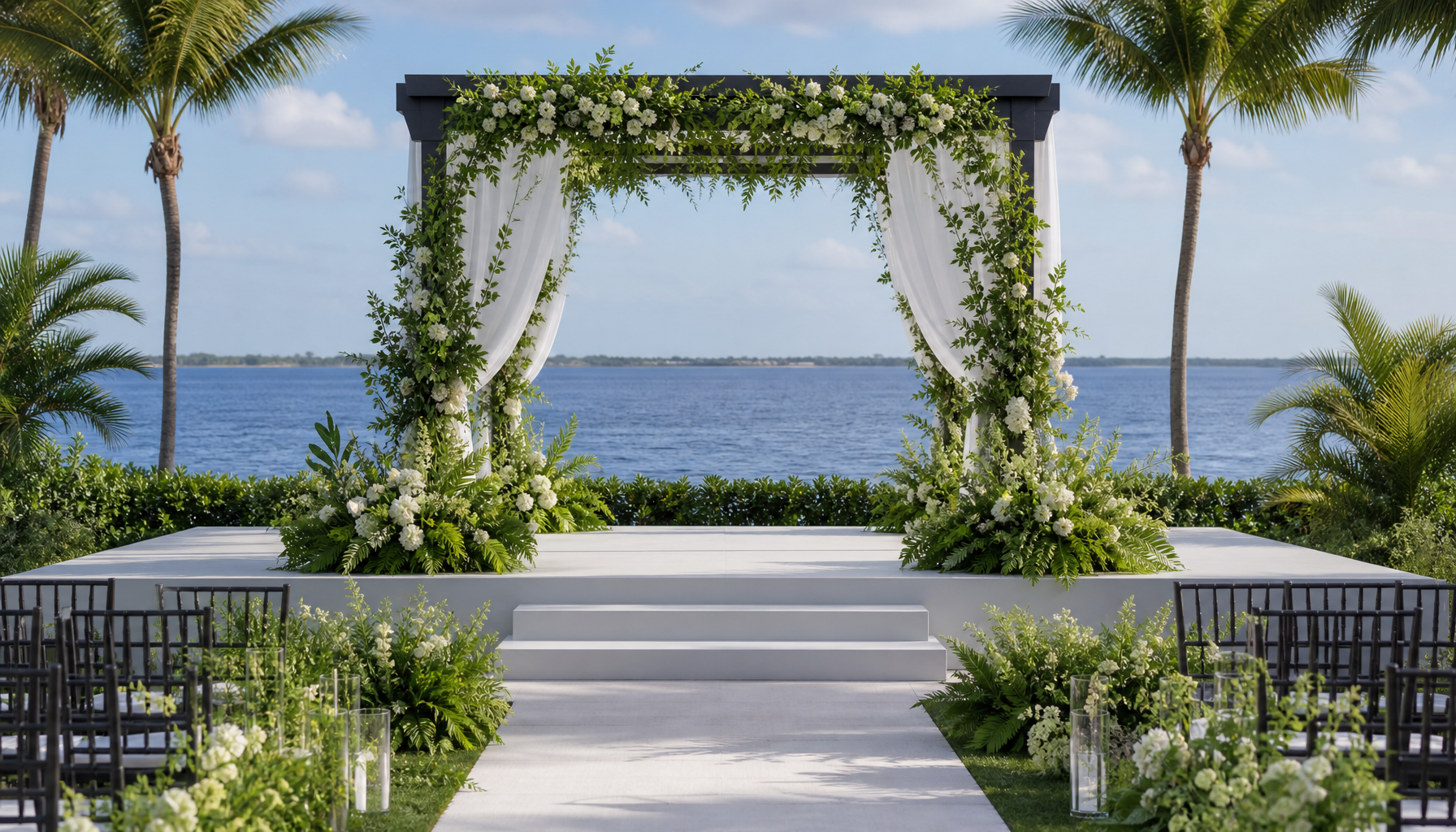
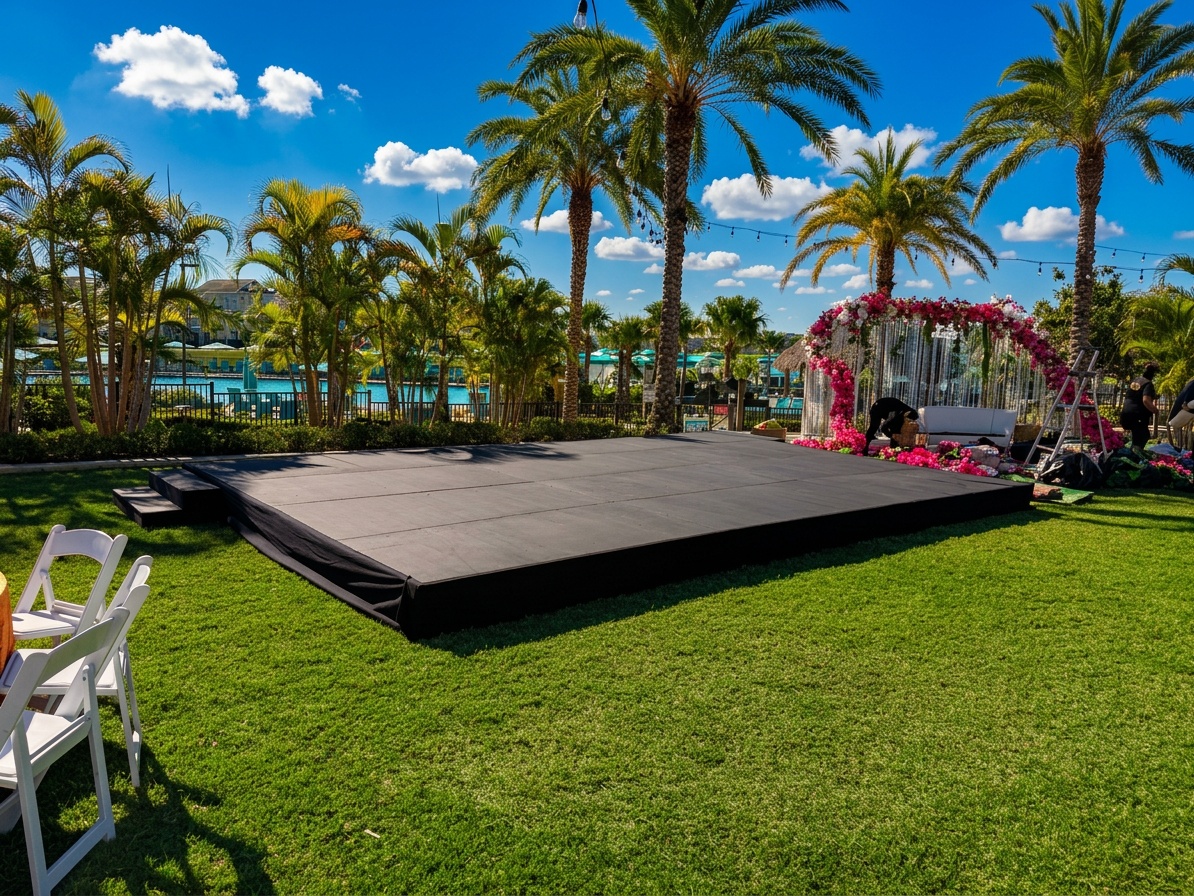
outdoor rectangular wedding ceremony stage setup in a garden setting with white skirting and floral arch backdrop


Round stage vs. rectangular stage: which works better for an outdoor ceremony?

A round stage creates a panoramic viewing experience that no rectangular configuration can match, and the 29ft diameter option from Stages Plus is particularly striking as a ceremony focal point in a garden or lakefront setting.

The choice between round and rectangular comes down to your venue geometry, your guest layout, and what you want the photographs to show. Here is how the two options compare across the factors couples ask about most:

FeatureRound StageRectangular Stage
Visual impact in photosDramatic; couple is the visual center from every angleClassic; strongest when paired with a backdrop arch or drape
Guest sightlinesExcellent 270-degree or 360-degree viewingBest from directly in front; side seats can be partially obstructed
Available sizes (Stages Plus)11ft, 17ft, 29ft diameterCustom widths, 8-24ft depth options
Backdrop flexibilityNatural backdrop is the default; drape behind works less cleanlyIdeal for pipe and drape, floral arches, or twinkle drape walls
Best venue typeGarden, lakefront, open lawn, or anywhere the surroundings are beautifulBallroom lawn, pavilion, or tented venue where you want to define the space
Wedding party capacity17ft fits couple, officiant, and a small party of 4; 29ft fits a full wedding party16×20 and larger comfortably fits 10+ on stage
Add-on compatibilityPairs with stage skirting and lighting; drape panels need custom fittingWorks with standard pipe and drape, skirting, stairs, ramps

For the Alvarez wedding in Winter Park this past April, our team set up a rectangular ceremony stage that let the couple frame their natural garden backdrop rather than cover it. Winter Park’s tree canopy and landscaping did the visual heavy lifting; the stage gave the couple elevation and structure without competing with the setting. That is a decision we make often in Central Florida: when the venue is already beautiful, the stage serves as a platform for the moment, not a set piece that distracts from it.


How do you handle Florida’s afternoon rain and heat at an outdoor ceremony?

At Stages Plus, our outdoor ceremony crews plan to have every setup fully completed before noon during Florida’s rainy season, because afternoon thunderstorms in Central Florida typically begin forming between 4 and 6 p.m. with very little warning once the sea breezes collide.

According to the FOX 35 Orlando meteorology team, “these breezes collide over the Florida peninsula in the afternoon, causing air to rise rapidly, condense, and form thunderstorms – usually between 4 and 6 p.m. when the heat is at its peak.” Orlando’s rainy season officially begins around May 24 and accounts for roughly 61% of the city’s annual rainfall.

The Florida Climate Center at Florida State University notes that no other part of the nation has more thunderstorm activity than Florida, with Central Florida’s summer storm frequency matching levels typically found only in equatorial Africa and the Amazon basin.

For a ceremony at a Winter Park garden venue in June: if your ceremony starts at 5 p.m., we aim to have the stage, shade cover, drape, and all rigging complete by 11 a.m. at the latest. That gives the setup time to settle before guests arrive, gives you a window to inspect everything, and clears the crew before the afternoon build-up begins.

For weather protection on the stage itself, our shade stage cover adds meaningful protection from both rain and direct sun. It looks intentional and finished rather than improvised, which matters for ceremony aesthetics. Paired with a twinkle drape rental backdrop frame, it wraps the stage perimeter in soft, glowing fabric that photographs beautifully even on an overcast afternoon.

Our post on Florida’s rainy season and covered stage rentals goes deeper on what that weather planning looks like across different event types if you want the full picture.

elevated outdoor stage platform with shade cover in open grass area, professional audio equipment, trees visible in background


Do guard rails ruin the look of a wedding ceremony stage?

Guard rails do not have to be visible at all, and at Stages Plus we use stage skirting, pipe and drape rental panels, and twinkle drape surrounds to conceal standard rails at nearly every wedding ceremony we set up above 30 inches.

Under OSHA standard 1910.29, guard rails are mandated on platforms 48 inches (4 feet) or higher above the ground, with a required top rail height of 42 inches. For ceremony stages in the 24 to 36 inch range that we typically build, OSHA does not technically require rails, but Stages Plus recommends them above 30 inches as our internal safety standard.

The industry standard itself acknowledges the visual tension. ANSI E1.46-2016, the standard for prevention of falls from portable stages, states directly: “A guard rail is effective fall protection when a performance is not going on, but might be visually in the way during a show.” That is the ceremony situation precisely: the rails protect people standing and moving in formal attire, but the couple wants an unobstructed visual in every photograph.

The solution we use most often is a combination approach: install standard guard rails for structural integrity, then wrap the entire perimeter in skirting or pipe and drape panels that drop to the deck edge. The rails are invisible from the audience. The stage perimeter reads as a clean, finished edge. Safety is fully in place. Nobody in the photos knows the rails are there.

For ceremonies where couples want extra visual drama, hanging twinkle drape inside the rail perimeter creates a soft glowing surround that looks intentional and romantic rather than functional. It is one of our most-requested ceremony add-ons.


What outdoor wedding stages look like across Central Florida: three recent installs

Our crew sets up ceremony stages from the coast to lake country to Winter Park’s garden venues, and the geography of each site shapes every staging decision we make.

The Alvarez install in Winter Park this past April is a good example of letting the venue guide the configuration. Winter Park has some of the most naturally photogenic outdoor ceremony settings in Central Florida, with mature tree canopy and manicured gardens that function as a living backdrop. We kept the stage profile lower and the skirting clean to let the natural setting do its work rather than compete with it.

For the Lamborn wedding in Eustis in late last March, we faced a different outdoor challenge. Eustis sits along Lake Eustis, and open waterfront venues get afternoon winds that affect drape tension and light fabric elements. We secured every panel with additional anchor points as a precaution. A well-anchored perimeter drape holds its shape even in a breezy lakefront setting.

The Samudrala wedding in Daytona Beach gave us a coastal outdoor setting with salt air and direct sun exposure. In those conditions, flooring and surface material choices matter more than they do inland. Hard-surface stage decking holds up better than carpet in high-humidity coastal conditions, and for that install we used a smooth-finish deck that worked with the coastal aesthetic and handled the humidity without issues.

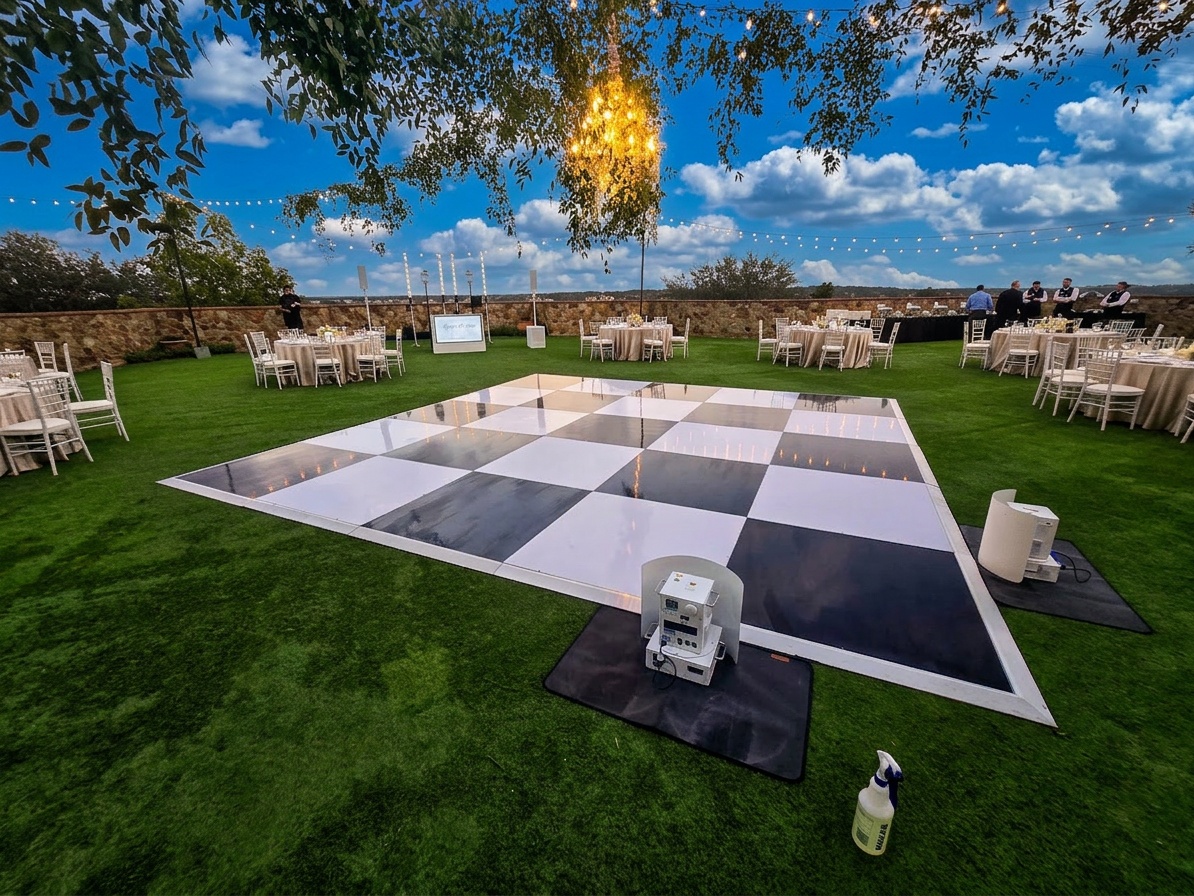
professional outdoor event dancefloor for a wedding and full lighting setup at dusk in a large open-air venue


What flooring works on an outdoor ceremony stage in Florida’s humidity?

For outdoor ceremony stages in Florida, a smooth-finish hardwood-look deck is our most common recommendation because it handles humidity, stays slip-resistant at typical ceremony heights, and photographs cleanly without competing with floral or drape elements.

We’ve seen carpet go wrong from morning dew more than once on open-air setups, and smooth-finish decking has become our default recommendation for outdoor ceremonies as a result.

Marley flooring works well for outdoor ceremonies where a dance component is planned, but we mostly use it for shaded or covered setups. Direct Florida sun makes the surface warm underfoot and scuff-prone faster than couples expect.

Carpet is the most formal-looking option and the softest underfoot for ceremonies where guests or the wedding party will be standing for extended periods. The limitation outdoors is moisture: if morning dew or a surprise shower hits before the ceremony, carpet retains moisture and can become slick. We recommend carpet outdoors only when a shade cover or tent structure is already in place.

For most open-air ceremony stages in Central Florida, our standard smooth-finish deck with white or ivory skirting around the perimeter is the finishing combination that photographs cleanly in all lighting conditions. Get a quote here to talk through configuration options, or browse our speaking stage rental and concert stage rental pages to see the range of configurations we work with.


How far in advance should I book a wedding stage in Orlando for peak season?

For spring wedding dates in March, April, or May, book your staging vendor 12 to 15 months in advance. Peak-season vendors in Orlando are frequently booked that far out, and staging availability follows the same pattern.

According to The Wedding Report’s 2025 Florida data, Florida hosted an estimated 158,764 weddings in 2025, ranking it third in the nation, with March and May each accounting for 15.6% of Florida’s annual wedding volume. That concentration of demand is why staging inquiries for spring months arrive months earlier than couples often expect.

At Stages Plus, we start seeing spring inquiries from October and November of the prior year. If you are planning a spring ceremony and reading this now, you are not too early to reach out. For fall dates in October and November, in our experience bookings typically come in six to nine months ahead. If you have a specific venue and date locked in, that is when to start the staging conversation.


Frequently asked questions

How high should an outdoor ceremony stage be so guests in the back can see?

For most outdoor ceremonies, 24 to 36 inches of stage height gives rear guests a clear sightline without the visual bulk of a concert-height platform. In our experience, at 36 inches with a 150-person guest layout on flat ground, guests seated 60 to 80 feet back can typically see the couple above the heads of the front rows. If your venue has a sloped lawn, we may recommend lower stage height since the natural grade does part of the work.

Do I need ADA accommodations on a ceremony stage?

If any member of the wedding party uses a wheelchair or has limited mobility, an ADA-compliant ramp is a straightforward addition to any stage configuration. For most setups, that means a ramp with a slope no steeper than 1:12, a minimum 36-inch clear width, and a level landing at the top. Our full ADA compliance guide for stage rentals covers the specific requirements in detail, and we work ramp access into ceremony layouts without disrupting the visual flow of the setup.

What add-ons do couples most often wish they had planned for in advance?

The four most common last-minute requests we get on ceremony day are stage skirting, a shade cover, stair handrails, and a podium or lectern. Skirting and shade covers can usually be added if we have inventory available, but they are much easier to include in the original quote. Handrails on the stairs are a safety item we always recommend flagging in advance, especially if elderly guests or the wedding party will be using formal footwear on the steps.

Can I use a natural backdrop instead of pipe and drape on the stage?

Yes, and for many Central Florida venues a natural backdrop produces better photographs than any constructed one. The key is stage placement: position the stage so the trees, water, or garden appear behind the couple from the primary camera angle, then keep the stage deck and skirting simple and neutral. We help couples think through sightlines and camera positioning during the quote process so the backdrop works with the setting rather than against it.

What is the best time of year for an outdoor ceremony in Central Florida?

March through May and October through December are the most comfortable outdoor wedding months in Central Florida, with lower humidity, lower rainfall probability, and temperatures that stay manageable for formal attire. Mid-June through September brings near-daily afternoon storms and high humidity. Summer ceremonies are doable with the right shade cover and setup schedule, but the weather planning requirements are considerably more demanding.


Planning an outdoor ceremony in Central Florida this season? Tell us your venue, your guest count, and your vision. At Stages Plus, we send custom stage recommendations and quotes within one business day, and our crew has set up ceremony stages from Winter Park garden venues to Daytona Beach coastline sites to Lake County waterfront properties. Get a quote here and we will get back to you fast.

Filed Under: Blog, Wedding Staging

Get Quote / Contact

Popular Stage Sizes

  • 8ft Stage Sizes
  • 12ft Stage Sizes
  • 16ft Stage Sizes
  • 20ft Stage Sizes
  • 24ft Stage Sizes

Blog

  • Pipe and Drape Backdrops for Wedding Ceremonies: Design Ideas for Orlando Couples
  • Designing ADA-Compliant Stage Layouts: A Checklist for Orlando Event Planners
  • What’s Included in an Orlando Stage Rental Audio Package?

Search


Privacy Policy

Warehouse / Office

6848 Stapoint Ct.
Winter Park, FL 32792
407-442-0254

Located in the Eastpoint Industrial Park
Map

Delivery, Setup, Tear Down

Orlando, DeLand, Deltona, Kissimmee, Sanford, Altamonte Springs, Apopka, Ocoee, Oviedo, St. Cloud, Winter Garden, Winter Park, Winter Springs, Titusville, Melbourne, Palm Bay, Winter Haven, Lakeland, Seminole, Orange, Osceola, Lake, Polk, Volusia, Brevard.

Copyright © 2026 · Modern Portfolio Pro Theme on Genesis Framework · WordPress · Log in