For an outdoor wedding ceremony in Florida, a rectangular stage in the 16×20 to 20×24 foot range works well for most wedding parties, while a round stage (11ft, 17ft, or 29ft diameter) creates a more intimate feel that photographs beautifully from every angle. Whatever shape you choose, plan for a shade cover or drape during rainy season (late May through September), schedule your setup to finish before noon, and book 12 to 15 months out for peak season dates in March, April, or May.
Key takeaways
- Stage shape drives photography and sightlines: round stages give guests clear views from nearly every angle; rectangular stages pair best with a natural backdrop or pipe and drape framed from the front.
- At Stages Plus, our round stage rental options (11ft, 17ft, and 29ft diameters) and custom rectangular configurations both work beautifully for outdoor ceremonies when matched to the right venue.
- Florida’s afternoon thunderstorms typically form between 4 and 6 p.m., which means outdoor ceremony setups need to be complete and fully secured before noon during rainy season.
- Guard rails are not OSHA-mandated below 48 inches of stage height, but Stages Plus recommends them above 30 inches. Stage skirting, pipe and drape, and twinkle drape panels can conceal standard rails without sacrificing safety.
- Florida’s peak outdoor wedding months are March through May and October through December. Book staging vendors 12 to 15 months ahead for those windows.
What stage size do you actually need for an outdoor ceremony?
For most Florida wedding ceremonies, a 16×20 or 20×24 rectangular stage comfortably fits two officiants, the couple, and a wedding party of six to eight. A solo couple ceremony with an officiant can work on a 12×16, but that leaves very little room for movement, and guests in the back can struggle to see the couple at that footprint without additional stage height.
At Stages Plus, we configure ceremony stages anywhere from 8 to 24 feet in depth depending on the wedding party size and venue layout. A crew guideline we rely on: allow roughly 8 square feet per person standing on stage. For a party of ten (couple, officiant, eight attendants), that points toward a minimum of 80 square feet of usable surface, so a 16×20 or larger.
Height matters too. We typically set ceremony stages between 24 and 36 inches for outdoor settings. That range gives rear guests a clear sightline without the visual weight of a concert-height platform, and keeps the couple elevated enough to feel like the focal point without towering over the front row.
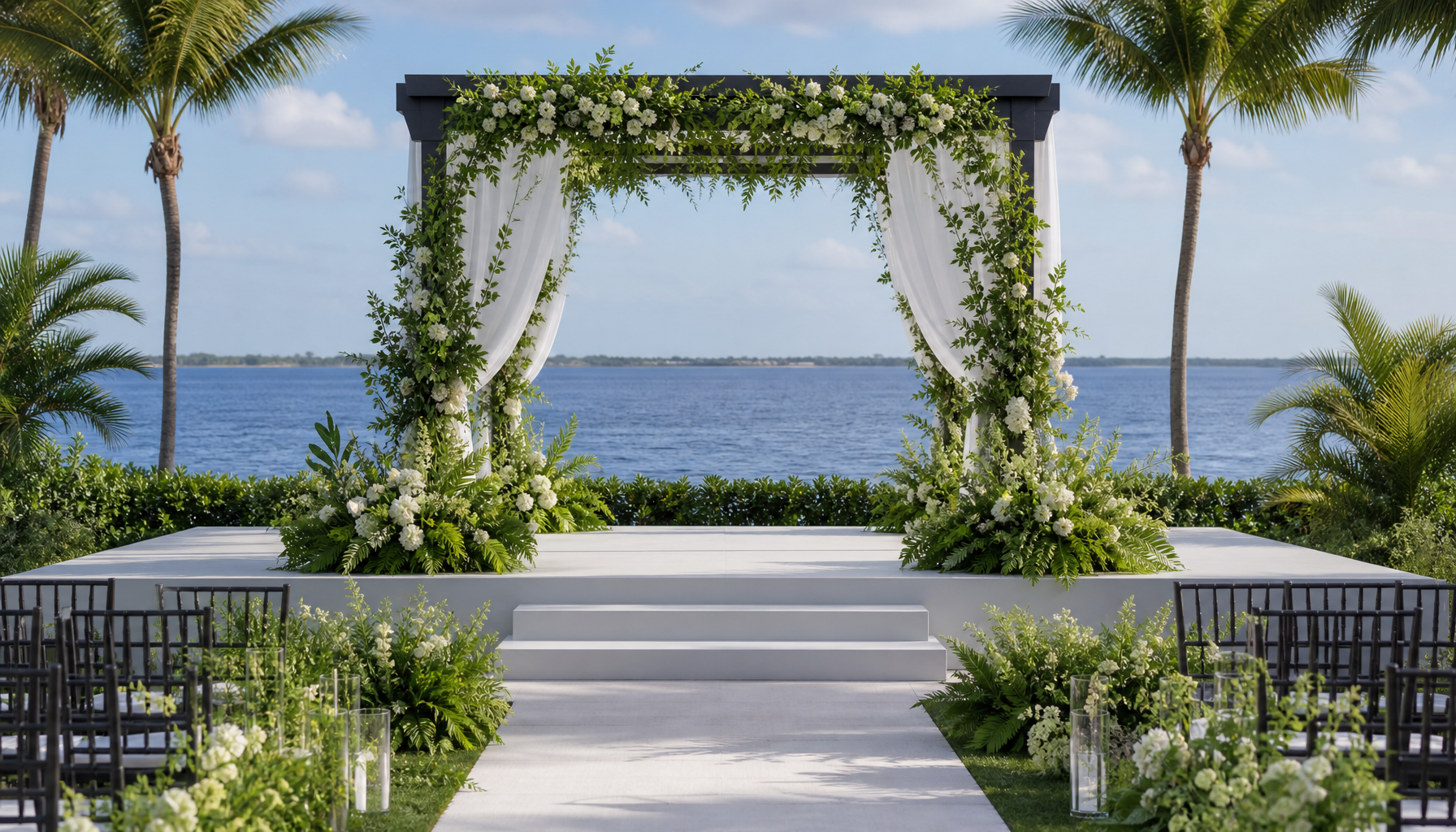
Round stage vs. rectangular stage: which works better for an outdoor ceremony?
A round stage creates a panoramic viewing experience that no rectangular configuration can match, and the 29ft diameter option from Stages Plus is particularly striking as a ceremony focal point in a garden or lakefront setting.
The choice between round and rectangular comes down to your venue geometry, your guest layout, and what you want the photographs to show. Here is how the two options compare across the factors couples ask about most:
| Feature | Round Stage | Rectangular Stage |
|---|---|---|
| Visual impact in photos | Dramatic; couple is the visual center from every angle | Classic; strongest when paired with a backdrop arch or drape |
| Guest sightlines | Excellent 270-degree or 360-degree viewing | Best from directly in front; side seats can be partially obstructed |
| Available sizes (Stages Plus) | 11ft, 17ft, 29ft diameter | Custom widths, 8-24ft depth options |
| Backdrop flexibility | Natural backdrop is the default; drape behind works less cleanly | Ideal for pipe and drape, floral arches, or twinkle drape walls |
| Best venue type | Garden, lakefront, open lawn, or anywhere the surroundings are beautiful | Ballroom lawn, pavilion, or tented venue where you want to define the space |
| Wedding party capacity | 17ft fits couple, officiant, and a small party of 4; 29ft fits a full wedding party | 16×20 and larger comfortably fits 10+ on stage |
| Add-on compatibility | Pairs with stage skirting and lighting; drape panels need custom fitting | Works with standard pipe and drape, skirting, stairs, ramps |
For the Alvarez wedding in Winter Park this past April, our team set up a rectangular ceremony stage that let the couple frame their natural garden backdrop rather than cover it. Winter Park’s tree canopy and landscaping did the visual heavy lifting; the stage gave the couple elevation and structure without competing with the setting. That is a decision we make often in Central Florida: when the venue is already beautiful, the stage serves as a platform for the moment, not a set piece that distracts from it.
How do you handle Florida’s afternoon rain and heat at an outdoor ceremony?
At Stages Plus, our outdoor ceremony crews plan to have every setup fully completed before noon during Florida’s rainy season, because afternoon thunderstorms in Central Florida typically begin forming between 4 and 6 p.m. with very little warning once the sea breezes collide.
According to the FOX 35 Orlando meteorology team, “these breezes collide over the Florida peninsula in the afternoon, causing air to rise rapidly, condense, and form thunderstorms – usually between 4 and 6 p.m. when the heat is at its peak.” Orlando’s rainy season officially begins around May 24 and accounts for roughly 61% of the city’s annual rainfall.
The Florida Climate Center at Florida State University notes that no other part of the nation has more thunderstorm activity than Florida, with Central Florida’s summer storm frequency matching levels typically found only in equatorial Africa and the Amazon basin.
For a ceremony at a Winter Park garden venue in June: if your ceremony starts at 5 p.m., we aim to have the stage, shade cover, drape, and all rigging complete by 11 a.m. at the latest. That gives the setup time to settle before guests arrive, gives you a window to inspect everything, and clears the crew before the afternoon build-up begins.
For weather protection on the stage itself, our shade stage cover adds meaningful protection from both rain and direct sun. It looks intentional and finished rather than improvised, which matters for ceremony aesthetics. Paired with a twinkle drape rental backdrop frame, it wraps the stage perimeter in soft, glowing fabric that photographs beautifully even on an overcast afternoon.
Our post on Florida’s rainy season and covered stage rentals goes deeper on what that weather planning looks like across different event types if you want the full picture.
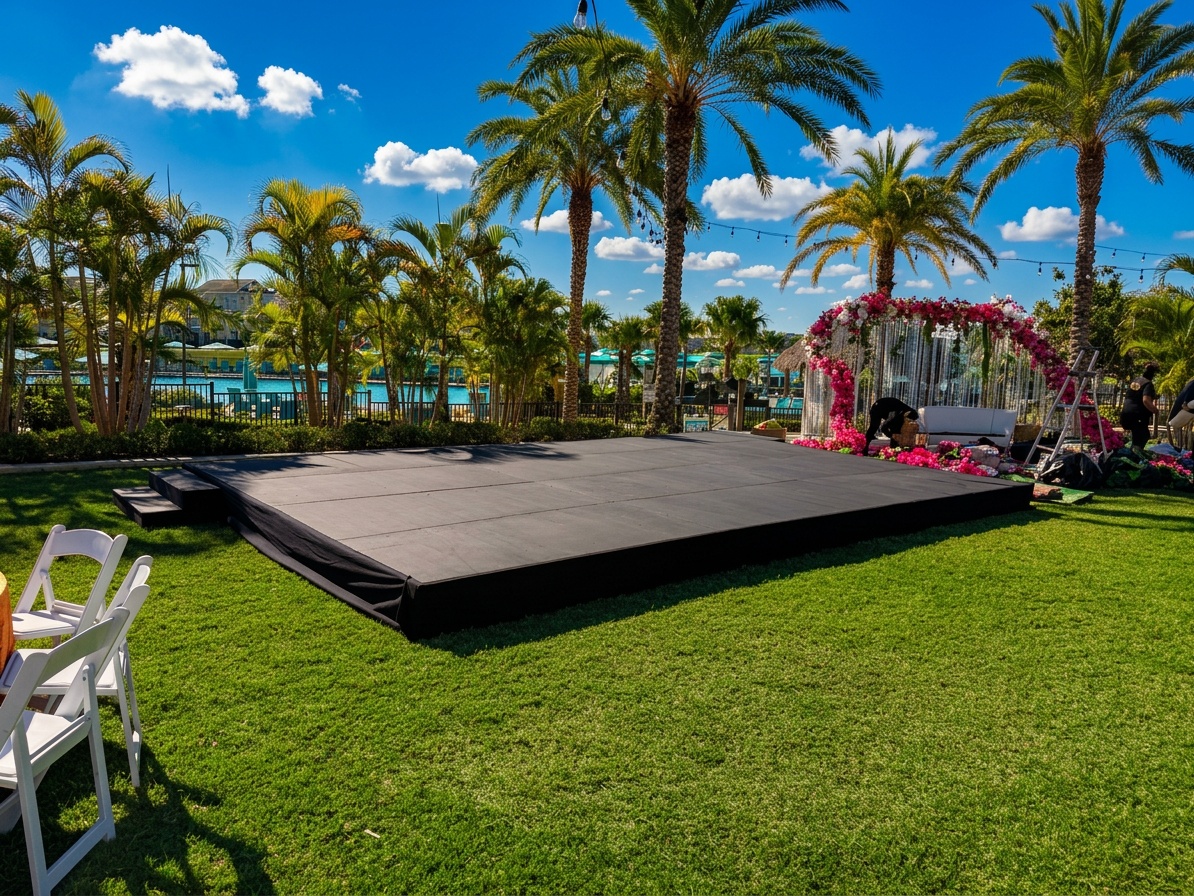
Do guard rails ruin the look of a wedding ceremony stage?
Guard rails do not have to be visible at all, and at Stages Plus we use stage skirting, pipe and drape rental panels, and twinkle drape surrounds to conceal standard rails at nearly every wedding ceremony we set up above 30 inches.
Under OSHA standard 1910.29, guard rails are mandated on platforms 48 inches (4 feet) or higher above the ground, with a required top rail height of 42 inches. For ceremony stages in the 24 to 36 inch range that we typically build, OSHA does not technically require rails, but Stages Plus recommends them above 30 inches as our internal safety standard.
The industry standard itself acknowledges the visual tension. ANSI E1.46-2016, the standard for prevention of falls from portable stages, states directly: “A guard rail is effective fall protection when a performance is not going on, but might be visually in the way during a show.” That is the ceremony situation precisely: the rails protect people standing and moving in formal attire, but the couple wants an unobstructed visual in every photograph.
The solution we use most often is a combination approach: install standard guard rails for structural integrity, then wrap the entire perimeter in skirting or pipe and drape panels that drop to the deck edge. The rails are invisible from the audience. The stage perimeter reads as a clean, finished edge. Safety is fully in place. Nobody in the photos knows the rails are there.
For ceremonies where couples want extra visual drama, hanging twinkle drape inside the rail perimeter creates a soft glowing surround that looks intentional and romantic rather than functional. It is one of our most-requested ceremony add-ons.
What outdoor wedding stages look like across Central Florida: three recent installs
Our crew sets up ceremony stages from the coast to lake country to Winter Park’s garden venues, and the geography of each site shapes every staging decision we make.
The Alvarez install in Winter Park this past April is a good example of letting the venue guide the configuration. Winter Park has some of the most naturally photogenic outdoor ceremony settings in Central Florida, with mature tree canopy and manicured gardens that function as a living backdrop. We kept the stage profile lower and the skirting clean to let the natural setting do its work rather than compete with it.
For the Lamborn wedding in Eustis in late last March, we faced a different outdoor challenge. Eustis sits along Lake Eustis, and open waterfront venues get afternoon winds that affect drape tension and light fabric elements. We secured every panel with additional anchor points as a precaution. A well-anchored perimeter drape holds its shape even in a breezy lakefront setting.
The Samudrala wedding in Daytona Beach gave us a coastal outdoor setting with salt air and direct sun exposure. In those conditions, flooring and surface material choices matter more than they do inland. Hard-surface stage decking holds up better than carpet in high-humidity coastal conditions, and for that install we used a smooth-finish deck that worked with the coastal aesthetic and handled the humidity without issues.
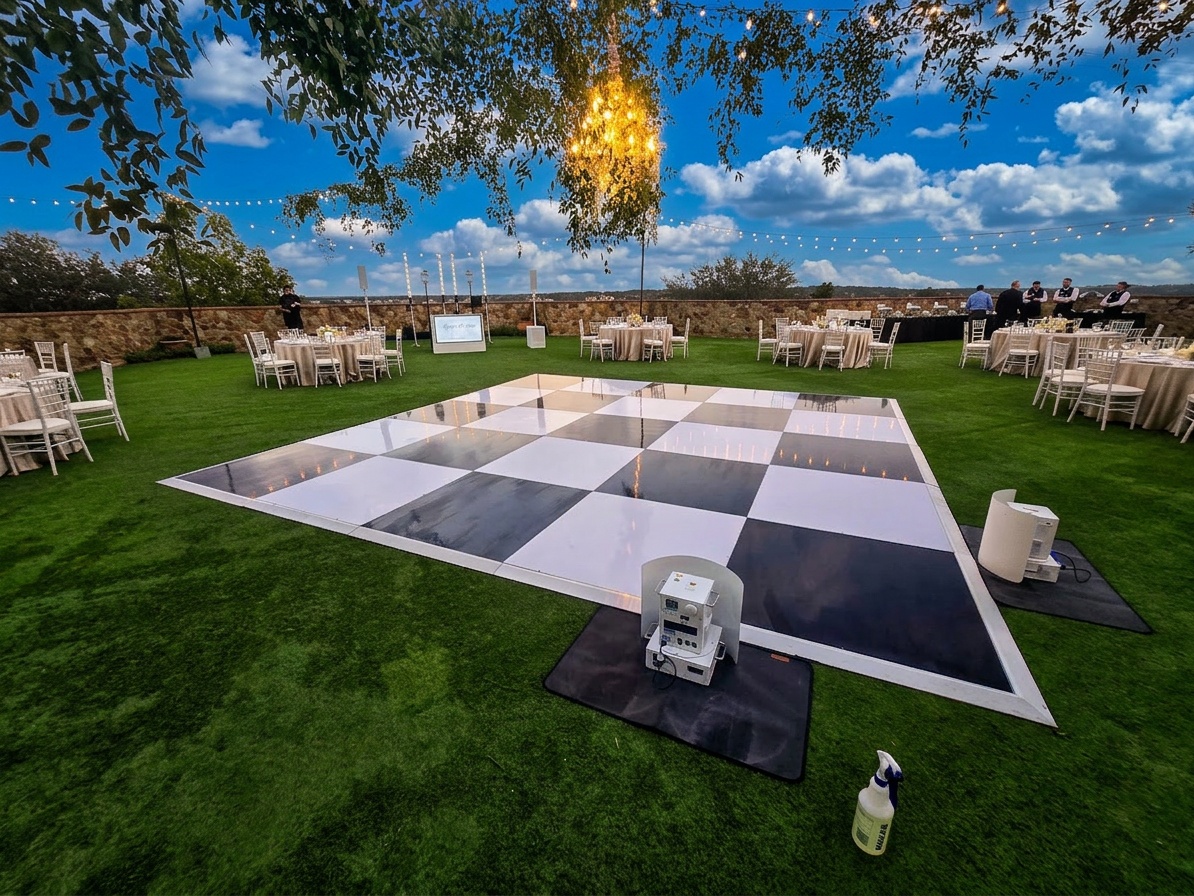
What flooring works on an outdoor ceremony stage in Florida’s humidity?
For outdoor ceremony stages in Florida, a smooth-finish hardwood-look deck is our most common recommendation because it handles humidity, stays slip-resistant at typical ceremony heights, and photographs cleanly without competing with floral or drape elements.
We’ve seen carpet go wrong from morning dew more than once on open-air setups, and smooth-finish decking has become our default recommendation for outdoor ceremonies as a result.
Marley flooring works well for outdoor ceremonies where a dance component is planned, but we mostly use it for shaded or covered setups. Direct Florida sun makes the surface warm underfoot and scuff-prone faster than couples expect.
Carpet is the most formal-looking option and the softest underfoot for ceremonies where guests or the wedding party will be standing for extended periods. The limitation outdoors is moisture: if morning dew or a surprise shower hits before the ceremony, carpet retains moisture and can become slick. We recommend carpet outdoors only when a shade cover or tent structure is already in place.
For most open-air ceremony stages in Central Florida, our standard smooth-finish deck with white or ivory skirting around the perimeter is the finishing combination that photographs cleanly in all lighting conditions. Get a quote here to talk through configuration options, or browse our speaking stage rental and concert stage rental pages to see the range of configurations we work with.
How far in advance should I book a wedding stage in Orlando for peak season?
For spring wedding dates in March, April, or May, book your staging vendor 12 to 15 months in advance. Peak-season vendors in Orlando are frequently booked that far out, and staging availability follows the same pattern.
According to The Wedding Report’s 2025 Florida data, Florida hosted an estimated 158,764 weddings in 2025, ranking it third in the nation, with March and May each accounting for 15.6% of Florida’s annual wedding volume. That concentration of demand is why staging inquiries for spring months arrive months earlier than couples often expect.
At Stages Plus, we start seeing spring inquiries from October and November of the prior year. If you are planning a spring ceremony and reading this now, you are not too early to reach out. For fall dates in October and November, in our experience bookings typically come in six to nine months ahead. If you have a specific venue and date locked in, that is when to start the staging conversation.
Frequently asked questions
How high should an outdoor ceremony stage be so guests in the back can see?
For most outdoor ceremonies, 24 to 36 inches of stage height gives rear guests a clear sightline without the visual bulk of a concert-height platform. In our experience, at 36 inches with a 150-person guest layout on flat ground, guests seated 60 to 80 feet back can typically see the couple above the heads of the front rows. If your venue has a sloped lawn, we may recommend lower stage height since the natural grade does part of the work.
Do I need ADA accommodations on a ceremony stage?
If any member of the wedding party uses a wheelchair or has limited mobility, an ADA-compliant ramp is a straightforward addition to any stage configuration. For most setups, that means a ramp with a slope no steeper than 1:12, a minimum 36-inch clear width, and a level landing at the top. Our full ADA compliance guide for stage rentals covers the specific requirements in detail, and we work ramp access into ceremony layouts without disrupting the visual flow of the setup.
What add-ons do couples most often wish they had planned for in advance?
The four most common last-minute requests we get on ceremony day are stage skirting, a shade cover, stair handrails, and a podium or lectern. Skirting and shade covers can usually be added if we have inventory available, but they are much easier to include in the original quote. Handrails on the stairs are a safety item we always recommend flagging in advance, especially if elderly guests or the wedding party will be using formal footwear on the steps.
Can I use a natural backdrop instead of pipe and drape on the stage?
Yes, and for many Central Florida venues a natural backdrop produces better photographs than any constructed one. The key is stage placement: position the stage so the trees, water, or garden appear behind the couple from the primary camera angle, then keep the stage deck and skirting simple and neutral. We help couples think through sightlines and camera positioning during the quote process so the backdrop works with the setting rather than against it.
What is the best time of year for an outdoor ceremony in Central Florida?
March through May and October through December are the most comfortable outdoor wedding months in Central Florida, with lower humidity, lower rainfall probability, and temperatures that stay manageable for formal attire. Mid-June through September brings near-daily afternoon storms and high humidity. Summer ceremonies are doable with the right shade cover and setup schedule, but the weather planning requirements are considerably more demanding.
Planning an outdoor ceremony in Central Florida this season? Tell us your venue, your guest count, and your vision. At Stages Plus, we send custom stage recommendations and quotes within one business day, and our crew has set up ceremony stages from Winter Park garden venues to Daytona Beach coastline sites to Lake County waterfront properties. Get a quote here and we will get back to you fast.