We've seen it happen more times than we'd like: a planner calls us two days before an event because they just realized the ramp they planned won't actually fit in the room. Or worse, they didn't plan one at all. When a speaker, honoree, or performer uses a wheelchair, that oversight becomes a real problem on event day, and it's not just a logistics issue.
ADA compliant staging is not optional for most public and semi-public events in Florida, and understanding the specific requirements before you book saves you from expensive last-minute changes on setup day.
We work with event planners across Central Florida year-round, and accessibility questions come up constantly, especially during graduation season when honorees or speakers with mobility needs are part of the program. Here's what you need to know before finalizing your stage setup.
Why ADA Compliance Matters for Staged Events in Florida
The Americans with Disabilities Act Title III covers places of public accommodation, and that coverage extends to temporary structures at public and semi-public events. A stage you rent for a corporate presentation, a school graduation, or a community ceremony qualifies. The Department of Justice has consistently held that event organizers can't exempt themselves from ADA requirements simply because the structure is temporary.
Florida adds another layer through the Florida ADA Accessibility Implementation Act (Sections 553.501 through 553.513 of Florida Statutes). This state law mirrors federal ADA Standards for Accessible Design but is enforced at the county permit level. If your event in Orange, Seminole, or Osceola County requires a temporary structure permit, an accessibility review is often part of that process, though the specifics vary by county and event scale, so check directly with the relevant building department when your permit is filed. One thing most organizers miss: the event organizer, not just the venue owner, carries responsibility for any temporary structures brought in for the event.
The Core ADA Requirements That Apply to Temporary Stages
Four areas of the ADA Standards for Accessible Design (Section 4.8) apply directly to temporary stages. Get all four right, and you've got a compliant setup. Miss one, and you've got liability.
Ramp Slope and Minimum Width Requirements
The maximum ramp slope is 1:12, meaning 1 inch of rise for every 12 inches of run. A stage set at 24 inches tall requires a minimum ramp run of 24 feet.
The minimum clear width is 36 inches, and edge protection is required for every 6 inches of rise. Our modular deck systems let us keep stage height as low as practical for the event type, which directly reduces the ramp footprint required. A stage at 16 inches instead of 24 inches cuts the minimum ramp run from 24 feet to 16 feet. In a tight venue, that 8-foot difference can determine whether the ramp plan actually works.
Platform Surface and Gap Specifications
The deck surface must be stable, firm, and slip-resistant. Gaps in the surface can't exceed 0.5 inch measured perpendicular to the direction of travel. Our stage decks lock together with tight tolerances, and the surface texture provides the slip resistance the standard requires. This is one area where modular rental equipment generally outperforms DIY staging built from plywood and sawhorses. No guesswork on the gap dimension.
Guard Rail Height on Accessible Routes
Guard rails are required when the stage surface is more than 30 inches above grade. When rails are present on an accessible route, the top rail must sit between 34 and 38 inches above the deck surface.
At Stages Plus, we require guard rails on all stages above 30 inches regardless of ADA compliance status, because it's the right call for safety. For accessible stages, we configure the rails to meet that 34 to 38 inch window on the routes where wheelchair users and others will be traveling.
Turning Space at the Top of the Ramp
A power wheelchair needs a minimum 60-inch diameter clear floor space to complete a pivot turn. That 60-inch turning radius requirement is one of the most frequently overlooked specs in temporary stage planning. If your ramp delivers a performer or honoree onto a platform without enough clear space to turn and face the audience, the accessible route fails even if the ramp itself is perfect. We account for this when we configure the landing zone at the top of every ramp we spec. It sounds like a small detail until it isn't.
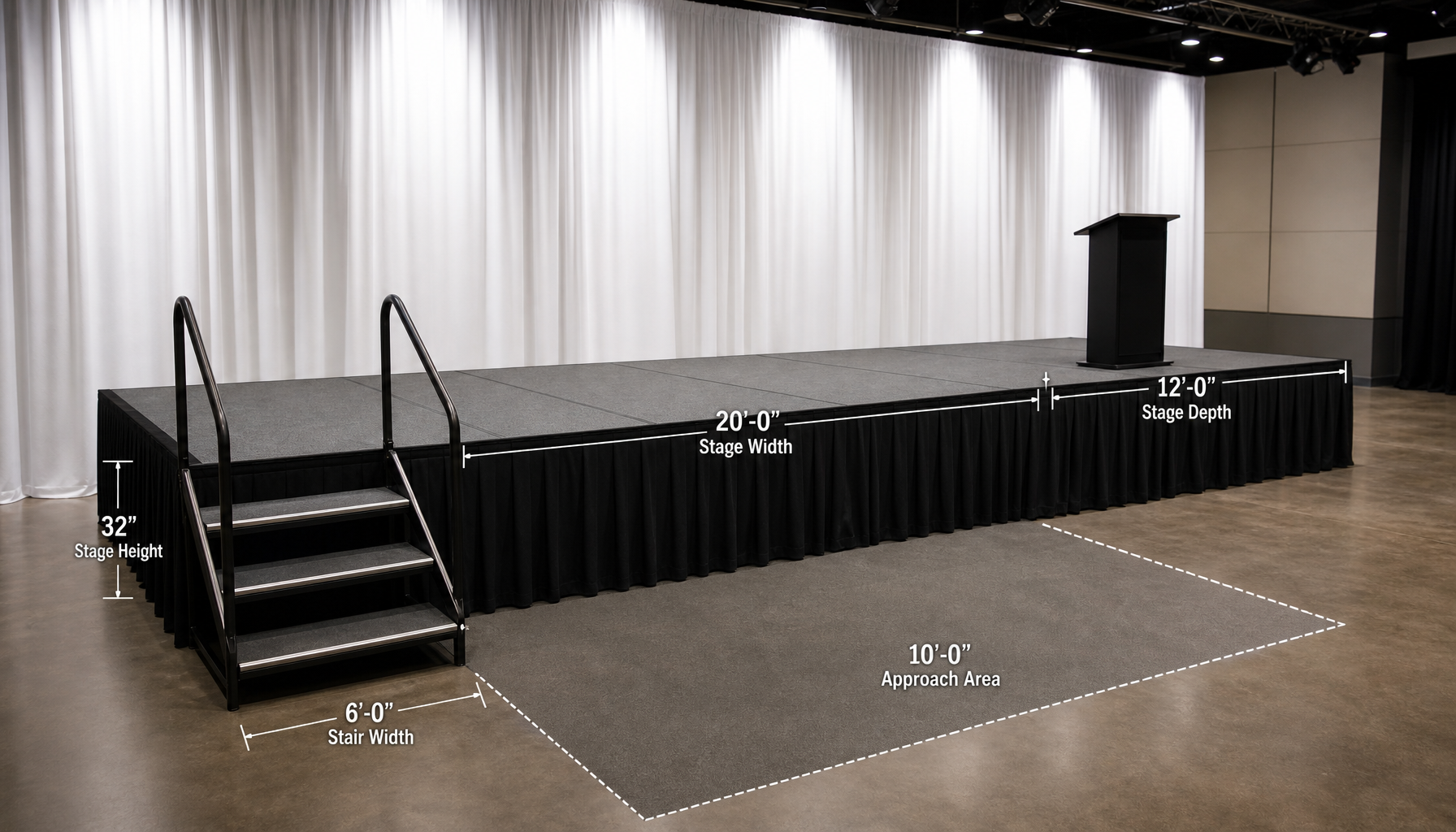
Ramp Specifications: Getting the Numbers Right
This is where accessible stage rental Orlando planners tend to hit the most questions. Let's walk through the math with real examples.
A 24-inch stage height requires a minimum 24-foot ramp run at the 1:12 slope maximum. Ramp runs over 30 feet require an intermediate landing of at least 60 inches. At the top and bottom of every ramp, you need a 60×60 inch level landing area so the person using the ramp can stop, orient themselves, and move onto the stage or off the ramp safely.
Our approach is to configure the stage height first based on sightlines and the event type, then spec the ramp to match. For a speaking stage or graduation setup, we often find that 16 to 20 inches of platform height gives good visibility from the audience while keeping the ramp to a manageable length. Honestly, that's the tradeoff most planners don't think about until we bring it up.
When a ramp must coexist alongside standard stairs, the two access points need to be clearly separated so neither path blocks the other. Check out our stair rental options for your stage setup to see how we configure multi-access stage entries when both stairs and a ramp are part of the plan.
Guard Rails and Edge Protection
Guard rails serve two separate functions on an accessible stage. The first is fall prevention for anyone on the elevated platform. The second, specific to ADA, is edge protection along any accessible route where the surface drops more than 0.5 inch at the edge, regardless of total platform height.
That second rule catches people off guard. A 12-inch stage doesn't require guard rails for fall prevention under most safety standards, but if wheelchair users are accessing it and the edge drops off sharply, edge protection is still required along the accessible portion of that stage. Low platform height doesn't mean you're off the hook.
We configure our guard rails to sit at the correct height for the accessible route, and we can position skirting to cover the structural frame cleanly without blocking the accessible path or the ramp landing. The goal is a setup that looks polished and meets the standard at the same time.
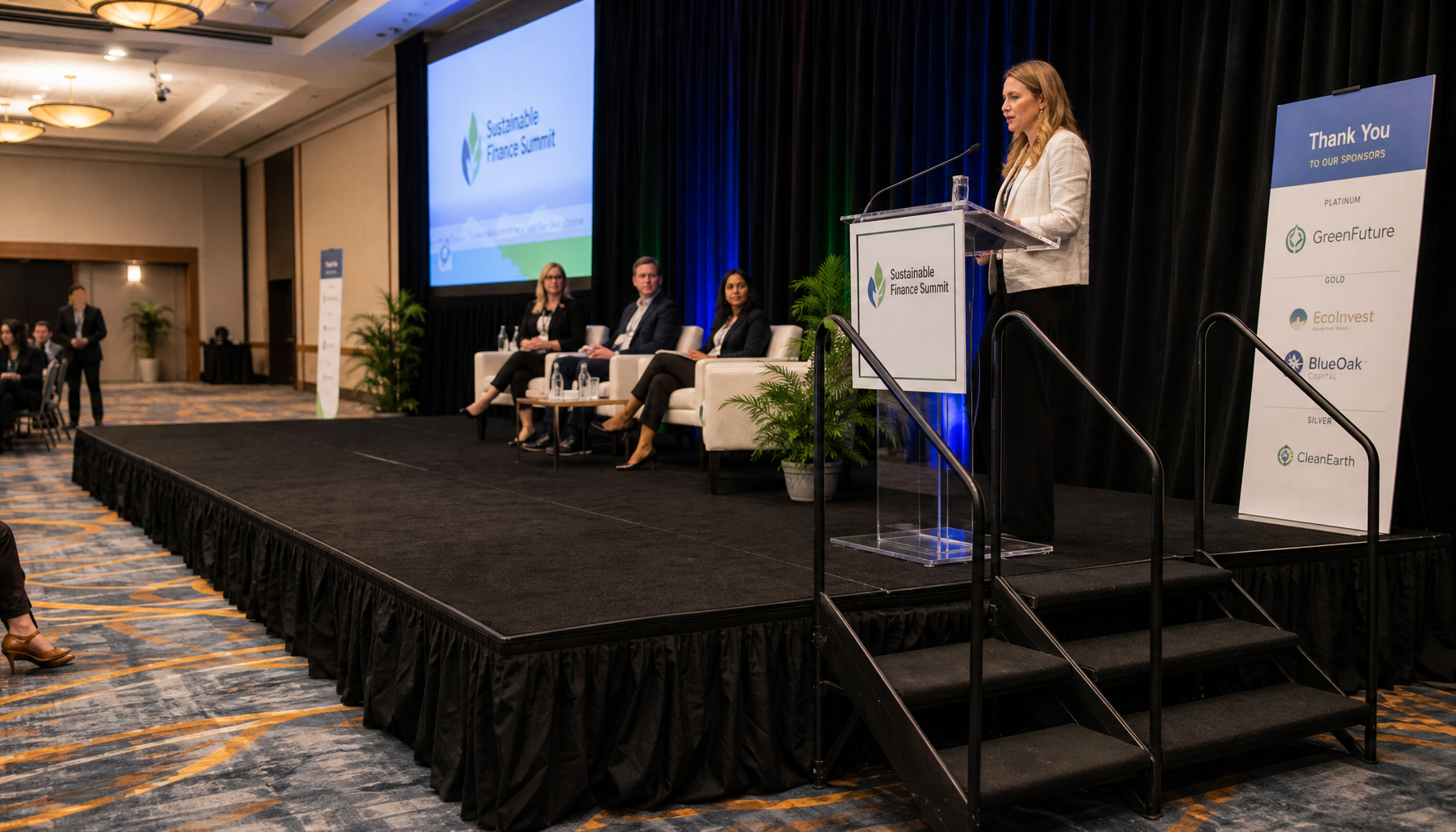
Florida-Specific Enforcement Context
The Florida ADA Accessibility Implementation Act doesn't create new technical requirements beyond the federal standard, but it formalizes how enforcement works at the local level. County building departments in Orange, Seminole, and Osceola counties each issue temporary structure permits, and those permits can involve an accessibility review before the event. That said, the process varies meaningfully by county and event scale, so check directly with the relevant building department when your permit is filed rather than assuming the review will happen automatically.
For events at high-profile venues like convention centers, hotels, and campus facilities, the venue itself often has an accessibility coordinator who will review your stage setup plan. Coming to that conversation with specific ramp dimensions, landing specs, and guard rail configurations already figured out makes the permitting and venue approval process much smoother. It also signals to the venue that you've done your homework.
And the broader point on Florida accessibility requirements for staging: the liability for a non-compliant temporary structure sits with the event organizer. Venue owners generally carry responsibility for the permanent structure and fixed elements. The rental equipment you bring in is your responsibility.
Real-World Setup: What It Looks Like in Practice
In February 2026, our team installed a stage at the Celeste Hotel for the Mastoris event. The hotel ballroom setup required us to plan a dedicated accessible approach path alongside the main stair entry, keeping both routes clear of each other. We ran an 18-foot ramp to meet the platform height, with 60×60 landings at the top and bottom, which left the ballroom floor plan cleaner than the client expected going in. Both access points stayed open throughout the event.
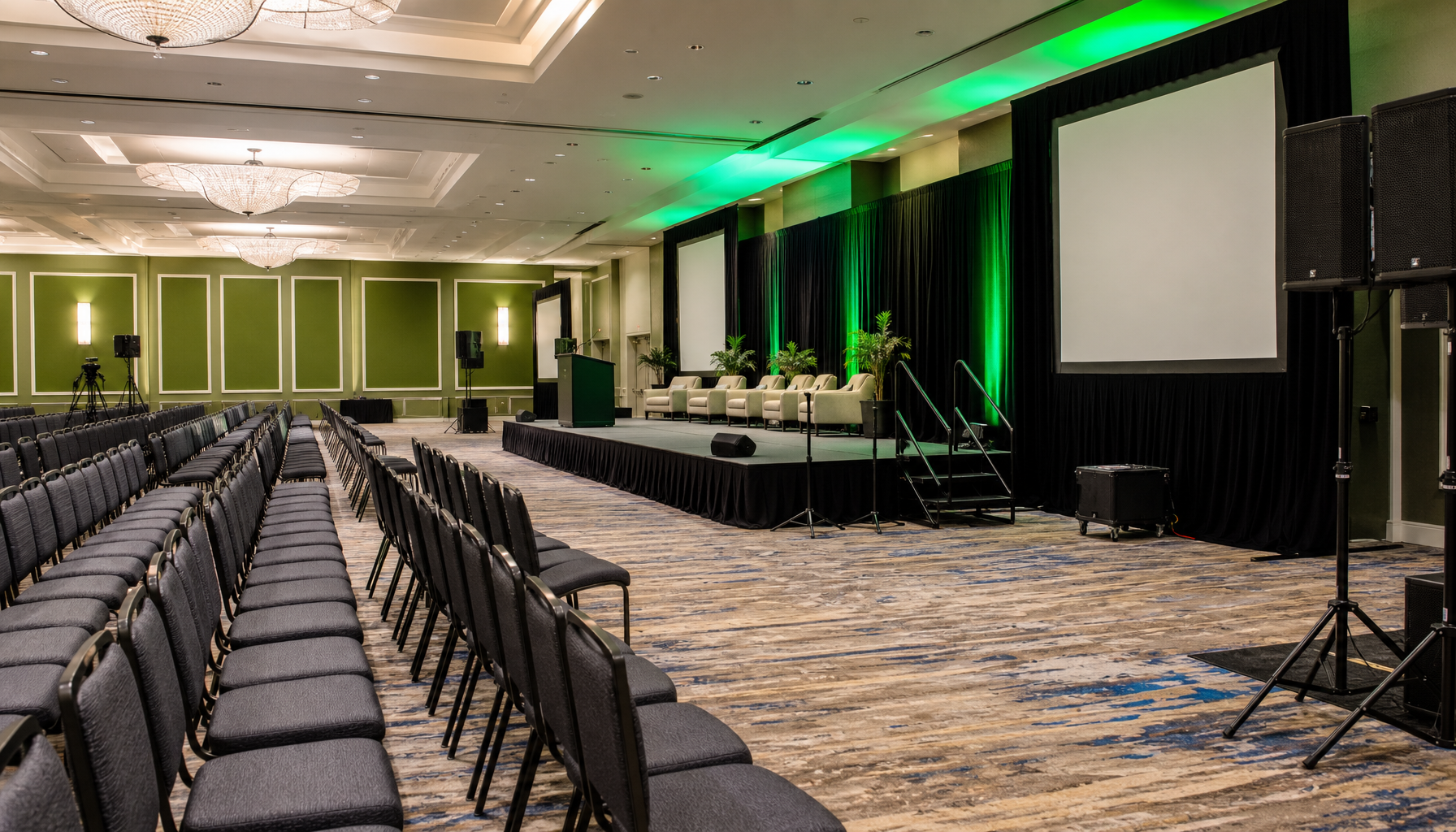
That same month, we completed a setup at a community venue in Apopka for the Perry event. Community venues often have more flexible floor plans, but they also mean we're working without the built-in infrastructure a large hotel provides. The room had a narrower doorway than the drawings showed, so we adjusted the ramp approach angle on-site to keep the 36-inch clear width intact. Good advance planning on the landing dimensions made the rest of the day straightforward.
In April 2026, we worked at Gaylord Palms for the Patel event. Convention-center-scale setups like Gaylord require especially careful attention to approach paths because the room layouts are large and the distances from the accessible parking and entry points to the stage can be significant. We mapped the full accessible route before the crew arrived and built multiple access points into the configuration so nothing funneled into a single path.
For more context on how we approach setup planning at different venues and event types, our post on how to choose the right stage size for your event covers the decision framework we use, which applies directly to accessible staging configurations.
Planning Checklist: Accessible Stage Rental
Before your event day, work through these seven items:
- Confirm stage height before finalizing ramp length (1 inch of height = 1 foot of minimum ramp run at 1:12 slope)
- Verify ramp width is at least 36 inches clear (wider if the venue expects high foot traffic on the accessible route)
- Check that landing space at the top and bottom of the ramp is at least 60×60 inches
- Confirm the deck surface is firm, stable, and slip-resistant with no gaps wider than 0.5 inch (our stage decks meet this standard)
- Position the ramp away from the main pedestrian path so foot traffic and the accessible route don't conflict
- Communicate the accessible entrance location to guests in advance, including in any pre-event communications
- Have a crew member present at load-in to confirm all deck connections are flush and the ramp is seated correctly before guests arrive
Our stage safety inspection checklist for Orlando events covers the broader safety review process, and accessibility verification fits naturally into that same pre-event walkthrough.
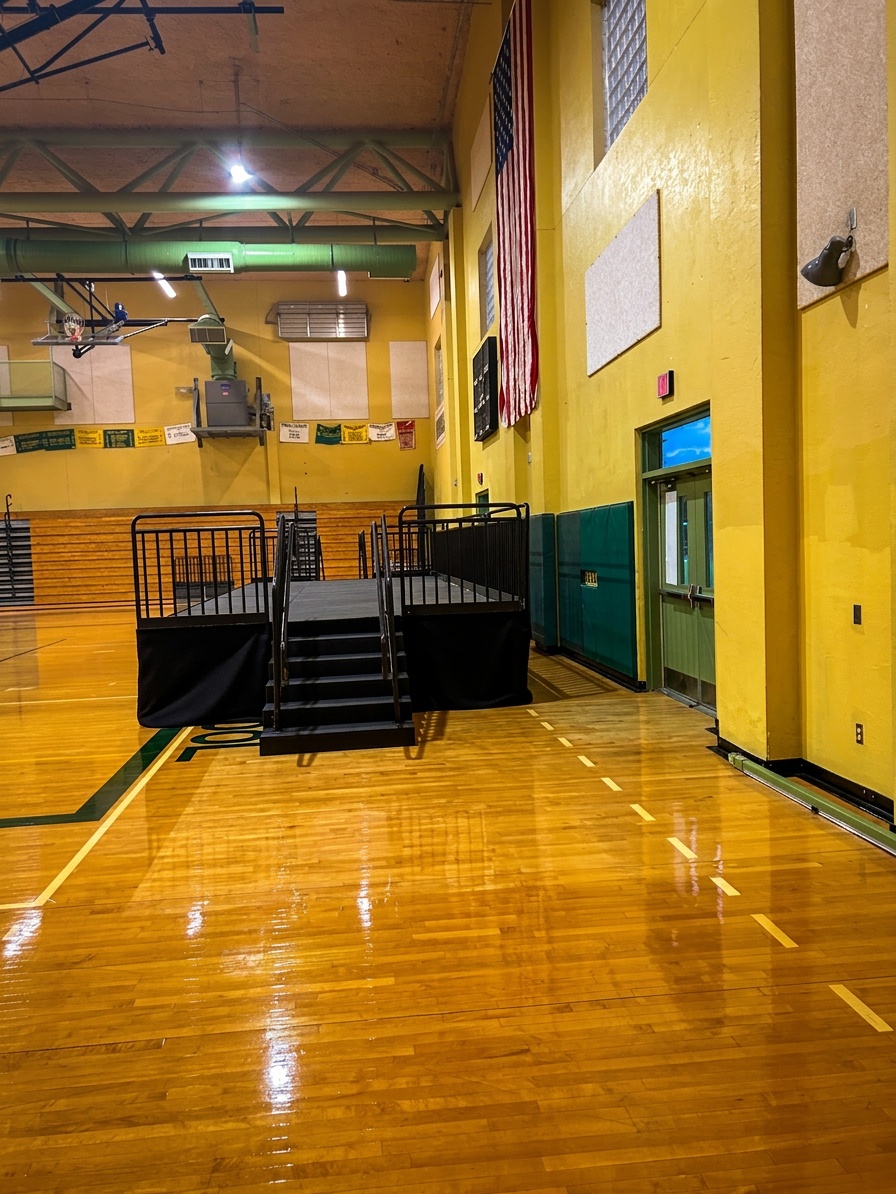
How to Request an ADA-Configured Stage Rental
When you reach out to us for a quote, give us two things: your desired stage height and whether you need a ramp included. From there, we calculate the ramp run, confirm the landing dimensions at both ends, and spec the guard rail configuration before anything ships to your venue. No surprises on delivery day because we resolve the measurements in advance.
If you're looking at speaking stage rental configurations for a graduation, award ceremony, or corporate event, accessible setup planning is part of how we approach every quote request. You can also use our Stage Size Calculator to get a starting point on platform dimensions, then bring that to us when you request your accessible configuration.
Planning an accessible event in Central Florida this graduation season or beyond? Tell us your stage height and we'll spec the ramp, landings, and guard rails to meet ADA requirements before your event day. Get a quote for your accessible stage setup and our team will take it from there.