Key takeaways
- Budget split: Allocate 50 – 55% of your total staging budget to the main stage (including audio, lighting, and rigging), 25 – 30% across secondary stages, and 15 – 20% on shared infrastructure.
- Stage sizing: A 2,000-person festival needs a minimum 24ft-depth main stage; secondary stages can run 16ft depth and still host a full band comfortably.
- Sound bleed: Orient stages 180 degrees from each other, maintain at least 300ft separation in open fields, and extend that buffer to 350 – 400ft at Florida sites with no tree line or structure breaks due to afternoon thermal inversions.
- Permits: The City of Orlando requires a Special Events Permit for events over 100 people on city property; Volusia County (Daytona corridor) mandates submittal 60 days before the event date.
- Book early: Equipment availability tightens 60 – 90 days before peak season (October – April in Florida), and booking 4 – 6 months out can prevent cost inflation of 20 – 30%.
How big should the main stage be for a Central Florida festival?
For a festival drawing 1,500 – 3,000 attendees, a main stage with 24ft of depth and at least 32 – 40ft of width gives headliners the room they need and the sightlines your crowd deserves.
Stage height scales with audience size: according to Centric Events' stage sizing guidance, events with 300 – 1,000 attendees need 24 – 36 inches of stage height, while audiences over 1,000 call for 36 – 48 inches.
Depth matters as much as width. TSE Entertainment's staging guide notes that a minimum 16ft stage depth is required just to give a full band usable room, since eight feet in front of the drummer is the minimum most performers expect. For a headliner with a full backline, touring production, and monitor engineer positioned downstage, 24ft depth is the practical floor.
For larger regional festivals targeting 5,000 or more attendees, the benchmark shifts. A Stageline SL320-class main stage features a 40ft x 40ft base and can support over 25,000 lbs of rigging capacity, which is why it has become the industry standard for national acts with full A/V packages. At that scale, you are also looking at structural engineering sign-off and county-level permitting well beyond a standard rental order.
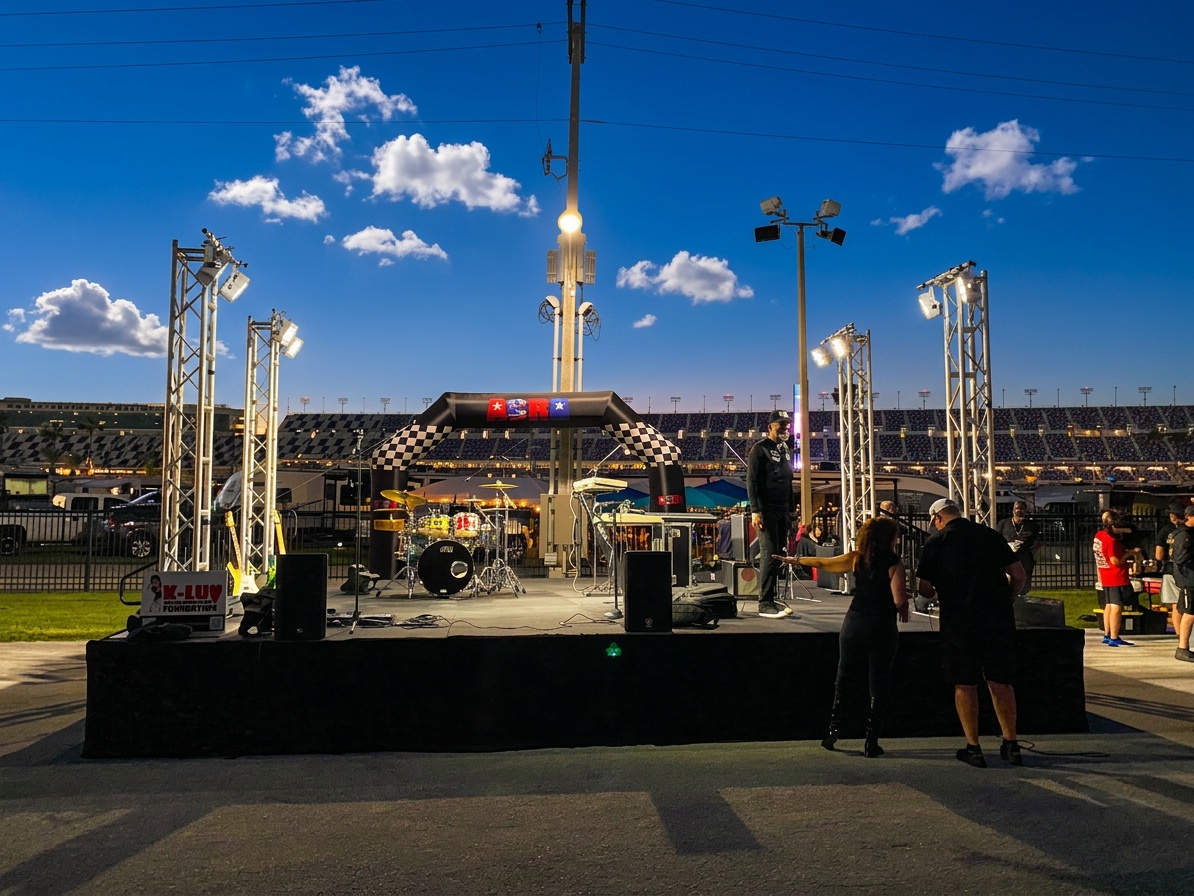
For the Orlando market, the sweet spot for a community or regional festival main stage lands between 24×40 and 24×48. That footprint handles a full band, a monitor engineer station, and basic lighting truss overhead without triggering the structural review thresholds that larger configurations require.
What size should secondary stages be relative to the main stage?
At Stages Plus, we pair a 24ft-depth main stage with 16ft-depth secondary stages for festivals in the 1,500 – 3,000 attendee range, giving secondary acts professional room while keeping equipment spend proportional.
The secondary stage exists to keep the festival alive during main-stage changeovers. It doesn't need to match the main stage footprint; it needs to handle the acts booked there. A 16×24 or 16×32 secondary stage comfortably fits a DJ setup, a small acoustic act, or a four-piece band, and can run at 24 – 36 inch height for a crowd of 300 – 1,000 gathering in front of it.
What changes at the secondary stage is the overhead infrastructure. Secondary stages rarely need the same truss rigging depth that a headliner demands, so you can run a lighter pipe and truss system overhead, a mid-tier audio package, and a simpler lighting rig. We build secondary stages with guard rails and stairs as standard because no amount of savings is worth a performer taking a fall offstage.
A festival running three stages follows the same logic: the third stage, often used for acoustic, spoken word, or DJ sets, can run as small as 12×16 or 12×20. Think of it as an activation space rather than a performance stage and size it accordingly.
Our concert stage rental sizes and configurations page shows the full range of footprints we carry, including the modular depth options that let you step from 16ft to 24ft based on your lineup.
Main stage vs. secondary stage: full side-by-side comparison
The table below reflects configurations and cost ranges Stages Plus applies in the Orlando market for 2026, not national averages, which run significantly higher for comparable setups.
| Feature | Main Stage | Secondary Stage | Tertiary / Activation Stage |
|---|---|---|---|
| Typical footprint (depth x width) | 24ft x 40 – 48ft | 16ft x 24 – 32ft | 12ft x 16 – 20ft |
| Recommended height | 36 – 48 in | 24 – 36 in | 16 – 24 in |
| Audio package tier | Full line array, dual FOH | Mid-tier PA, single FOH | Compact PA or DJ monitor rig |
| Lighting package | Intelligent moving heads, truss | Par cans + basic moving heads | Par cans or uplights |
| Audience risers needed | Yes (for 500+ crowds) | Optional | No |
| Camera riser needed | Yes (IMAG or livestream) | Optional (recommended) | Rarely |
| Guard rails required | Yes (stage above 30in) | Yes (stage above 30in) | Yes if above 30in |
| Stage skirting | Yes | Yes | Optional |
| Approx. rental cost range (Orlando, 2026) | Call for quote | Call for quote | Call for quote |
| Setup crew hours (est.) | 4 – 8 hrs | 2 – 4 hrs | 1 – 2 hrs |
Note on cost ranges: national sources cite main stages for 20,000-person festivals at $400,000 – $900,000 with secondary stages at $75,000 – $200,000 each. Central Florida community festivals at 1,000 – 5,000 attendees run substantially lower. Get a festival staging quote for the figures that match your specific headcount and configuration.
How do you prevent sound bleed between festival stages?
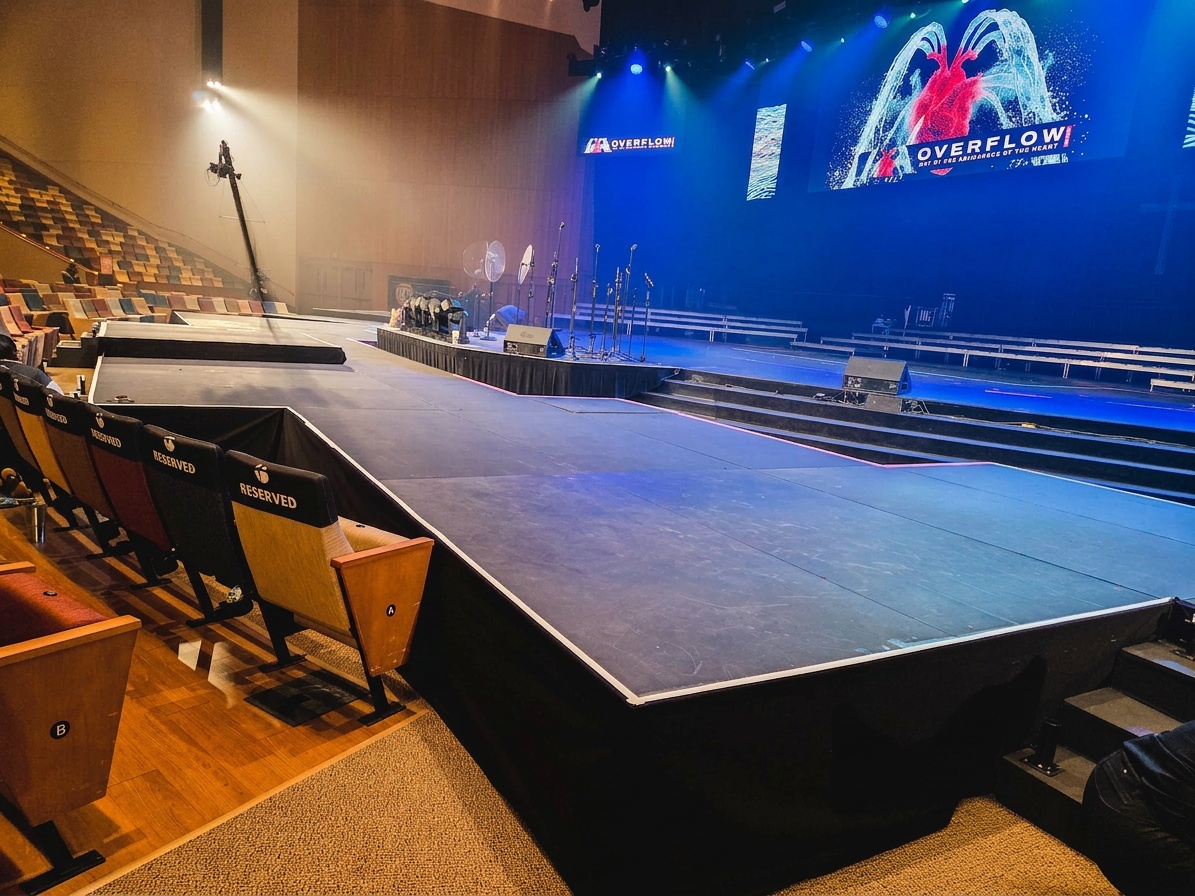
The 180-degree reversal rule plus a 300ft minimum separation handles most open-field situations in Central Florida, but Florida's afternoon thermal inversions can carry bass frequencies further than expected. Push that buffer to 350 – 400ft at sites without a tree line or structural break.
Ticket Fairy's guide to multi-stage sound separation explains the risk directly: "Nothing can derail a great festival vibe faster than sound bleed – that unwelcome clash of audio from different stages." Their research confirms that cardioid subwoofer arrays can reduce backward low-end bass rumble by 15 dB or more, keeping powerful bass frequencies focused on the audience side rather than spilling toward neighboring stages.
The second tool is scheduling. Running stages on an alternating pattern, where Stage A performs while Stage B goes dark for changeover, effectively eliminates bleed even at closer distances because there is only one loud source at any given moment.
The table below compares the main sound-bleed mitigation strategies:
| Strategy | How It Works | Pros | Cons | Cost Impact |
|---|---|---|---|---|
| 180° stage mouth reversal | Both stages face away from each other | Simple, zero added cost, most effective for high-SPL acts | Requires open field; not always layout-compatible | None |
| 300 – 400ft separation | Physical distance between stage faces | Works regardless of orientation | Requires large venue footprint | Increases site cost |
| Cardioid subwoofer array | Sub stacks configured to cancel rear-firing bass | Reduces rear bass by up to 15 dB | Requires skilled audio engineer; higher audio package cost | Adds to audio line item |
| Alternating schedule offsets | One stage dark while other performs | Eliminates bleed entirely | Reduces total performance hours; artist scheduling constraints | None (production choice) |
| Acoustic barriers / terrain | Trees, structures, terrain breaks | Free if site has natural features | Unreliable; Florida's flat terrain limits options | Variable |
Florida's specific challenge is the afternoon thermal inversion pattern common from October through April, the same window that defines the Central Florida festival season. Warm air near the ground and cooler air above can act as a sound channel, bouncing low frequencies further than a standard outdoor calculation predicts. If your site has no tree canopy or building breaks between stages, build in the 400ft buffer from the start.
How should you split your festival staging budget?
At Stages Plus, we recommend spending roughly 50 – 55% of the total staging budget on the main stage, 25 – 30% across secondary stages, and the remaining 15 – 20% on shared infrastructure: risers, guard rails, skirting, and power distribution.
Towerhouse Global's 2026 event production cost analysis confirms this ratio holds across event types: "The main stage alone – with lighting, audio, LED backdrop, and multi-camera IMAG – accounts for 50 – 60% of total production budget." Their broader guidance reinforces the quality-over-quantity argument: "A single, well-designed main stage with high-quality lighting and audio delivers more audience impact than spreading budget across five mediocre setups."
For smaller local festivals targeting 1,000 – 5,000 attendees, Startup Financial Projection's music festival cost breakdown puts the total production budget in the $100,000 – $500,000 range, with roughly 25% of that allocated specifically to staging, sound, and lighting. That means a $200,000-budget festival has approximately $50,000 to work with on the full staging and audio package across all stages.
Practical implications for a two-stage Central Florida festival on a $50,000 staging-and-audio budget:
- Main stage (24×40, audio, lighting, risers, rails): roughly $27,500 – $30,000
- Secondary stage (16×24, mid-tier audio, basic lighting): roughly $12,500 – $15,000
- Shared infrastructure (camera riser, additional audience risers, skirting, power runs): remaining $5,000 – $10,000
These are directional allocations based on what we typically configure for this market. Actual figures depend on your specific lineup, production rider requirements, and site conditions.
What are the Florida permit and ADA requirements for a multi-stage festival?
Multi-stage festivals in the Orlando corridor typically cross the threshold for Special Events Permits in multiple jurisdictions simultaneously, and each county operates on its own timeline.
The City of Orlando's Special Events Permit requirements are triggered by any event on city property with more than 100 attendees. Events with fewer than 100 people also require a permit if they involve vending, alcohol, temporary structures, or street closures – which means virtually every festival configuration triggers the process.
For festivals in the Daytona Beach corridor, Volusia County's Outdoor Entertainment Event Permit Application mandates submittal a minimum of 60 days before the event date.
Multi-stage events on the Orlando-to-Daytona corridor often cross county lines. A festival site straddling Orange and Osceola counties, or using a Daytona-area venue in Volusia County, may require separate permit pulls in each jurisdiction. Plan for that complexity from day one.
On ADA compliance: every stage in your festival layout needs an accessible path and a code-compliant ramp. The standard slope is 1:12 – a 24-inch-high stage requires approximately 24 feet of ramp run plus landings, per Centric Events' stage sizing guidelines. If you're running a main stage at 42 inches of height, budget for over 40 feet of ramp run. That's not a line item many first-time festival producers include in their initial layout, and it can create real space planning problems on a compressed site.
Our full breakdown of ADA ramp requirements by stage height lives in our post on how to choose the right stage size for your Orlando event.
What does a real multi-stage install look like on the Orlando-to-Daytona corridor?
No competitor serving this market from outside the region can match the logistical depth our crew builds through repeated same-day installs across venues separated by 60-plus miles.
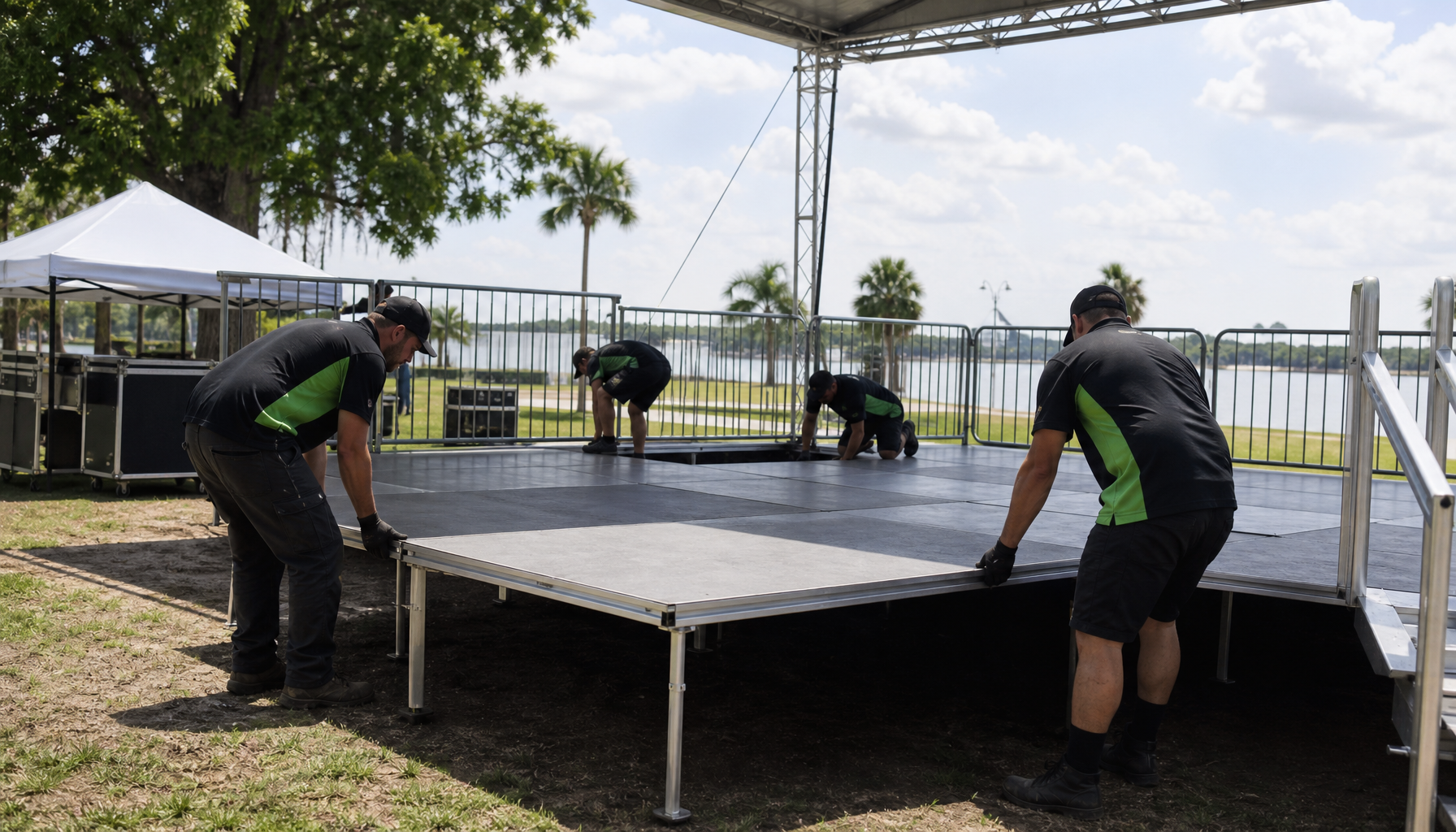
In late March and early April 2026, our team ran a stretch of back-to-back multi-setup installs that shows exactly why local knowledge matters at festival scale.
On March 27, we set up an outdoor stage in Eustis for the Lamborn event, a secondary-stage-scale build that tested our crew's ability to work efficiently on an open-field site with limited infrastructure. The ground-level logistics that never make it into a planning guide were all there: uneven turf, power run positioning, and the specific challenge of anchoring stage decks when soil softens after rain.
Four days later, on March 31, we were in Daytona Beach for the Samudrala event, a larger outdoor footprint that required us to think about sightlines, crowd flow between activation areas, and the way sound behaves at a coastal site with no natural barriers. That install is one of the clearest examples in our recent archive of how different site conditions change every decision about stage orientation and audio positioning.
On April 3 and 4, our crew handled the Schultz install in Orlando and then struck the Patel setup at the Gaylord, a teardown that showed how post-festival logistics cascade when multiple stages need to come down in a compressed window.
This is the Orlando-to-Daytona corridor in real terms: our team regularly executes same-day installs at venues separated by more than 60 miles. The inventory management, crew routing, and delivery sequencing for a multi-stage festival across this region is something we've built actual systems for.
Our audience riser rental page covers the riser configurations we deployed at Daytona and similar large-footprint outdoor events.
How far in advance do you need to book a multi-stage setup?
Book your multi-stage festival configuration 4 – 6 months before your event date, especially if it falls between October and April, when Central Florida's compressed outdoor festival calendar creates real equipment and crew availability pressure.
Towerhouse Global's 2026 production cost analysis is direct on the financial consequence of late booking: "Equipment availability and crew scheduling tighten 60 – 90 days before peak event seasons; booking a production partner 4 – 6 months out gives access to preferred equipment and avoids rush pricing that can inflate event production costs by 20 – 30%."
For multi-stage events, the booking window matters even more because you're coordinating multiple stage footprints, multiple audio systems, and multiple crew deployments. A single-stage event can sometimes be accommodated on a shorter timeline. A festival with a 24×40 main stage, a 16×24 secondary stage, an audience riser, a camera riser, and shared infrastructure across both stages is a logistics operation that needs runway to execute correctly.
Our typical recommendation for Central Florida festival producers: submit your inquiry by the end of July if you're targeting an October – December event date. That gives us time to confirm inventory, build your configuration quote, and flag any site-specific requirements before you're locked into a venue contract.
Check our stage lighting packages and audio packages for Orlando events pages to understand what each tier includes before your first planning call.
Frequently asked questions
Can a secondary stage double as a DJ or acoustic stage to control costs?
Yes, and this is one of the most effective cost-control moves available to a first-time festival producer. A 16×24 stage with a compact PA and basic lighting handles DJ sets, acoustic performances, and spoken word without a full line array. At Stages Plus, we configure secondary stages as multi-format platforms regularly. The key is clarifying the heaviest use case (a DJ with a full subwoofer rig versus an acoustic duo) before finalizing the audio package.
Do I need separate camera risers at secondary stages?
Not always, but we recommend one at any secondary stage where you plan to stream or record live. A camera riser gives your video crew a clean angle without putting them in the crowd. For tertiary or activation stages, a handheld or tripod setup usually suffices. See our post on camera riser setup for live production for the configurations we use.
What mistakes do first-time festival producers make with stage sizing and spacing?
The most common errors we see: undersizing the main stage depth (booking a 16ft-depth stage for a headliner with a full backline), forgetting ADA ramp space in the layout, and placing stages without accounting for sound bleed. A close second is underestimating teardown time. Festivals that run into their venue curfew during strike often face penalty fees that exceed what a better-planned logistics sequence would have cost.
How does the Florida heat affect multi-stage festival logistics?
It affects setup timing more than anything. Our crew plans early-morning installs for summer and shoulder-season events to avoid peak afternoon heat, which also coincides with the daily thunderstorm window. For October – April festivals, heat is less of a crew factor, but UV exposure on extended outdoor builds still matters. We also factor shade cover placement around secondary stages when the event layout allows for it.
How many days does a multi-stage festival setup take?
A two-stage festival with full audio, lighting, risers, and rails typically requires one full day of setup (8 – 12 hours depending on configuration complexity) and a half-day to full day of strike. Larger configurations with three or more stages, truss systems, and overnight security requirements may need a two-day install window. We confirm your build timeline as part of the quote process.
The bottom line on multi-stage festival planning in Central Florida
Multi-stage festival staging in Orlando is manageable when you start with the right size ratios, a realistic budget split, and an honest look at Florida's specific complications: thermal inversions, multi-county permits, and a peak season that demands early booking. Our recommendation is a 24ft-depth main stage, a 16ft-depth secondary stage, 180-degree mouth reversal with 350 – 400ft separation at open-field sites, and a budget that protects the main stage experience above everything else.
Planning a multi-stage festival in Central Florida? Tell us your headcount, venue, and tentative dates and we'll build a staged configuration quote, covering main stage, secondary stages, risers, and all shared infrastructure, in one package. Get a festival staging quote