The ADA Specs Most Orlando Event Planners Miss Until the Day Before
You have the venue booked, the speaker lineup confirmed, and the stage rental on order. Then someone asks: "Is there a ramp for the keynote speaker who uses a wheelchair?" That question, asked 24 hours before load-in, is one we hear more than we should. Getting ADA stage ramps Orlando right is not complicated, but it does require planning from the start, not as a last-minute add-on.
This post walks through the actual numbers: slope ratios, minimum ramp widths, landing dimensions, and the Florida-specific rules that apply when you are renting a stage for a graduation ceremony, corporate awards night, or community event in Central Florida.
Whether you are planning a corporate conference at a downtown Orlando hotel or a graduation ceremony at a school auditorium, understanding ADA stage ramps Orlando requirements before you book your stage rental can save you from costly last-minute changes and potential liability.
What the ADA Standards Actually Say About Temporary Stages
A lot of event planners assume ADA requirements only apply to permanent structures. That assumption is wrong, and it can create real problems at Florida venues.
The ADA Standards for Accessible Design apply to temporary event structures when those structures serve as program access points. If a performer, speaker, or award recipient needs to access the stage, that stage must be accessible. The Florida Building Code adopts these standards, and Florida's civil rights statutes (Fla. Stat. § 760.08, covering places of public accommodation) extend accessibility obligations to private events open to the public. Worth confirming with your venue's legal team for high-profile events, but the expectation is there.
The three numbers you need to know for any stage ramp are:
- Maximum slope ratio: 1:12. For every 1 inch of rise, the ramp must extend at least 12 inches horizontally. A 24-inch high stage requires a minimum 24-foot ramp run. If space is tight, that math matters enormously during venue layout planning.
- Minimum clear ramp width: 36 inches. This is the usable width between any edge protection or handrails. Some venue coordinators confuse total ramp width with clear width. The 36-inch measurement is the clear path.
- Maximum rise per ramp run: 30 inches. If your stage is taller than 30 inches, the ramp must include an intermediate landing before continuing.
These are minimums. For high-traffic events where multiple people may use the ramp at the same time, wider is always better.
Landing Dimensions, Edge Protection, and Handrail Height
The slope and width numbers get most of the attention. But the details around landings and handrails are where setups most often fall short of a full compliance review.
Every Ramp Run Needs a Landing at the Top and Bottom, and the Dimensions Are Specific
Landings must be at least 60 inches long and at least as wide as the ramp itself. That 60-inch depth gives a wheelchair user enough room to maneuver without rolling back down the slope. If the ramp changes direction at an intermediate landing, the landing must be at least 60 inches by 60 inches. That is a 5-foot square turning radius.
For a large stage in a ballroom or outdoor tent, that footprint is manageable. For a narrow side-stage access at a smaller venue, it requires careful placement from the start. We have seen this ramp footprint surprise more than a few planners who thought a 30-inch stage was no big deal.
One more detail worth knowing: if the ramp connects to a doorway, the bottom landing needs 60 inches of clear space beyond the door swing. That comes up more than you would expect at enclosed venues like hotel ballrooms.
Edge Protection Keeps the Setup Safe and Looking Clean
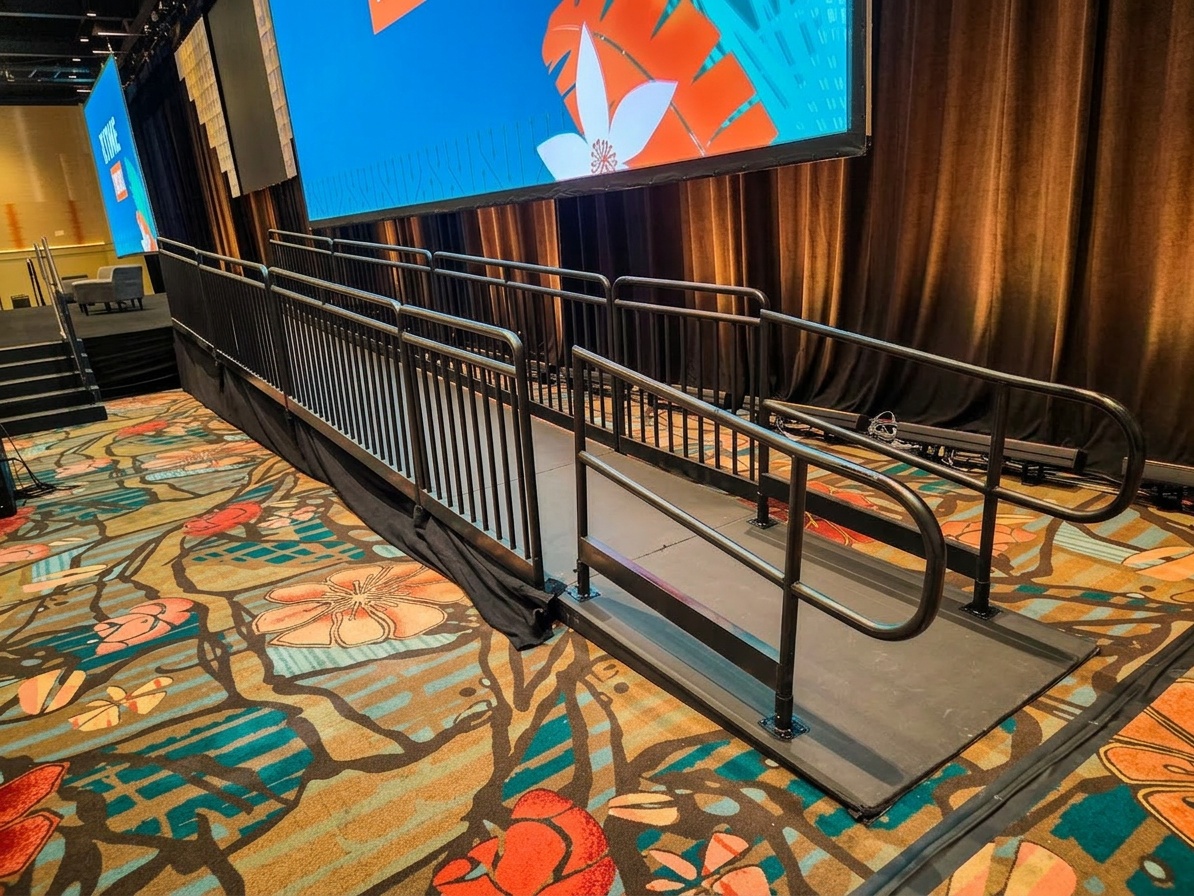
Any ramp surface without a wall or barrier on both sides needs edge protection. Typically that means a raised curb of at least 4 inches on the open sides, or an extended ramp surface that prevents a wheelchair wheel from rolling off the edge. Our ramp systems include side rails that satisfy this requirement while also giving the setup a clean, finished look.
Handrail Height Has More to It Than Most People Realize
Handrails are required on both sides of any ramp with a rise greater than 6 inches. The gripping surface must be between 34 and 38 inches above the ramp surface. Handrails also need to extend horizontally at least 12 inches beyond the top of the ramp and slope down to the bottom landing. Those horizontal extensions are the part most often skipped in quick setups.
For a full breakdown of how these components fit into a safe stage system, our stage safety inspection checklist for Orlando events covers ramp components alongside the rest of the structural safety items every planner should verify before the event opens.
Applying These Specs at a Real Orlando Venue: The Gaylord Palms Install
In April 2026, our team set up a stage at the Gaylord Palms, one of Orlando's busiest and most active convention properties. The setup required a full presentation stage with ADA-compliant ramp access integrated directly into the design from the start.
At Gaylord Palms, the interior event spaces are substantial but they have defined traffic flow patterns. We positioned the ramp on the stage-right side to keep the center and stage-left areas open for crew movement and presenter sightlines. The stage height in this setup required a ramp run that extended back behind the stage deck, with a proper landing at the top connecting flush to the deck surface.
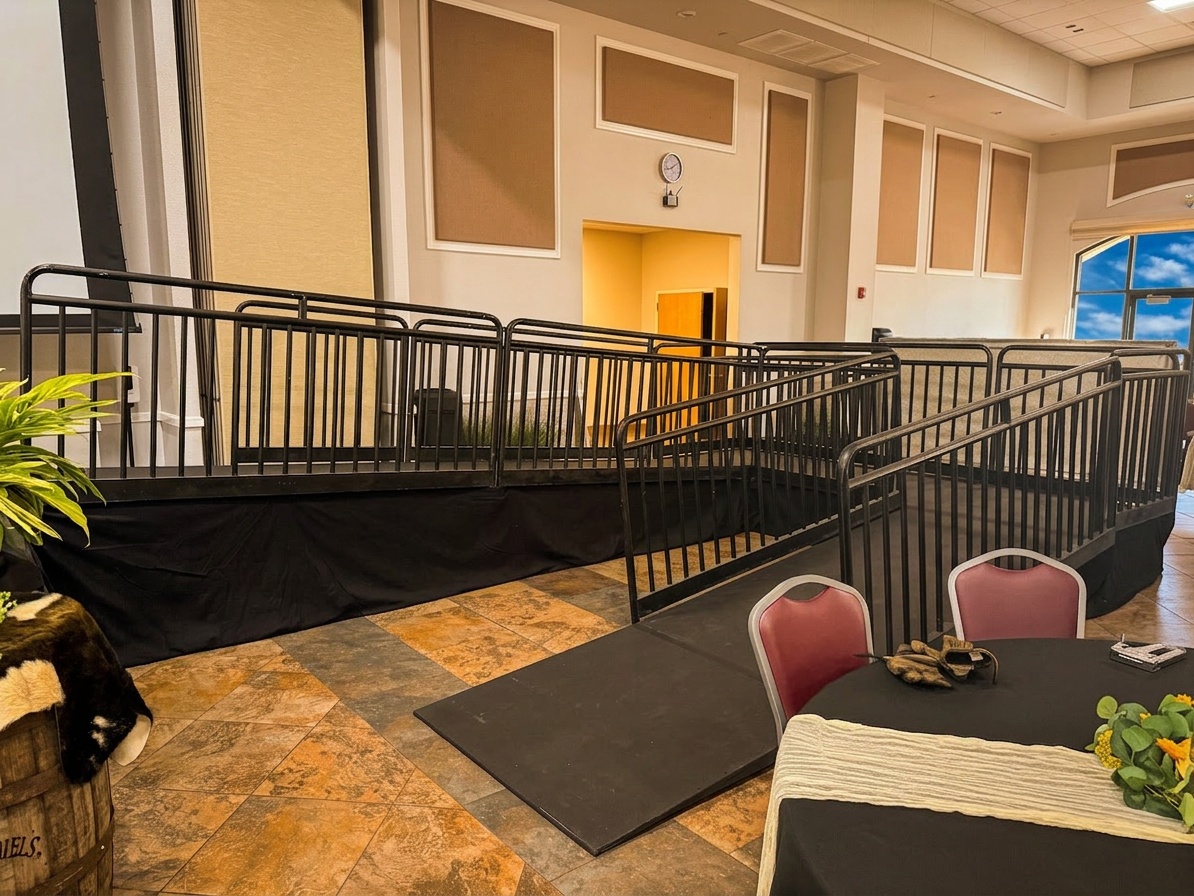
The detail that made this setup work was planning the ramp run length before finalizing the overall stage footprint. A last-minute ramp addition would have forced us to either compromise the slope ratio or cut into the audience floor space. By designing the ramp into the initial layout, the whole system fit cleanly and met spec without any workarounds.
And for events at major convention venues like Gaylord Palms, building the ramp in from the start also matters for the venue's own permitting and insurance documentation. Venues of that size often require proof of ADA compliance as part of the event approval process.
Our speaking stage rental configurations include ramp options that can be spec'd into your quote from the beginning, so the ramp run length and landing layout are part of the original design rather than an afterthought.
What the Strike Reveals: Ramps Are Standard Equipment, Not Extras
In March 2026, our crew handled a teardown at an Orlando hotel ballroom following a multi-day awards event. Strike days are where you really see how a stage system was put together. When the ramp and guard rail components come down, it is immediately obvious whether those elements were integrated from the start or clamped on at the last minute.
On this teardown, the ramp sections, handrails, and edge protection came off as part of a systematic breakdown sequence. Each component had been built into the stage frame rather than added externally. That is how it should work, and honestly, it makes strike go faster too.
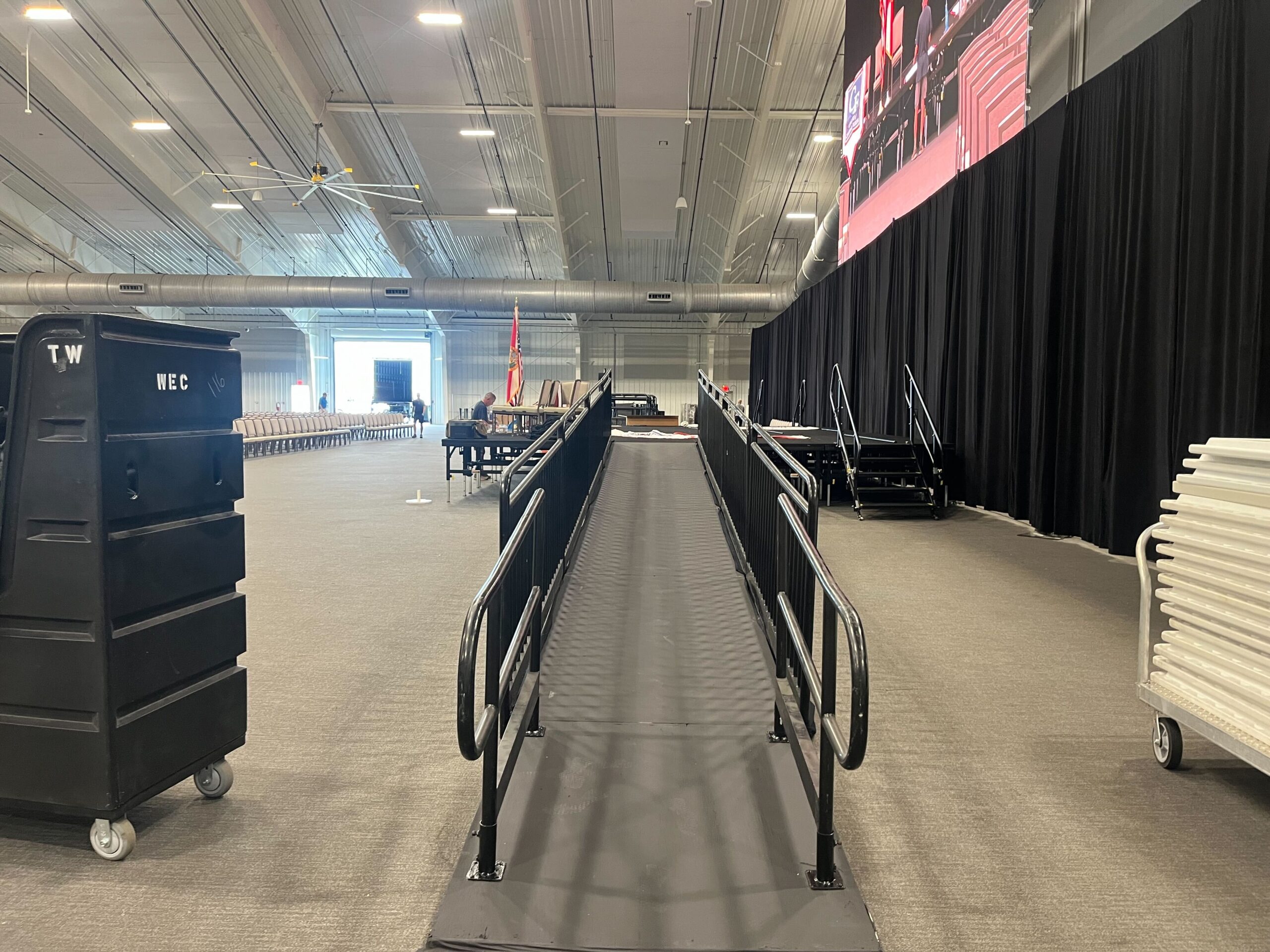
The takeaway for event planners is straightforward. When you get a quote and ramps are listed as a line item add-on with no dimensions specified, ask for the slope calculation based on your actual stage height. A ramp line item that does not reference the rise and run is not a compliant ramp quote. It is a placeholder that may not actually work at your venue.
For reference on how staging components connect to broader Florida compliance requirements, our post on ADA compliant staging and accessibility requirements in Florida goes deeper on the regulatory framework behind these standards.
Calculating the Ramp You Actually Need
The math is simple once you know your stage height. Take the stage height in inches and multiply by 12. That gives you the minimum ramp run length in inches. Divide by 12 to get feet.
A 24-inch high stage requires a minimum 24-foot ramp run at the 1:12 slope ratio.
A 32-inch high stage requires a minimum 32-foot ramp run, which is longer than many event planners expect and needs to be accounted for in the venue floor plan before load-in day.
So what happens when your venue cannot fit a straight 32-foot run? A switchback ramp with an intermediate 60×60-inch landing is the answer. It doubles the footprint, but the slope stays compliant.
For outdoor events, surface material matters too. Ramp surfaces must be stable, firm, and slip-resistant. Florida rain can make smooth surfaces slippery fast, so our outdoor ramp systems use non-slip deck surfacing rather than bare metal or smooth composite. That is not an optional upgrade here, it is standard practice.
If you are not sure how a ramp fits into your overall stage footprint, the stage size calculator on our site can help you start mapping out dimensions before you call.
Putting It All Together for Summer and Fall Events
June through September is a busy stretch for graduations, corporate award ceremonies, and community events across Central Florida. These are exactly the types of events where speaker stages are used and where ADA ramp access is most likely to be needed.
School graduations frequently have faculty, administrators, or student honorees who use mobility aids. Corporate awards events may have executives or honorees who need ramp access. Planning for accessibility from the first quote, rather than treating it as an upgrade request, is what keeps your event running smoothly and your organization protected.
Honestly, most planners who call us the day before load-in asking about ramps are not being negligent. They just did not know to ask the question earlier. That is why we raise it ourselves during the quoting process now.
Our performance staging rental packages can include fully integrated ramp systems, and we build the slope calculations into your quote so you know exactly what footprint you are working with before the contract is signed.
The ADA stage ramp requirements are not complicated. The 1:12 slope ratio, 36-inch clear width, 60-inch landings, 34-to-38-inch handrail height, and edge protection rules are clear and consistent. The challenge is applying them before the stage is already built, not the day before the event when your options are limited.
Plan the Ramp Before You Plan Anything Else
Every stage setup at Stages Plus starts with the same question: what height are we building to, and who needs to access this stage? If the answer includes anyone using a wheelchair, a walker, or any mobility device, the ramp dimensions shape the entire layout. Getting that right from the start is easier, cheaper, and better for everyone at your event.
Need a ramp built into your stage quote? Tell us your stage height and we will calculate the exact run length and landing dimensions you need. Call us at 407-442-0254 or visit our How to Get a Quote page to submit your event details for a custom accessible stage setup.