Key takeaways
- A 10×6 ft wall of P3.91mm panels weighs 320-432 lbs before frames and cabling. Confirm the distributed load rating with your stage rental company before the AV vendor arrives.
- Peak power draw for a 10×6 ft P3.9 wall reaches approximately 2,880W (roughly 24 amps at 120V). That circuit needs to be dedicated and labeled before panels arrive.
- At Stages Plus, our operational standard for floor-stacked LED walls is a minimum 16 ft stage depth, keeping performers and the screen from competing for the same square footage.
- The stage deck must be locked and level before any LED floor-stack is positioned on it. That sequencing rule protects both the panels and the load path.
- Outdoor LED walls in Florida require at least 5,000 nits brightness and IP65/IP54 weatherproofing. Unshaded south- or west-facing stages may need 6,000-8,000 nits.
Adding an LED video wall to a rental stage requires coordinating four things before load-in day: confirming the stage deck’s distributed load rating handles panel weight, routing dedicated power circuits during deck build, selecting a mounting method that fits your depth and rigging constraints, and sequencing the AV vendor’s arrival after the deck is locked and level. Get those four items right and the integration is straightforward.
How much does an LED video wall weigh, and can a rental stage floor handle it?
A 10×6 ft LED wall built from P3.91mm panels weighs roughly 320-432 lbs of panel hardware alone, and that number climbs once you add frames, cabling, and any truss structure.
Individual P3.91mm indoor rental panels weigh approximately 18 lbs (8.16 kg) each, per LED Nation USA. A 10×6 ft wall requires roughly 20-24 of those 500x500mm cabinets, putting bare panel weight at 320-432 lbs. A large corporate-format LED wall at 12 meters wide by 5 meters tall can weigh 800 to 1,200 kilograms including trussing infrastructure, according to a Vocal Media production feature on corporate LED installs.
Standard rental stage decking is rated for distributed loads, not concentrated point loads. A floor-stacked LED wall transfers its weight through base frame feet onto a relatively small area of deck. Before Stages Plus delivers any stage that will host a floor-stacked screen, we confirm the deck’s distributed load rating accommodates the panel weight without requiring shims or additional blocking underneath.
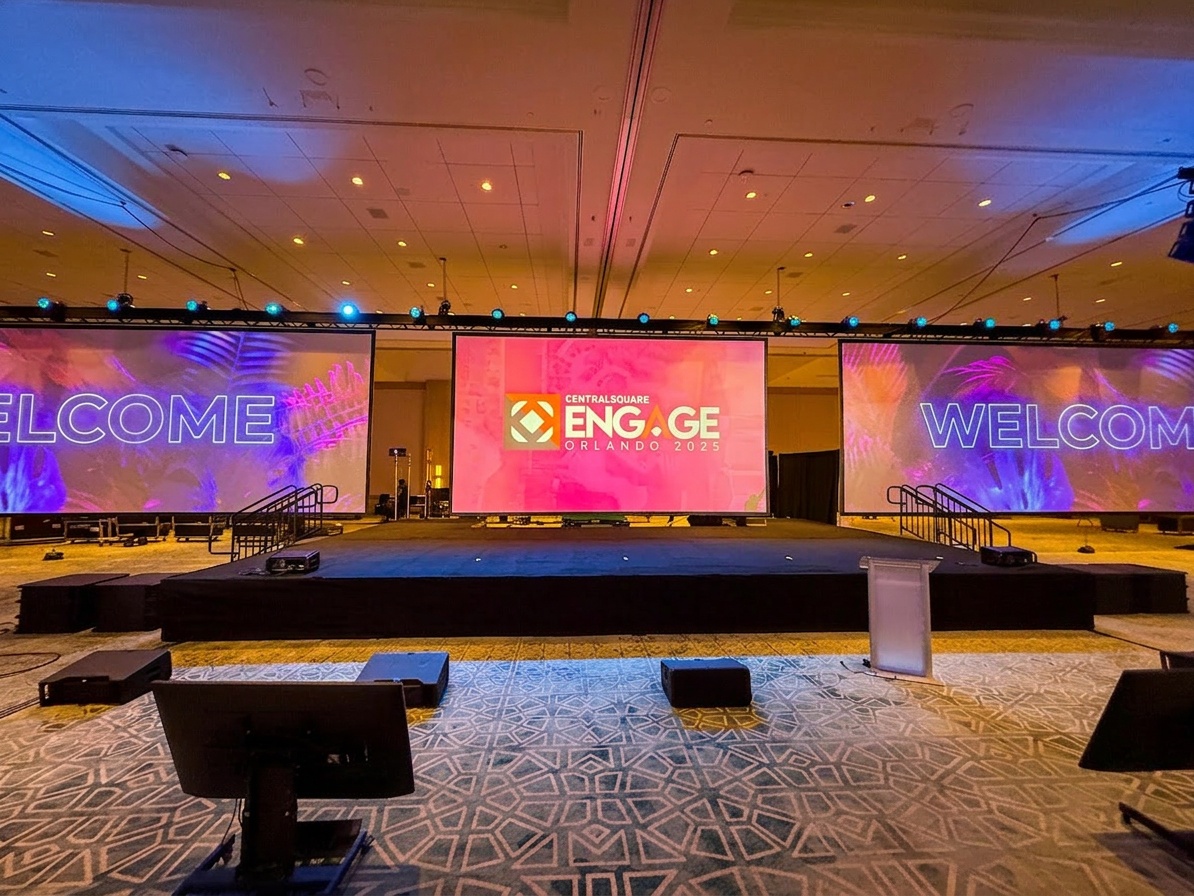
At our April 2026 install at the Gaylord Palms for a corporate speaking event, the AV vendor brought a 12×8 ft LED wall to sit upstage of a 24 ft wide speaking platform. Before that wall was positioned, our crew verified the load path and confirmed the stage’s distributed load rating could handle the panel stack without modification. That conversation happened before load-in, not during it.
How much power does an LED screen require, and does the venue need a dedicated circuit?
A 10×6 ft P3.91mm LED wall draws roughly 1,200-1,440 watts on average and can spike to approximately 2,880 watts peak, which works out to roughly 24 amps on a 120V circuit at maximum brightness.
Per-panel average power draw for P3.91mm cabinets runs approximately 60 watts, with a peak of 120 watts per panel, per LED Market USA. At the wall level, JYLED and IAMLEDWALL report average power consumption for P3.9 at approximately 220W/m², with peak consumption potentially reaching 800-900W/m² depending on brightness and content.
The practical rule: never share an LED wall’s circuit with stage lighting, audio amplifiers, or any other high-draw equipment. At Stages Plus, we route dedicated power drops during deck build so the AV vendor has a clean, labeled feed waiting when they arrive. Sharing that circuit is how you get brownouts mid-presentation.
As Lumina Event Lighting explains in their LED wall setup guide, an LED wall requires both electrical power and video signal routing in parallel. Power distribution must account for the total load of the display, and each panel connects to a power supply while also receiving video data through the processing chain.
For events that also include stage lighting packages and audio packages for staged events, we plan power budgets for each element independently from the start. An LED wall needs its own circuit allocation in the venue load plan before anything is plugged in.
What mounting options exist for LED walls on a rental stage?
The three standard mounting methods for LED walls on stages are floor-stack upstage, rear-truss flown, and goal-post truss flown. Each has different implications for stage deck load, rigging complexity, and sightlines.
As THOR-AV describes in their LED rigging guide, suspended LED displays are hung from stage trusses, wall-mounted displays are affixed to frames, and ground-stacked displays involve stacking panels on the ground with stabilizers or ladder-style frames to support the weight. Here is how those methods compare in practice for a Central Florida event:
| Mounting Method | Load on Stage Deck | Rigging Complexity | Sightline Impact | Wind Exposure Risk | Setup Time (Stages Plus crew estimate) | Typical Use Case |
|---|---|---|---|---|---|---|
| Floor-stack upstage | High (concentrated at base feet) | Low | Low if positioned correctly | Low (ground level) | Fastest (1-2 hrs) | Corporate keynotes, speaking events, indoor galas |
| Rear-truss flown | None directly on deck | High (requires rated truss and motors) | Minimal | Moderate-High (elevated height) | Longest (3-5 hrs) | Concerts, festivals, large outdoor productions |
| Goal-post truss flown | Transferred to truss base feet on deck | Moderate | Minimal | Higher (wide span) | Moderate (2-3 hrs) | Multi-day outdoor events, music festivals |
Wind exposure ratings assume a freestanding outdoor install. A venue enclosure or tent cover changes all three flown configurations to low risk.
For flown configurations, load path engineering becomes critical. Per New York Stage Production’s LED rigging safety guidance, anchor points must be verified to handle total wall weight plus dynamic factors, and structural load supports should be rated at a minimum of 1.5 times the screen weight as a safety baseline.
For most corporate and speaking events in the Orlando market, floor-stacking is the faster and more practical choice when the stage is deep enough to accommodate it.
What minimum stage depth do you need when adding a floor-stacked LED wall?
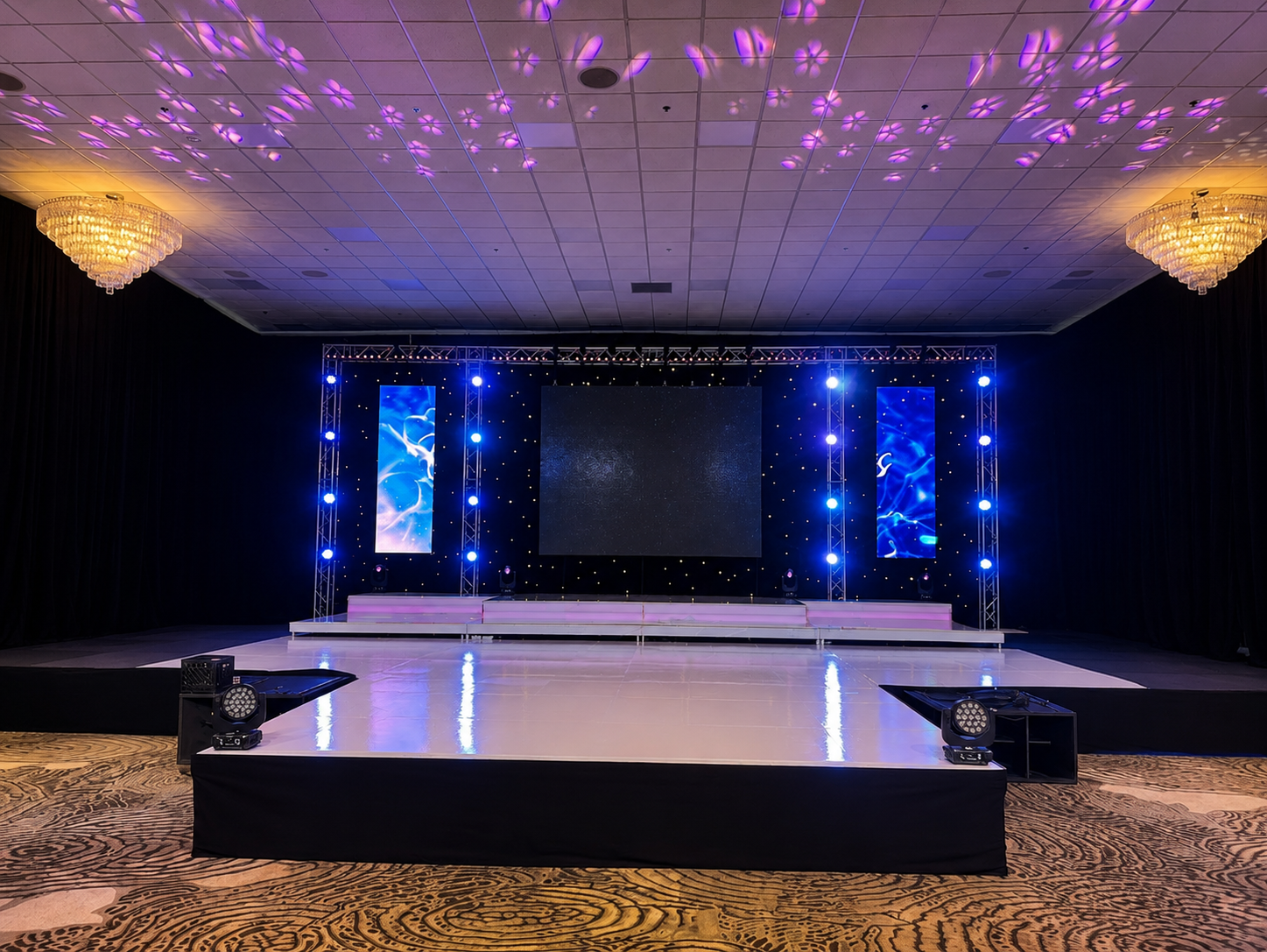
At Stages Plus, our minimum recommended stage depth when a floor-stacked LED wall is placed upstage of a presenter is 16 ft. Anything shallower and the screen starts eating into performer space.
That 16 ft figure comes from our crew’s operational experience across hundreds of installs, not a manufacturer spec sheet. Here is the math: a P3.91mm cabinet is 3 inches deep. The floor-stack frame adds additional depth behind that. Our crew allows 2-3 ft of clearance behind the stack for cable management and ventilation. Then count back from the screen face toward the front of the stage: a presenter needs 6-8 ft of working space minimum to move, use a podium, and stay visible to the audience.
Add those dimensions together on a 12 ft deep stage and the screen ends up too close to the presenter, compresses depth perception on camera, and creates a tip hazard if someone steps back without looking.
Our 16ft stage sizes are built with full-production setups in mind. If your event includes a floor-stacked LED screen, 16 ft of depth is the starting point, not an optional upgrade.
For our April 2026 install coordinating a speaking platform with multiple production elements on the same deck, depth planning was confirmed on the pre-load-in coordination call. Getting those dimensions locked before load-in day is what prevents redesigns at 7 a.m. on event morning.
Do outdoor LED walls require different specs for Florida events?
Outdoor LED walls for Florida events must run at a minimum of 5,000 nits to remain visible in direct sunlight. Unshaded stages facing south or west may require 6,000-8,000 nits, and all outdoor panels must carry IP65/IP54 weatherproofing ratings.
According to Linsn LED’s outdoor screen buying guide, outdoor LED screens run at 5,000 nits or above to stay visible in direct sunlight, compared to indoor screens at 800-1,500 nits. Sun Belt states including Florida require higher minimum brightness due to intense sunlight throughout the day, with LED Craft noting 6,000-8,000 nits as the recommended range for unshaded conditions. LEGIDATECH’s outdoor screen visibility guide confirms outdoor LED displays must meet IP65 (front) and IP54 (rear) ratings minimum to resist rain, dust, and UV exposure.
Florida’s heat also affects LED cabinet ventilation. Cabinets need airflow behind them. Pushing a floor-stack tight against a pipe-and-drape backdrop traps heat and can cause brightness throttling or panel shutdowns during a 6-8 hour outdoor event day. Build the ventilation gap into your depth calculation before load-in, not after the screen is already positioned.
What are the structural and permit requirements for rigged LED walls in Florida?
Flown LED walls on rental stages in Florida may require both an engineering review and a building permit, depending on structure size. Get both questions answered before the AV vendor schedules their rigging crew.
Under the 2023 Florida Building Code Section 3103, via UpCodes, temporary structures covering more than 120 square feet that will accommodate 10 or more persons cannot be erected without a permit from the building official. The code requires these structures to conform to structural strength, fire safety, means of egress, and other life-safety requirements.
For overhead rigging specifically, ANSI E1.21-2024, published by the Entertainment Services and Technology Association, is the current governing standard for temporary ground-supported structures at outdoor entertainment events. It covers custom temporary structures supporting performance platforms and establishes structural reliability and safety requirements for the design process, involving structural engineers, riggers, and production companies.
For any event where an LED wall will be flown above the stage rather than floor-stacked, we strongly recommend engaging a licensed structural engineer to verify the rigging plan, regardless of whether the venue or municipality requires a formal permit. That review protects everyone involved in the production.
The pre-load-in coordination checklist
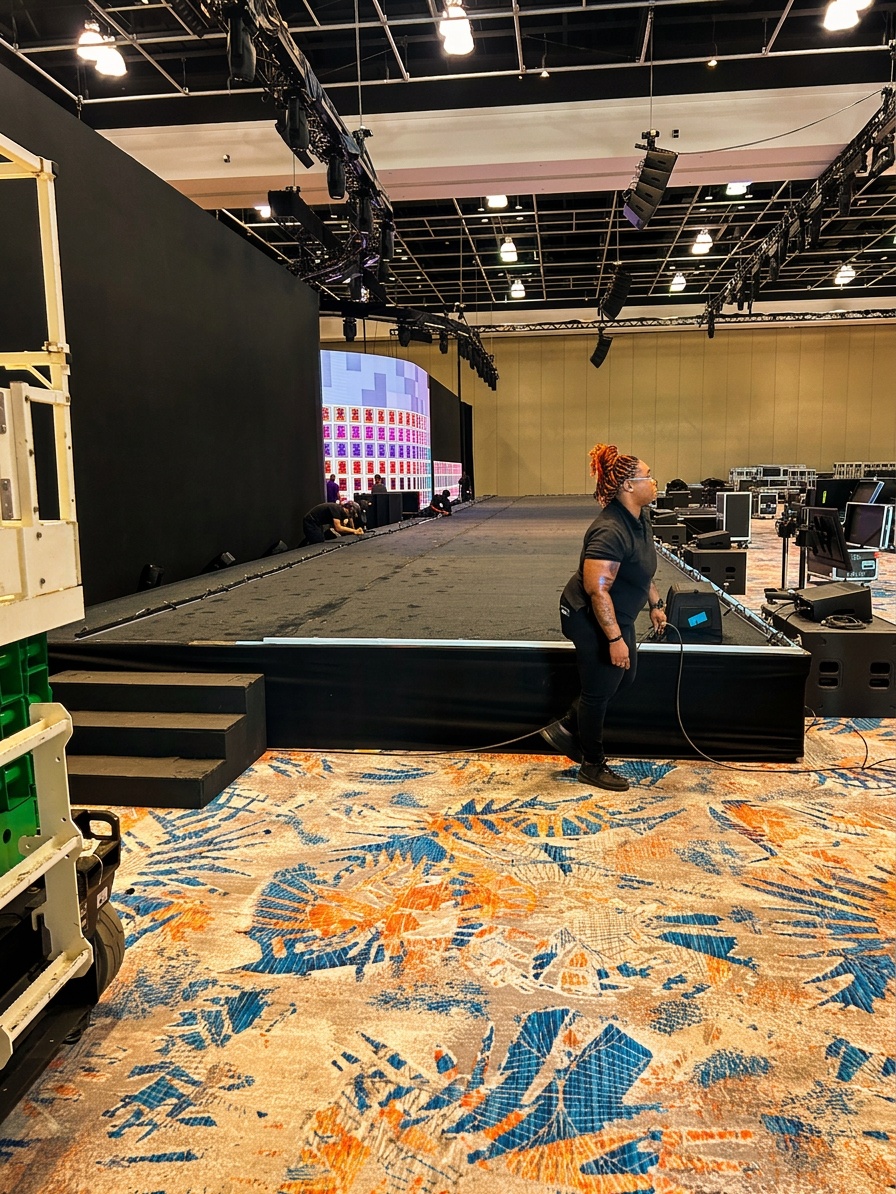
The most common source of LED wall problems on event day is a coordination gap between the stage rental company and the AV vendor. At Stages Plus, we work through a standard checklist before any combined stage-and-screen install.
Here is the checklist our crew uses:
- Confirm stage dimensions and deck load rating with the AV vendor at least one week out. Share the specific distributed load rating for the deck model being delivered.
- Establish a power plan. The AV vendor provides total amperage draw for their screen. We identify dedicated circuit placement and route power drops during deck build so cables are managed before panels arrive.
- Agree on sequencing. The stage deck must be locked, leveled, and fully assembled before any LED floor-stack is positioned on it. Placing panels on a partially assembled deck creates both a tip risk and a load-path problem.
- Walk the cable route. Every cable crossing a walking surface must be covered with a cable ramp or protective sleeve. Cable management is a trip-hazard compliance issue and should be treated as one from the start.
- Confirm LED arrival time relative to stage build. For our standard installs, the stage deck is complete 60-90 minutes before the AV vendor positions floor-stacked panels. This gives our crew time to clear the deck and verify level before the screen comes in.
- For outdoor installs, verify brightness and IP specs against the venue orientation. If the stage faces west and the event runs through sunset, the AV vendor needs that information early enough to spec the right panels.
For events that combine screens with full production audio, our concert stage rental configurations are designed with these coordination requirements built into the delivery and setup sequence.
Frequently asked questions
How far from the stage edge should a floor-stacked LED wall sit to avoid blocking sightlines?
The screen face should sit at least 8-10 ft from the downstage edge when presenters are working in front of it. That distance gives performers adequate working space, keeps the screen from intruding on front-row sightlines, and respects the minimum optimal viewing distance for P3.91mm panels (8-15 ft) from the nearest seated audience members.
Does Florida heat affect LED panel performance?
Yes. Florida summer heat combined with direct sun can push LED cabinet temperatures toward their operating threshold during long event days. Outdoor floor-stacks need rear ventilation clearance built into the stage layout. Cabinets pushed tight against a pipe-and-drape backdrop trap heat and can cause brightness throttling or panel shutdowns. Factor that clearance into your stage depth planning before load-in.
What stage sizes and configurations work best for common LED wall aspect ratios?
A 16:9 landscape wall pairs naturally with a 24-32 ft wide stage, where the screen spans the upstage area without overhanging the sides. Portrait column configurations work well flanking a center podium on a narrower 16-20 ft stage. Share your stage width with the AV vendor early so they build the wall to fit the deck proportions, rather than discovering a sizing conflict on load-in morning.
When does a flown LED wall require a structural engineer review in Florida?
Any LED wall flown above a stage on a temporary truss structure should have a structural engineer review the rigging plan, regardless of whether the local building official requires a formal permit. Florida Building Code Section 3103 triggers a permit requirement at 120 sq ft of covered structure accommodating 10 or more persons. ANSI E1.21-2024 is the governing industry standard for the rigging design itself.
How early does the LED screen need to arrive relative to stage build?
In our operational experience at Stages Plus, the LED floor-stack should arrive no earlier than 60-90 minutes after stage build is complete. The deck needs to be locked, leveled, and cleared before panels are positioned on it. Sending the AV vendor in while the stage crew is still assembling creates safety and alignment problems that take longer to correct than the time saved by overlapping the two crews.
Planning an event with an LED video wall in the Orlando area? When you request a quote, share your screen dimensions, venue name, and whether the install is indoor or outdoor. Our team at Stages Plus will confirm stage depth, power routing, and load capacity before load-in day so there are no surprises on event morning. Request a quote at Stages Plus and we will work through the coordination checklist with you from the start.