Orlando Stage Rental

Bands, Runways, Speaking Engagements, Award Ceremonies, Schools

Call Now! 407-442-0254

  • About
    • Blog
  • Pricing
  • Packages
    • Audio Packages
    • Stage Lighting
  • Contact
  • Reserve
  • Stage Sizes
    • 8ft Stage Sizes
    • 12ft Stage Sizes
    • 16ft Stage Sizes
    • 20ft Stage Sizes
    • 24ft Stage Sizes
  • Stage Rentals
    • Speaking Stage Rental
    • Single Performer Stage Rental
    • Concert Stage Rental
    • Round Stage Rental
    • Performance Staging Rental
    • Graduation Stage Rental
    • Wedding Stages
  • Runway
  • Pipe / Drape
  • Audience Riser
  • Pool Cover
  • Tent Floor
  • Camera Riser
  • Stage Accessories
    • Stair Rental
    • Ramp Rental
    • Dancefloor Rentals
    • Barricade Crowd Control Rental
    • Podium Rental

Stage Lighting Packages Explained: Choosing the Right Setup for Your Orlando Event

August 17, 2026 by ravivziv@gmail.com

On this page

  • Stage lighting rental Orlando packages come in three tiers
  • Wash lighting vs spotlight vs uplighting
  • Stage lighting tiers scale by complexity, not just fixture count
  • Matching lighting fixtures to stage size and event type
  • Outdoor Orlando lighting needs different electrical planning than indoor venues
  • Booking lighting alongside your stage and audio
  • Frequently asked questions

Stage lighting rental Orlando packages come in three tiers

At our Winter Park warehouse, we keep three ready-to-deploy lighting tiers in stock, and our crews can typically turn a standard wash-lighting package around within 48 hours of booking for Orlando-area events.

That timing matters because plenty of clients book a stage weeks out and only think about lighting the week before. Since we stock all three tiers instead of special-ordering fixtures per job, we can usually accommodate that without pushing the event date.

warehouse shelving with stacked stage lighting fixtures and cable spools, Winter Park

Wash lighting vs spotlight vs uplighting

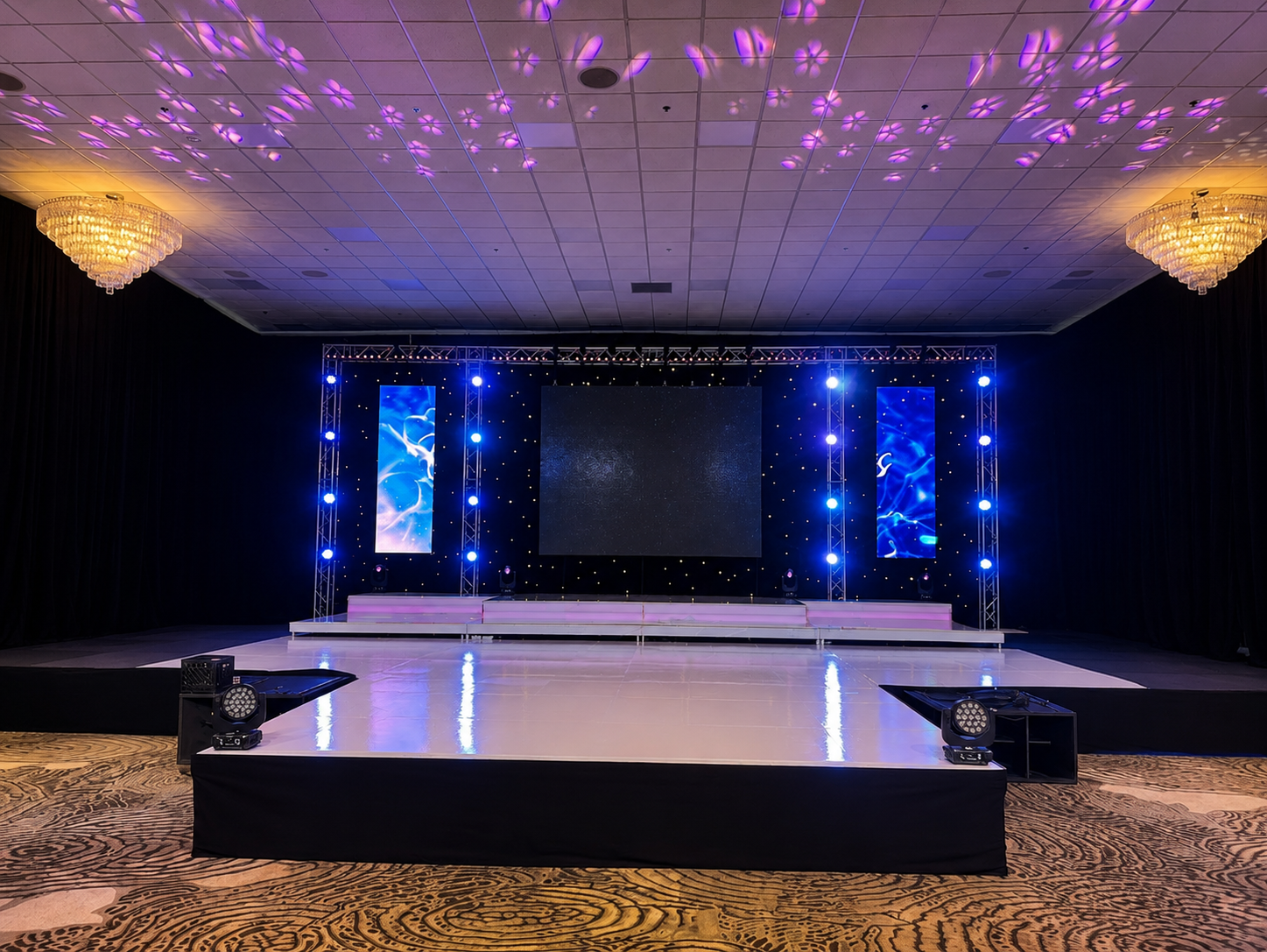
Wash lighting, spotlights, and uplighting solve three different problems, and most events need at least two of the three working together. Wash lighting is broad, even light thrown across the entire stage so performers, speakers, and presentation screens are visible without harsh shadows. It's the baseline for nearly every stage we set up, from a graduation stage to a concert deck.

Spotlights isolate a single point: a soloist, a bride and groom during a first dance, an award recipient walking up. They're directional and controlled, usually run by an operator or preset to a fixed mark. Uplighting works differently: fixtures placed at floor level around the perimeter of a tent, ballroom, or stage skirting, washing color up walls, columns, or drape to set mood rather than illuminate performers.

A wedding reception often uses all three: wash for the head table and stage, a spot for key moments, uplighting around the room for atmosphere. We build this combination often, the setup featured on our Wedding Stages page. A corporate keynote usually only needs wash plus a single spot on the podium. A concert leans hardest on wash and moving spotlights, with uplighting reserved for the DJ booth or backdrop. Choosing the right combination is exactly what our Stage Lighting team walks through with clients before quoting.

Stage lighting tiers scale by complexity, not just fixture count

The three lighting tiers we run scale by how much control, staffing, and hardware a show needs, not by a single price point. Essential Wash is the simplest tier: fixed fixtures aimed to cover a stage or podium evenly, no operator required for most events. It's what we recommend for a straightforward speaking stage or small ceremony.

Performance tier steps up in complexity. It adds dedicated spotlights, color mixing, and usually a basic operator or preset cue sequence, which is why we build it most often for weddings and DJ-driven receptions. Full Production goes further still: moving head fixtures that pan and tilt on their own, haze for visible beams, and a full lighting board run live by a technician throughout the show. That's the tier we bring for concerts, dance competitions, and galas where the lighting itself is part of the performance.

Because every event's stage width, run time, and programming needs are different, the exact scope (and the resulting quote) varies more than a flat price list can capture. Our Orlando Stage Rental Pricing Guide walks through the variables that move a quote up or down across stage and equipment rentals, lighting included.

Matching lighting fixtures to stage size and event type

Fixture count should scale with stage footprint and event type, not just budget. A small speaking stage might only need a handful of wash fixtures to cover the podium and presentation area cleanly. A wide concert or dance-competition stage needs enough fixtures to cover the full width evenly, without dark edges once a full band or dance line spreads out.

For a wedding, that typically means wash lighting on the stage plus uplighting scattered around the tent or ballroom perimeter, scaled to room size. A corporate keynote or award ceremony usually needs far fewer fixtures, just enough wash and spot coverage to light the stage and podium clearly, which pairs well with our Speaking Stage Rental setups. A concert or dance competition needs the most: wash across the full stage width, moving spots tracking performers, and often haze to make beams visible from the audience, the kind of build we quote regularly through our Concert Stage Rental page.

The most common mistake we see is planners either under-lighting a wide stage or over-lighting a small one with more moving fixtures than the space or budget can support. Matching fixture count to actual stage width, not just event size, is the fix, and it's the same logic we walk through on our How to Choose the Right Stage Size for Your Orlando Event guide.

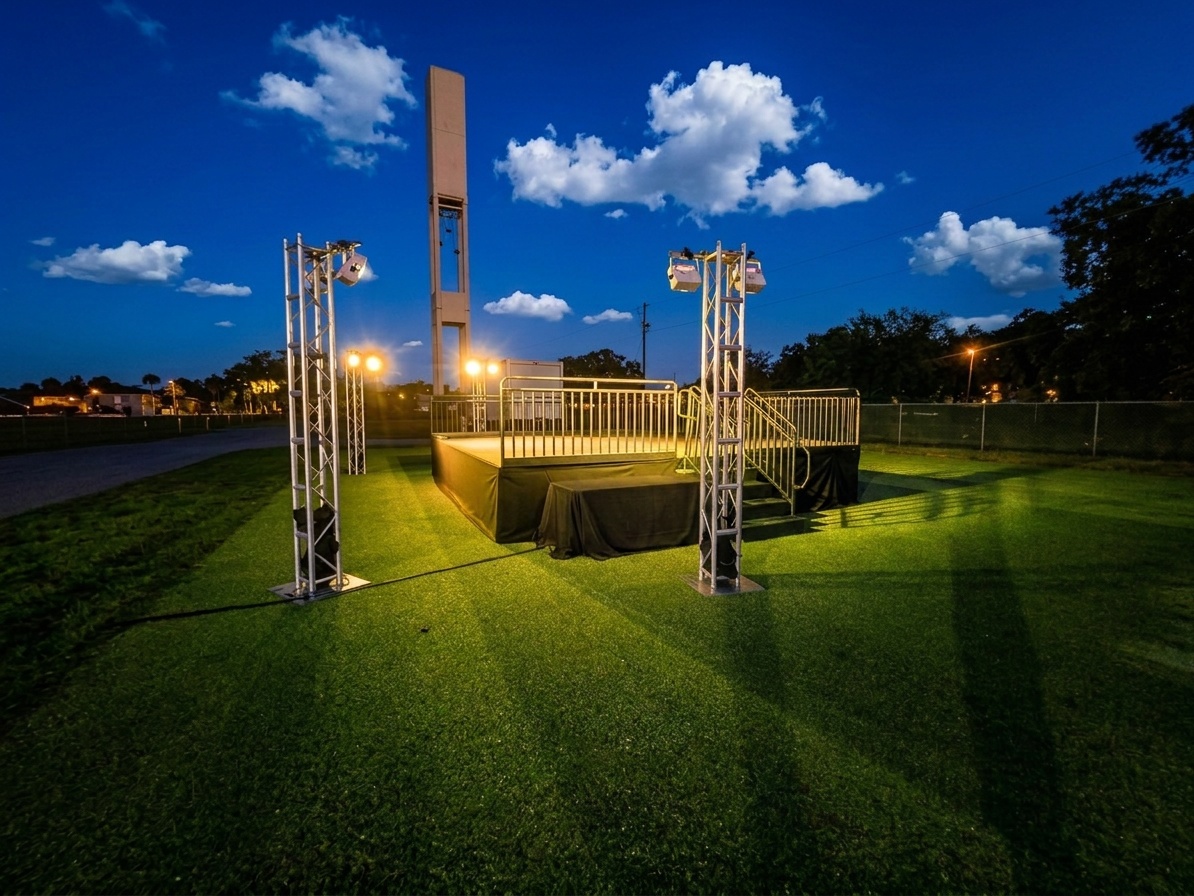
moving head lighting fixtures on truss above an outdoor stage at dusk

Outdoor Orlando lighting needs different electrical planning than indoor venues

Outdoor Orlando events require GFCI-protected temporary power circuits and a rain contingency plan that indoor venues simply don't need.

Temporary event electrical installations fall under NEC Article 590, which requires ground-fault circuit-interrupter protection for portable, personnel-used receptacles up to 30 amps and 125 volts, according to NSS Ltd's breakdown of NEC 590.6.

That's the baseline for any stage lighting we run on generator or temporary power outdoors, whether it's a single evening reception or a longer multi-day setup.

Rain is the other Florida-specific variable.

Orlando's wettest months are June and August, with June averaging 8.0 inches of rain and August seeing a 55.4 percent chance of rain on any given day, according to ExtremeWeatherWatch.

Those storms tend to hit as sudden afternoon downpours rather than steady all-day rain. For outdoor events during rainy season, we typically plan for rated, weatherproof fixtures and a covered rig rather than assuming the sky will stay clear through an evening reception. Our team covers the electrical side of this in more depth in the Stage Lighting Safety Guide, which pairs well with this post if you're planning anything outdoors.

Booking lighting alongside your stage and audio

Lighting can be booked as its own line item or bundled with your stage and audio order, and bundling it simplifies power planning since one crew handles the whole electrical footprint.

We recommend booking lighting at the same time you reserve your stage, ideally three to four weeks out for standard events and further ahead for anything during peak wedding or festival season. Because we keep all three lighting tiers in stock at our Winter Park warehouse, last-minute additions are usually possible. Early booking still gives our crew time to plan power distribution correctly, rather than running lighting off whatever circuit happens to be nearest the stage.

Pairing lighting with sound matters technically, not just logistically. Both draw power and often share the same truss or rigging points, and each needs to go up before drape or backdrop is installed. Our Audio Packages page details what's included on the sound side, and our guide to Sound System Integration with Rental Stages walks through how the two systems work together on one stage build.

crew running cable and rigging truss lighting above a stage before an event

Frequently asked questions

What's the difference between wash lighting, spotlights, and uplighting?

Wash lighting evenly illuminates the whole stage, spotlights isolate a single performer or speaker, and uplighting places color fixtures at floor level around a room's perimeter for ambiance. Most events, especially weddings, use a combination of all three rather than relying on just one type.

How does a basic package differ from a premium package?

Essential Wash covers a stage with fixed, even lighting and no operator needed. Performance adds spotlights, color, and light programming. Full Production brings moving heads, haze, and a technician running the board live. The right tier depends on stage size and how central lighting is to the show, so we quote each one based on your specific setup rather than a flat menu.

What lighting package fits a wedding versus a corporate event versus a concert?

Weddings typically need Performance-tier lighting: wash plus uplighting and a spotlight for key moments. Corporate events usually only need Essential Wash on the stage and podium. Concerts and dance competitions need Full Production, with moving spots and haze for beam visibility across a wider stage.

Do outdoor Orlando events need different lighting than indoor venues?

Yes. Outdoor events require GFCI-protected temporary power under NEC Article 590 and weatherproof or rain-rated fixtures, especially during Orlando's June and August rainy stretch when afternoon storms are common. Indoor venues can typically run standard fixtures off existing building power.

Can lighting be combined with an audio package, or is it always separate?

Lighting and audio can be booked together or as separate line items. We recommend bundling them when possible since both systems often share truss, rigging, and power circuits, which simplifies setup and reduces the chance of an electrical conflict on site.

Picking the right stage lighting rental in Orlando comes down to matching tier to event: Essential Wash for a simple speaking stage, Performance for a wedding or DJ set, Full Production for a concert or gala. If you're not sure which fits your stage size and needs, run your numbers through our Stage Size Calculator or reach out and our team will match lighting to your stage, venue, and timeline before you commit to a package.

Filed Under: Audio Visual Solutions, Blog

Projection mapping on rental stages: throw distance, surface choice, and real budget numbers

August 13, 2026 by admin

Projection mapping on a rental stage uses one or more calibrated projectors to turn a flat or dimensional surface, a drape panel, a backdrop wall, or a 3D set piece, into a moving visual canvas instead of a static backdrop. It differs from an LED screen because it adds no extra hardware to the stage itself, just calibrated light. At Stages Plus, we size the stage depth and surface together from the first planning call so the projection actually works on show day.

On this page

  • Projection mapping versus LED screens and traditional backdrops
  • The best stage surfaces for projection mapping
  • Throw distance and stage depth for projection mapping
  • Combining projection mapping with drape, LED, and stage lighting
  • Projection mapping outdoors in Florida daylight and humidity
  • Common mistakes that ruin an outdoor projection mapping setup
  • Budget planning for projection mapping on a rental stage
  • Frequently asked questions
  • Conclusion

Key takeaways

  • Projection mapping transforms any flat or curved surface into a moving visual display using calibrated light instead of screen hardware.
  • Matte, light-colored, flat surfaces produce the sharpest mapped image. Glossy or textured surfaces scatter light and distort visuals.
  • On a 24ft-deep concert stage, our crew reserves 12-14ft of rear throw space to fill a 20ft-wide mapping surface without hotspotting.
  • Daytime outdoor mapping needs at least 2,500 to 4,000 lumens, and large 16ft+ wide screens need 6,000+ ANSI lumens to stay visible in Florida sun.
  • Small stage-backdrop mapping typically runs $5,000-$15,000, while single-projector setups start around $1,000-$1,850 per day.

Projection mapping versus LED screens and traditional backdrops

Projection mapping uses light and software calibration to make a physical surface display moving visuals, while an LED screen is a physical panel that generates its own light. With projection mapping, an AV crew points a calibrated projector at a stage backdrop, a drape wall, or a dimensional set piece, and the software warps the image to match the surface’s exact contours. There’s nothing to rig, no panel weight to support on the stage deck, and no seams between tiles.

That’s the biggest practical difference for a rental stage. An LED wall adds load weight and rigging points that factor into our stage engineering. Projection mapping adds a projector position and a throw-distance requirement instead. Both can look great, and both can run on the same stage, but they solve different problems.

If a client wants a hard-edged, bright, always-visible video wall regardless of ambient light, our LED screen integration with rental stages guide covers that route in detail. If they want a surface that seems to bend, glow, or come alive in ways a flat screen can’t, projection mapping is the tool that gets there. For clients still deciding on overall footprint, our Stage Size Calculator is a useful starting point before we get into projector-specific math.

The best stage surfaces for projection mapping

Flat, matte, light-colored surfaces produce the cleanest projection-mapped image, while glossy, transparent, or heavily textured surfaces scatter light and blur the visual. Textured walls need extra calibration time to avoid warping the image, which is why most AV crews steer clients toward a matte finish whenever the surface is a design choice rather than a fixed structure.

This is exactly why our matte-white pipe and drape backdrops for Orlando stages have become one of our go-to low-cost mapping surfaces. A properly tensioned, wrinkle-free panel gives a projector a flat, evenly lit canvas without the cost of a dedicated projection screen rental. We’ve used this exact setup on stage backdrops where a client wanted a mapped visual effect but didn’t have the budget for a full architectural projection package.

Curved or built set pieces work too, but they need real calibration time on site, not a plug-and-play file. If your design calls for mapping a 3D structure, columns, arches, or a stepped set piece, budget more setup hours than you would for a single flat panel, since every plane on the structure needs its own alignment pass.

Throw distance and stage depth for projection mapping

Throw distance is one of the biggest factors in deciding how deep your stage needs to be. The most common projector throw ratio is 2.0, meaning for every foot of image width, the projector needs 2 feet of throw distance, so a 20-foot-wide mapping surface needs roughly 40 feet of throw with a standard-throw projector, per ProjectorCentral’s projection calculator. Short-throw units bring that ratio down closer to 0.4-1.0, and ultra-short-throw models can sit just inches from the surface.

This is where our own build math comes in. On a 24ft-deep concert stage, our crew’s rule of thumb is to reserve a minimum of 12-14ft of rear throw space for a standard short-throw projector to fill a 20ft-wide mapping surface without hotspotting or dim edges. That’s not a manufacturer spec sheet number, it’s a working figure we’ve validated across our own Central Florida stage inventory over repeated builds. If a client’s mapping design calls for a wider surface or a longer throw, we typically move them up to a larger stage footprint, like our concert stage rental options that offer deeper rear zones for AV gear.

Front projection changes this math again, since the projector sits in the audience’s sightline path rather than behind the surface. That usually means a raised truss position instead of extra stage depth, a call we make together with the AV crew during the site walk.

Combining projection mapping with drape, LED, and stage lighting

Projection mapping does not replace pipe and drape, LED screens, or stage lighting. It layers on top of them, and most of our AV-forward builds use two or three of these together. A matte-white drape wall can serve as both a mapping surface and a clean sightline block for backstage areas. An LED screen can anchor the center of a stage while mapped visuals wrap the surrounding drape or set pieces around it. Stage lighting still handles performer visibility and mood, since a projector is calibrated for the backdrop, not the people standing in front of it.

Sequencing matters more than most planners expect. Our stage lighting safety guide covers why stage wash needs to stay off the mapped surface itself, since spill light washes out a projected image fast. Audio placement matters too. If a subwoofer sits where the drape surface needs to stay taut and flat, vibration can ripple the fabric and blur the projection, so we plan audio and mapping surface positions together rather than as separate decisions. Our sound system integration guide for Orlando stages walks through the same coordination process for audio gear on a working stage, and our Audio Packages page lists the equipment tiers we typically pair with an AV-forward build like this.

Projection mapping outdoors in Florida daylight and humidity

Projection mapping works outdoors, but daylight and Florida humidity both put real limits on it that indoor-focused guides rarely mention. Ambient light is the biggest technical risk outdoors. Projection mapping thrives in controlled lighting, so projector placement and a flat, matte surface matter even more once the sun is up. Industry guidance recommends at least 2,500 to 4,000 lumens for visibility in daytime outdoor conditions, and any mapped screen wider than 16 feet needs at least 6,000 ANSI lumens to stay visible, according to Valerion’s outdoor lumens guide. That’s why most of our clients booking outdoor daytime mapping either scale down the visual scope or shift the reveal to dusk and evening.

Humidity is the other Florida-specific hazard most planners outside this market never account for. Condensation risk rises sharply once relative humidity climbs above 70% and the temperature swing exceeds 12-15°F, a combination that’s common on a Central Florida summer evening as the sun goes down, according to XGIMI’s guide on protecting projectors from dew and humidity. A fogged lens mid-show ruins the effect instantly, which is why we recommend a climate-controlled projector enclosure, not a basic tarp or plastic box, for any hot, humid evening booking. We coordinate this enclosure decision with our AV partners any time a stage build includes projection gear running through the night.

Common mistakes that ruin an outdoor projection mapping setup

Most outdoor projection mapping failures come down to three things: ambient light nobody planned for, humidity nobody protected against, and wind moving the surface itself. We saw all three risk factors come up during a run of builds in late June 2026, prepping stage decking and drape surfaces ahead of AV integration for private events around Central Florida. No single client’s story here, just a pattern that repeats every summer.

A drape panel used as a mapping surface is fabric, not a rigid screen, so it moves in even light. Any breeze off a nearby lake, an HVAC vent, or foot traffic backstage can shift the fabric enough to blur a mapped image that looked crisp in rehearsal. This is a lesson we’ve learned entirely on site, not from a manufacturer spec sheet: we now tension drape panels with additional weighted bases and check tautness one final time right before doors open, especially on outdoor builds near Central Florida’s afternoon storm winds. Skipping that last tautness check is the single most common reason a projection mapping reveal looks soft instead of sharp.

Budget planning for projection mapping on a rental stage

Adding projection mapping to a rental stage typically costs $1,000-$1,850 per day for a single-projector setup, while a full small stage-backdrop mapping package runs $5,000-$15,000 depending on surface size and how many projectors are blended together. The low end of that range usually covers a single projector on a flat matte drape surface with a straightforward content loop. The high end covers edge-blended setups with multiple projectors across a wider or dimensional surface, custom content creation, and on-site calibration time.

At Stages Plus, projection mapping is quoted alongside the stage build itself, not as an afterthought, because the surface size and throw distance directly affect which stage footprint we recommend. When a client calls us with a projection mapping idea, we ask about surface width and desired brightness before we ever talk stage dimensions, since those two numbers drive both the AV quote and the stage depth. Our Pricing page covers our general stage rental ranges, and our Packages page shows how AV add-ons like this typically bundle with a stage build.

Frequently asked questions

Does projection mapping work in daylight?

Yes, but with real limits. Daytime outdoor mapping needs at least 2,500-4,000 lumens to stay visible, and wide surfaces over 16 feet need 6,000+ ANSI lumens. Many clients scale down the design or move the reveal to dusk or evening, when ambient light drops and the mapped visuals read far more vividly.

How much does adding projection mapping to a stage rental cost?

Single-projector setups typically run $1,000-$1,850 per day, while a full small stage-backdrop mapping package runs $5,000-$15,000 depending on surface size, number of projectors, and content complexity. Larger or edge-blended, multi-projector designs land toward the higher end of that range.

How far in advance should we book a stage with projection mapping?

We recommend booking at least 4-6 weeks ahead for a stage build that includes projection mapping. That lead time gives our crew and AV partners room to confirm surface size, throw distance, and stage depth together, plus schedule a calibration pass before doors open on event day.

Can projection mapping work on a pipe and drape backdrop?

Yes, and it’s one of our most common low-cost mapping surfaces. A tensioned, wrinkle-free matte-white drape panel gives a projector a flat, evenly lit canvas without renting a dedicated projection screen. It does need extra wind and vibration precautions outdoors, since fabric moves more than a rigid screen.

What’s the difference between projection mapping and an LED wall?

Projection mapping uses calibrated light to display visuals on an existing surface, adding no extra hardware weight to the stage. An LED wall is a physical panel that generates its own light and adds rigging and load weight the stage has to support. Both can run on the same stage, but they solve different design problems.

Conclusion

Projection mapping can turn a simple stage backdrop into the most memorable part of an event, but it only works when the surface, throw distance, and Florida weather are planned together from day one. At Stages Plus, we build that planning into every quote so the visual effect actually holds up on show night. Ready to talk through your design? Reach out through our how to get a quote page and we’ll help you size the stage and the surface together.

Filed Under: Audio Visual Solutions, Blog

LED Screen Integration with Rental Stages: Technical Requirements and Setup

July 2, 2026 by admin

On this page

  • How much does an LED video wall weigh, and can a rental stage floor handle it?
  • How much power does an LED screen require, and does the venue need a dedicated circuit?
  • What mounting options exist for LED walls on a rental stage?
  • What minimum stage depth do you need when adding a floor-stacked LED wall?
  • Do outdoor LED walls require different specs for Florida events?
  • What are the structural and permit requirements for rigged LED walls in Florida?
  • The pre-load-in coordination checklist
  • Frequently asked questions

Key takeaways

  • A 10×6 ft wall of P3.91mm panels weighs 320-432 lbs before frames and cabling. Confirm the distributed load rating with your stage rental company before the AV vendor arrives.
  • Peak power draw for a 10×6 ft P3.9 wall reaches approximately 2,880W (roughly 24 amps at 120V). That circuit needs to be dedicated and labeled before panels arrive.
  • At Stages Plus, our operational standard for floor-stacked LED walls is a minimum 16 ft stage depth, keeping performers and the screen from competing for the same square footage.
  • The stage deck must be locked and level before any LED floor-stack is positioned on it. That sequencing rule protects both the panels and the load path.
  • Outdoor LED walls in Florida require at least 5,000 nits brightness and IP65/IP54 weatherproofing. Unshaded south- or west-facing stages may need 6,000-8,000 nits.

Adding an LED video wall to a rental stage requires coordinating four things before load-in day: confirming the stage deck’s distributed load rating handles panel weight, routing dedicated power circuits during deck build, selecting a mounting method that fits your depth and rigging constraints, and sequencing the AV vendor’s arrival after the deck is locked and level. Get those four items right and the integration is straightforward.

How much does an LED video wall weigh, and can a rental stage floor handle it?

A 10×6 ft LED wall built from P3.91mm panels weighs roughly 320-432 lbs of panel hardware alone, and that number climbs once you add frames, cabling, and any truss structure.

Individual P3.91mm indoor rental panels weigh approximately 18 lbs (8.16 kg) each, per LED Nation USA. A 10×6 ft wall requires roughly 20-24 of those 500x500mm cabinets, putting bare panel weight at 320-432 lbs. A large corporate-format LED wall at 12 meters wide by 5 meters tall can weigh 800 to 1,200 kilograms including trussing infrastructure, according to a Vocal Media production feature on corporate LED installs.

Standard rental stage decking is rated for distributed loads, not concentrated point loads. A floor-stacked LED wall transfers its weight through base frame feet onto a relatively small area of deck. Before Stages Plus delivers any stage that will host a floor-stacked screen, we confirm the deck’s distributed load rating accommodates the panel weight without requiring shims or additional blocking underneath.

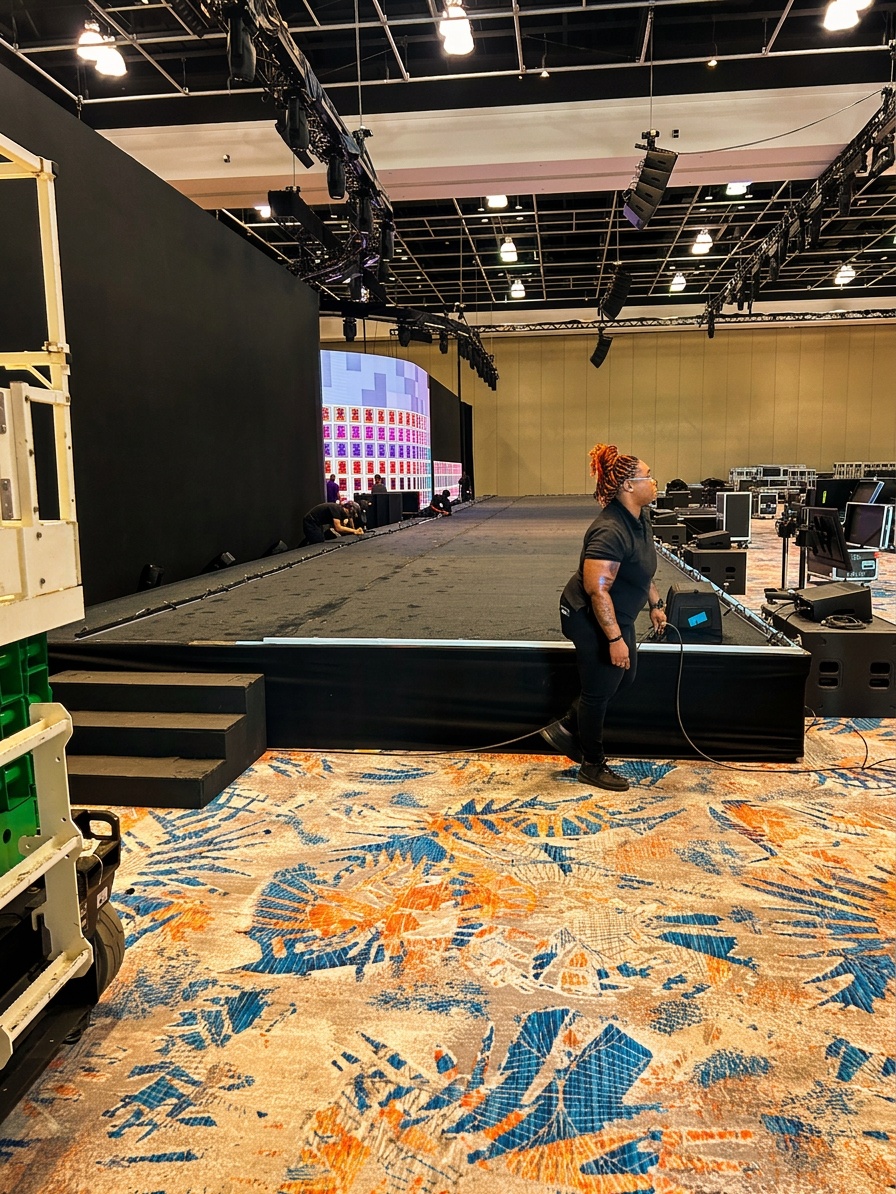
At our April 2026 install at the Gaylord Palms for a corporate speaking event, the AV vendor brought a 12×8 ft LED wall to sit upstage of a 24 ft wide speaking platform. Before that wall was positioned, our crew verified the load path and confirmed the stage’s distributed load rating could handle the panel stack without modification. That conversation happened before load-in, not during it.

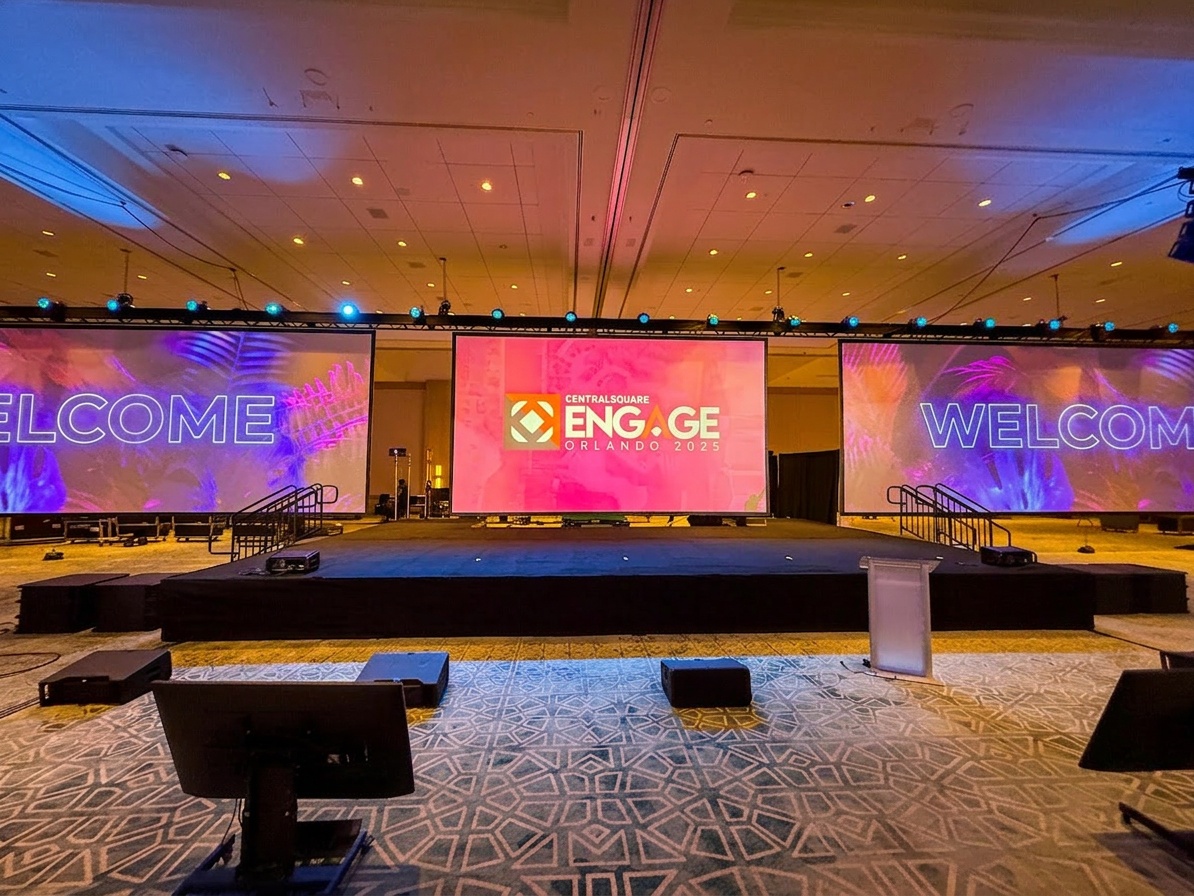
ENG.GE Orlando 2025 Conference Main Stage Setup

How much power does an LED screen require, and does the venue need a dedicated circuit?

A 10×6 ft P3.91mm LED wall draws roughly 1,200-1,440 watts on average and can spike to approximately 2,880 watts peak, which works out to roughly 24 amps on a 120V circuit at maximum brightness.

Per-panel average power draw for P3.91mm cabinets runs approximately 60 watts, with a peak of 120 watts per panel, per LED Market USA. At the wall level, JYLED and IAMLEDWALL report average power consumption for P3.9 at approximately 220W/m², with peak consumption potentially reaching 800-900W/m² depending on brightness and content.

The practical rule: never share an LED wall’s circuit with stage lighting, audio amplifiers, or any other high-draw equipment. At Stages Plus, we route dedicated power drops during deck build so the AV vendor has a clean, labeled feed waiting when they arrive. Sharing that circuit is how you get brownouts mid-presentation.

As Lumina Event Lighting explains in their LED wall setup guide, an LED wall requires both electrical power and video signal routing in parallel. Power distribution must account for the total load of the display, and each panel connects to a power supply while also receiving video data through the processing chain.

For events that also include stage lighting packages and audio packages for staged events, we plan power budgets for each element independently from the start. An LED wall needs its own circuit allocation in the venue load plan before anything is plugged in.

What mounting options exist for LED walls on a rental stage?

The three standard mounting methods for LED walls on stages are floor-stack upstage, rear-truss flown, and goal-post truss flown. Each has different implications for stage deck load, rigging complexity, and sightlines.

As THOR-AV describes in their LED rigging guide, suspended LED displays are hung from stage trusses, wall-mounted displays are affixed to frames, and ground-stacked displays involve stacking panels on the ground with stabilizers or ladder-style frames to support the weight. Here is how those methods compare in practice for a Central Florida event:

Mounting MethodLoad on Stage DeckRigging ComplexitySightline ImpactWind Exposure RiskSetup Time (Stages Plus crew estimate)Typical Use Case
Floor-stack upstageHigh (concentrated at base feet)LowLow if positioned correctlyLow (ground level)Fastest (1-2 hrs)Corporate keynotes, speaking events, indoor galas
Rear-truss flownNone directly on deckHigh (requires rated truss and motors)MinimalModerate-High (elevated height)Longest (3-5 hrs)Concerts, festivals, large outdoor productions
Goal-post truss flownTransferred to truss base feet on deckModerateMinimalHigher (wide span)Moderate (2-3 hrs)Multi-day outdoor events, music festivals

Wind exposure ratings assume a freestanding outdoor install. A venue enclosure or tent cover changes all three flown configurations to low risk.

For flown configurations, load path engineering becomes critical. Per New York Stage Production’s LED rigging safety guidance, anchor points must be verified to handle total wall weight plus dynamic factors, and structural load supports should be rated at a minimum of 1.5 times the screen weight as a safety baseline.

For most corporate and speaking events in the Orlando market, floor-stacking is the faster and more practical choice when the stage is deep enough to accommodate it.

big

What minimum stage depth do you need when adding a floor-stacked LED wall?

At Stages Plus, our minimum recommended stage depth when a floor-stacked LED wall is placed upstage of a presenter is 16 ft. Anything shallower and the screen starts eating into performer space.

That 16 ft figure comes from our crew’s operational experience across hundreds of installs, not a manufacturer spec sheet. Here is the math: a P3.91mm cabinet is 3 inches deep. The floor-stack frame adds additional depth behind that. Our crew allows 2-3 ft of clearance behind the stack for cable management and ventilation. Then count back from the screen face toward the front of the stage: a presenter needs 6-8 ft of working space minimum to move, use a podium, and stay visible to the audience.

Add those dimensions together on a 12 ft deep stage and the screen ends up too close to the presenter, compresses depth perception on camera, and creates a tip hazard if someone steps back without looking.

Our 16ft stage sizes are built with full-production setups in mind. If your event includes a floor-stacked LED screen, 16 ft of depth is the starting point, not an optional upgrade.

For our April 2026 install coordinating a speaking platform with multiple production elements on the same deck, depth planning was confirmed on the pre-load-in coordination call. Getting those dimensions locked before load-in day is what prevents redesigns at 7 a.m. on event morning.

Do outdoor LED walls require different specs for Florida events?

Outdoor LED walls for Florida events must run at a minimum of 5,000 nits to remain visible in direct sunlight. Unshaded stages facing south or west may require 6,000-8,000 nits, and all outdoor panels must carry IP65/IP54 weatherproofing ratings.

According to Linsn LED’s outdoor screen buying guide, outdoor LED screens run at 5,000 nits or above to stay visible in direct sunlight, compared to indoor screens at 800-1,500 nits. Sun Belt states including Florida require higher minimum brightness due to intense sunlight throughout the day, with LED Craft noting 6,000-8,000 nits as the recommended range for unshaded conditions. LEGIDATECH’s outdoor screen visibility guide confirms outdoor LED displays must meet IP65 (front) and IP54 (rear) ratings minimum to resist rain, dust, and UV exposure.

Florida’s heat also affects LED cabinet ventilation. Cabinets need airflow behind them. Pushing a floor-stack tight against a pipe-and-drape backdrop traps heat and can cause brightness throttling or panel shutdowns during a 6-8 hour outdoor event day. Build the ventilation gap into your depth calculation before load-in, not after the screen is already positioned.

What are the structural and permit requirements for rigged LED walls in Florida?

Flown LED walls on rental stages in Florida may require both an engineering review and a building permit, depending on structure size. Get both questions answered before the AV vendor schedules their rigging crew.

Under the 2023 Florida Building Code Section 3103, via UpCodes, temporary structures covering more than 120 square feet that will accommodate 10 or more persons cannot be erected without a permit from the building official. The code requires these structures to conform to structural strength, fire safety, means of egress, and other life-safety requirements.

For overhead rigging specifically, ANSI E1.21-2024, published by the Entertainment Services and Technology Association, is the current governing standard for temporary ground-supported structures at outdoor entertainment events. It covers custom temporary structures supporting performance platforms and establishes structural reliability and safety requirements for the design process, involving structural engineers, riggers, and production companies.

For any event where an LED wall will be flown above the stage rather than floor-stacked, we strongly recommend engaging a licensed structural engineer to verify the rigging plan, regardless of whether the venue or municipality requires a formal permit. That review protects everyone involved in the production.

The pre-load-in coordination checklist

The most common source of LED wall problems on event day is a coordination gap between the stage rental company and the AV vendor. At Stages Plus, we work through a standard checklist before any combined stage-and-screen install.

Here is the checklist our crew uses:

  1. Confirm stage dimensions and deck load rating with the AV vendor at least one week out. Share the specific distributed load rating for the deck model being delivered.
  2. Establish a power plan. The AV vendor provides total amperage draw for their screen. We identify dedicated circuit placement and route power drops during deck build so cables are managed before panels arrive.
  3. Agree on sequencing. The stage deck must be locked, leveled, and fully assembled before any LED floor-stack is positioned on it. Placing panels on a partially assembled deck creates both a tip risk and a load-path problem.
  4. Walk the cable route. Every cable crossing a walking surface must be covered with a cable ramp or protective sleeve. Cable management is a trip-hazard compliance issue and should be treated as one from the start.
  5. Confirm LED arrival time relative to stage build. For our standard installs, the stage deck is complete 60-90 minutes before the AV vendor positions floor-stacked panels. This gives our crew time to clear the deck and verify level before the screen comes in.
  6. For outdoor installs, verify brightness and IP specs against the venue orientation. If the stage faces west and the event runs through sunset, the AV vendor needs that information early enough to spec the right panels.

For events that combine screens with full production audio, our concert stage rental configurations are designed with these coordination requirements built into the delivery and setup sequence.

speaking stage setup at Gaylord Palms with LED wall positioned upstage of a 24ft wide platform, April 2026

Frequently asked questions

How far from the stage edge should a floor-stacked LED wall sit to avoid blocking sightlines?

The screen face should sit at least 8-10 ft from the downstage edge when presenters are working in front of it. That distance gives performers adequate working space, keeps the screen from intruding on front-row sightlines, and respects the minimum optimal viewing distance for P3.91mm panels (8-15 ft) from the nearest seated audience members.

Does Florida heat affect LED panel performance?

Yes. Florida summer heat combined with direct sun can push LED cabinet temperatures toward their operating threshold during long event days. Outdoor floor-stacks need rear ventilation clearance built into the stage layout. Cabinets pushed tight against a pipe-and-drape backdrop trap heat and can cause brightness throttling or panel shutdowns. Factor that clearance into your stage depth planning before load-in.

What stage sizes and configurations work best for common LED wall aspect ratios?

A 16:9 landscape wall pairs naturally with a 24-32 ft wide stage, where the screen spans the upstage area without overhanging the sides. Portrait column configurations work well flanking a center podium on a narrower 16-20 ft stage. Share your stage width with the AV vendor early so they build the wall to fit the deck proportions, rather than discovering a sizing conflict on load-in morning.

When does a flown LED wall require a structural engineer review in Florida?

Any LED wall flown above a stage on a temporary truss structure should have a structural engineer review the rigging plan, regardless of whether the local building official requires a formal permit. Florida Building Code Section 3103 triggers a permit requirement at 120 sq ft of covered structure accommodating 10 or more persons. ANSI E1.21-2024 is the governing industry standard for the rigging design itself.

How early does the LED screen need to arrive relative to stage build?

In our operational experience at Stages Plus, the LED floor-stack should arrive no earlier than 60-90 minutes after stage build is complete. The deck needs to be locked, leveled, and cleared before panels are positioned on it. Sending the AV vendor in while the stage crew is still assembling creates safety and alignment problems that take longer to correct than the time saved by overlapping the two crews.


Planning an event with an LED video wall in the Orlando area? When you request a quote, share your screen dimensions, venue name, and whether the install is indoor or outdoor. Our team at Stages Plus will confirm stage depth, power routing, and load capacity before load-in day so there are no surprises on event morning. Request a quote at Stages Plus and we will work through the coordination checklist with you from the start.

Filed Under: Audio Visual Solutions, Blog

Get Quote / Contact

Popular Stage Sizes

  • 8ft Stage Sizes
  • 12ft Stage Sizes
  • 16ft Stage Sizes
  • 20ft Stage Sizes
  • 24ft Stage Sizes

Blog

  • Stage Lighting Packages Explained: Choosing the Right Setup for Your Orlando Event
  • Projection mapping on rental stages: throw distance, surface choice, and real budget numbers
  • Reception Band Stage Layout: Optimizing Music Performance Areas for Weddings

Search


Privacy Policy

Warehouse / Office

6848 Stapoint Ct.
Winter Park, FL 32792
407-442-0254

Located in the Eastpoint Industrial Park
Map

Delivery, Setup, Tear Down

Orlando, DeLand, Deltona, Kissimmee, Sanford, Altamonte Springs, Apopka, Ocoee, Oviedo, St. Cloud, Winter Garden, Winter Park, Winter Springs, Titusville, Melbourne, Palm Bay, Winter Haven, Lakeland, Seminole, Orange, Osceola, Lake, Polk, Volusia, Brevard.

Copyright © 2026 · Modern Portfolio Pro Theme on Genesis Framework · WordPress · Log in