Projection mapping on a rental stage uses one or more calibrated projectors to turn a flat or dimensional surface, a drape panel, a backdrop wall, or a 3D set piece, into a moving visual canvas instead of a static backdrop. It differs from an LED screen because it adds no extra hardware to the stage itself, just calibrated light. At Stages Plus, we size the stage depth and surface together from the first planning call so the projection actually works on show day.
Key takeaways
- Projection mapping transforms any flat or curved surface into a moving visual display using calibrated light instead of screen hardware.
- Matte, light-colored, flat surfaces produce the sharpest mapped image. Glossy or textured surfaces scatter light and distort visuals.
- On a 24ft-deep concert stage, our crew reserves 12-14ft of rear throw space to fill a 20ft-wide mapping surface without hotspotting.
- Daytime outdoor mapping needs at least 2,500 to 4,000 lumens, and large 16ft+ wide screens need 6,000+ ANSI lumens to stay visible in Florida sun.
- Small stage-backdrop mapping typically runs $5,000-$15,000, while single-projector setups start around $1,000-$1,850 per day.
Projection mapping versus LED screens and traditional backdrops
Projection mapping uses light and software calibration to make a physical surface display moving visuals, while an LED screen is a physical panel that generates its own light. With projection mapping, an AV crew points a calibrated projector at a stage backdrop, a drape wall, or a dimensional set piece, and the software warps the image to match the surface’s exact contours. There’s nothing to rig, no panel weight to support on the stage deck, and no seams between tiles.
That’s the biggest practical difference for a rental stage. An LED wall adds load weight and rigging points that factor into our stage engineering. Projection mapping adds a projector position and a throw-distance requirement instead. Both can look great, and both can run on the same stage, but they solve different problems.
If a client wants a hard-edged, bright, always-visible video wall regardless of ambient light, our LED screen integration with rental stages guide covers that route in detail. If they want a surface that seems to bend, glow, or come alive in ways a flat screen can’t, projection mapping is the tool that gets there. For clients still deciding on overall footprint, our Stage Size Calculator is a useful starting point before we get into projector-specific math.
The best stage surfaces for projection mapping
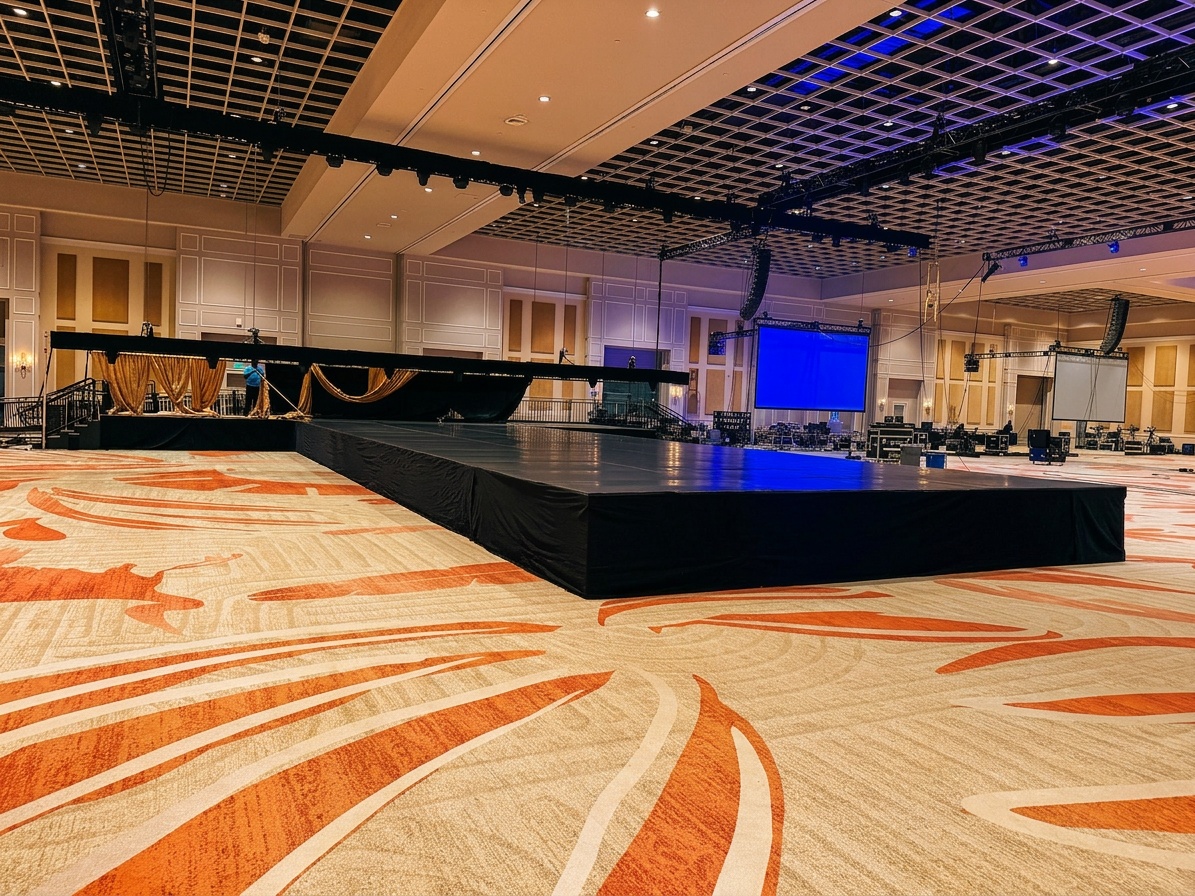
Flat, matte, light-colored surfaces produce the cleanest projection-mapped image, while glossy, transparent, or heavily textured surfaces scatter light and blur the visual. Textured walls need extra calibration time to avoid warping the image, which is why most AV crews steer clients toward a matte finish whenever the surface is a design choice rather than a fixed structure.
This is exactly why our matte-white pipe and drape backdrops for Orlando stages have become one of our go-to low-cost mapping surfaces. A properly tensioned, wrinkle-free panel gives a projector a flat, evenly lit canvas without the cost of a dedicated projection screen rental. We’ve used this exact setup on stage backdrops where a client wanted a mapped visual effect but didn’t have the budget for a full architectural projection package.
Curved or built set pieces work too, but they need real calibration time on site, not a plug-and-play file. If your design calls for mapping a 3D structure, columns, arches, or a stepped set piece, budget more setup hours than you would for a single flat panel, since every plane on the structure needs its own alignment pass.
Throw distance and stage depth for projection mapping
Throw distance is one of the biggest factors in deciding how deep your stage needs to be. The most common projector throw ratio is 2.0, meaning for every foot of image width, the projector needs 2 feet of throw distance, so a 20-foot-wide mapping surface needs roughly 40 feet of throw with a standard-throw projector, per ProjectorCentral’s projection calculator. Short-throw units bring that ratio down closer to 0.4-1.0, and ultra-short-throw models can sit just inches from the surface.
This is where our own build math comes in. On a 24ft-deep concert stage, our crew’s rule of thumb is to reserve a minimum of 12-14ft of rear throw space for a standard short-throw projector to fill a 20ft-wide mapping surface without hotspotting or dim edges. That’s not a manufacturer spec sheet number, it’s a working figure we’ve validated across our own Central Florida stage inventory over repeated builds. If a client’s mapping design calls for a wider surface or a longer throw, we typically move them up to a larger stage footprint, like our concert stage rental options that offer deeper rear zones for AV gear.
Front projection changes this math again, since the projector sits in the audience’s sightline path rather than behind the surface. That usually means a raised truss position instead of extra stage depth, a call we make together with the AV crew during the site walk.
Combining projection mapping with drape, LED, and stage lighting
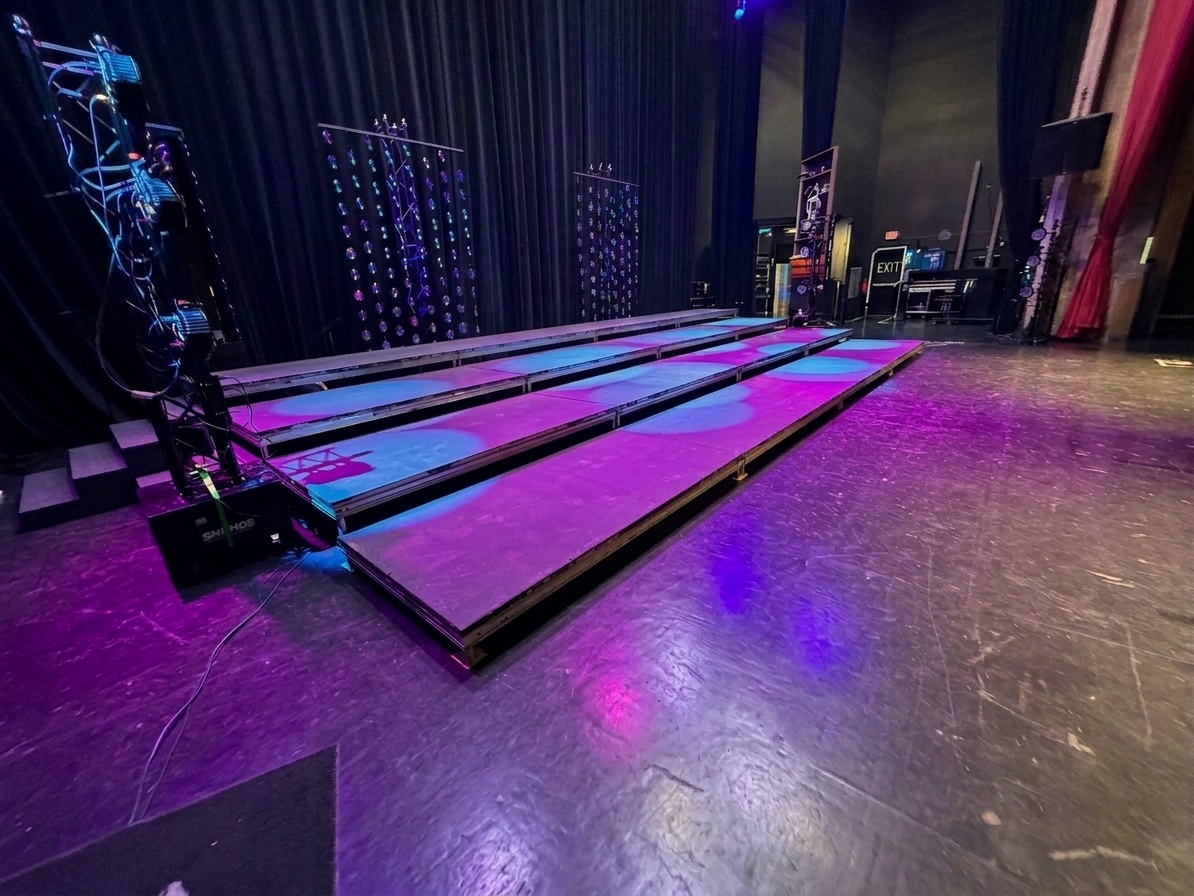
Projection mapping does not replace pipe and drape, LED screens, or stage lighting. It layers on top of them, and most of our AV-forward builds use two or three of these together. A matte-white drape wall can serve as both a mapping surface and a clean sightline block for backstage areas. An LED screen can anchor the center of a stage while mapped visuals wrap the surrounding drape or set pieces around it. Stage lighting still handles performer visibility and mood, since a projector is calibrated for the backdrop, not the people standing in front of it.
Sequencing matters more than most planners expect. Our stage lighting safety guide covers why stage wash needs to stay off the mapped surface itself, since spill light washes out a projected image fast. Audio placement matters too. If a subwoofer sits where the drape surface needs to stay taut and flat, vibration can ripple the fabric and blur the projection, so we plan audio and mapping surface positions together rather than as separate decisions. Our sound system integration guide for Orlando stages walks through the same coordination process for audio gear on a working stage, and our Audio Packages page lists the equipment tiers we typically pair with an AV-forward build like this.
Projection mapping outdoors in Florida daylight and humidity
Projection mapping works outdoors, but daylight and Florida humidity both put real limits on it that indoor-focused guides rarely mention. Ambient light is the biggest technical risk outdoors. Projection mapping thrives in controlled lighting, so projector placement and a flat, matte surface matter even more once the sun is up. Industry guidance recommends at least 2,500 to 4,000 lumens for visibility in daytime outdoor conditions, and any mapped screen wider than 16 feet needs at least 6,000 ANSI lumens to stay visible, according to Valerion’s outdoor lumens guide. That’s why most of our clients booking outdoor daytime mapping either scale down the visual scope or shift the reveal to dusk and evening.
Humidity is the other Florida-specific hazard most planners outside this market never account for. Condensation risk rises sharply once relative humidity climbs above 70% and the temperature swing exceeds 12-15°F, a combination that’s common on a Central Florida summer evening as the sun goes down, according to XGIMI’s guide on protecting projectors from dew and humidity. A fogged lens mid-show ruins the effect instantly, which is why we recommend a climate-controlled projector enclosure, not a basic tarp or plastic box, for any hot, humid evening booking. We coordinate this enclosure decision with our AV partners any time a stage build includes projection gear running through the night.
Common mistakes that ruin an outdoor projection mapping setup
Most outdoor projection mapping failures come down to three things: ambient light nobody planned for, humidity nobody protected against, and wind moving the surface itself. We saw all three risk factors come up during a run of builds in late June 2026, prepping stage decking and drape surfaces ahead of AV integration for private events around Central Florida. No single client’s story here, just a pattern that repeats every summer.
A drape panel used as a mapping surface is fabric, not a rigid screen, so it moves in even light. Any breeze off a nearby lake, an HVAC vent, or foot traffic backstage can shift the fabric enough to blur a mapped image that looked crisp in rehearsal. This is a lesson we’ve learned entirely on site, not from a manufacturer spec sheet: we now tension drape panels with additional weighted bases and check tautness one final time right before doors open, especially on outdoor builds near Central Florida’s afternoon storm winds. Skipping that last tautness check is the single most common reason a projection mapping reveal looks soft instead of sharp.
Budget planning for projection mapping on a rental stage
Adding projection mapping to a rental stage typically costs $1,000-$1,850 per day for a single-projector setup, while a full small stage-backdrop mapping package runs $5,000-$15,000 depending on surface size and how many projectors are blended together. The low end of that range usually covers a single projector on a flat matte drape surface with a straightforward content loop. The high end covers edge-blended setups with multiple projectors across a wider or dimensional surface, custom content creation, and on-site calibration time.
At Stages Plus, projection mapping is quoted alongside the stage build itself, not as an afterthought, because the surface size and throw distance directly affect which stage footprint we recommend. When a client calls us with a projection mapping idea, we ask about surface width and desired brightness before we ever talk stage dimensions, since those two numbers drive both the AV quote and the stage depth. Our Pricing page covers our general stage rental ranges, and our Packages page shows how AV add-ons like this typically bundle with a stage build.
Frequently asked questions
Does projection mapping work in daylight?
Yes, but with real limits. Daytime outdoor mapping needs at least 2,500-4,000 lumens to stay visible, and wide surfaces over 16 feet need 6,000+ ANSI lumens. Many clients scale down the design or move the reveal to dusk or evening, when ambient light drops and the mapped visuals read far more vividly.
How much does adding projection mapping to a stage rental cost?
Single-projector setups typically run $1,000-$1,850 per day, while a full small stage-backdrop mapping package runs $5,000-$15,000 depending on surface size, number of projectors, and content complexity. Larger or edge-blended, multi-projector designs land toward the higher end of that range.
How far in advance should we book a stage with projection mapping?
We recommend booking at least 4-6 weeks ahead for a stage build that includes projection mapping. That lead time gives our crew and AV partners room to confirm surface size, throw distance, and stage depth together, plus schedule a calibration pass before doors open on event day.
Can projection mapping work on a pipe and drape backdrop?
Yes, and it’s one of our most common low-cost mapping surfaces. A tensioned, wrinkle-free matte-white drape panel gives a projector a flat, evenly lit canvas without renting a dedicated projection screen. It does need extra wind and vibration precautions outdoors, since fabric moves more than a rigid screen.
What’s the difference between projection mapping and an LED wall?
Projection mapping uses calibrated light to display visuals on an existing surface, adding no extra hardware weight to the stage. An LED wall is a physical panel that generates its own light and adds rigging and load weight the stage has to support. Both can run on the same stage, but they solve different design problems.
Conclusion
Projection mapping can turn a simple stage backdrop into the most memorable part of an event, but it only works when the surface, throw distance, and Florida weather are planned together from day one. At Stages Plus, we build that planning into every quote so the visual effect actually holds up on show night. Ready to talk through your design? Reach out through our how to get a quote page and we’ll help you size the stage and the surface together.