A round stage rental makes sense when your event is built around 360-degree viewing, think fashion shows, quinceañera courts of honor, in-the-round performances, or product reveals, rather than a single-direction presentation with slides or a video wall. At Stages Plus, we stock 29ft, 17ft, and 11ft round stages, and the right diameter depends on how many people perform on the platform at once, not just how many guests show up.
Key takeaways
- A round stage puts the audience on all sides of the performer, so there is no upstage or downstage the way there is on a rectangular deck.
- Stages Plus stocks three fixed diameters: 29ft for a full quinceañera court, 17ft for smaller courts or fashion shows, and 11ft for a single performer or product reveal.
- A circular stage needs at least two stair or ramp access points instead of the single rear stair typical on a rectangular stage.
- ADA rules require wheelchair spaces dispersed around the whole performance area when seating encircles it.
- A round stage is the wrong choice for slide-heavy presentations or keynotes with a video wall.
What a round stage rental is and how it differs from rectangular staging
A round stage puts the audience on all sides of the performer instead of on just one side. This format is often called theatre-in-the-round, a recognized staging configuration where "the audience surrounds the performance space on all sides," creating a more immersive experience than a proscenium or front-facing setup, according to Revision World's staging configuration guide.
A rectangular stage assumes one primary sightline. The audience faces forward, screens and backdrops sit upstage, and everything is blocked toward that direction. A round stage rental from Stages Plus flips that assumption. There is no upstage or downstage. Every seat has a full view of center stage, but no seat has the "best" angle the way front-row-center does on a rectangular deck.
That single difference drives almost every other decision in this post, from lighting placement to where the stairs go. A round stage isn't just a stylistic choice. It changes how a performer moves, how sound gets designed, and how an audience gets seated, and we walk through all of it with clients before they book.
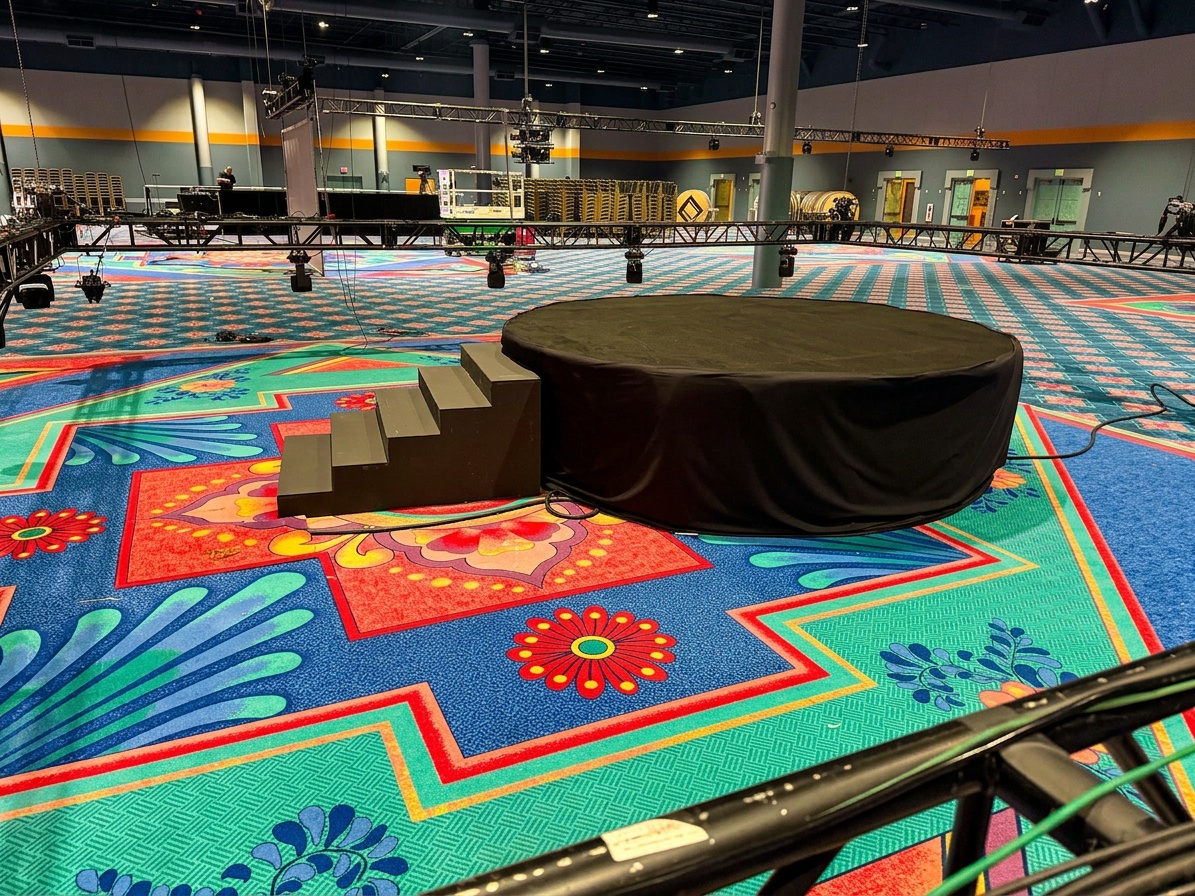
Round stage sizes and choosing the right diameter
Stages Plus stocks three fixed round stage diameters, 29ft, 17ft, and 11ft, and the right one depends on how many people need to be on the platform at once, not just how many guests are attending.
- The 29' Round Stage is our largest circular option. It suits full-scale formations that need real room to move, such as a full quinceañera court of honor. Industry planning guidance notes that a choreographed vals performance for a full traditional court of 14 damas and 14 chambelanes needs at least 25 feet across to perform comfortably, per The Barn 305's quinceañera reception guide. A 29ft diameter gives that full court room to spare while still leaving space for the honoree at center.
- The 17ft round stage works well for smaller courts of honor, fashion show center stages with a handful of models circulating at once, or in-the-round musical acts with a few performers. Many modern quinceañeras scale the court down to 7 damas and 7 chambelanes, or even just one of each, according to Marinaj Banquets, and a 17ft stage fits that scale without wasting rentable floor space.
- The 11ft round stage is built for a single performer or a small acoustic act, a speaker doing a "surrounded" Q&A format, or a compact product reveal where the item itself, not a crowd of performers, is the focus.
Choosing between them comes down to how many bodies are moving on the platform at once and how close the audience needs to feel. Our team can walk through this with you directly, and our Stage Size Calculator is a fast way to get a starting recommendation before a call.
Event types that genuinely benefit from circular staging
Circular staging earns its cost when the format itself is part of the experience, not just a stage-shaped platform to stand on.
Fashion shows are the clearest example. A round center stage lets the audience see garments from every angle as models circulate, instead of only from a front-facing runway view. If your event is built around a runway walk rather than an in-the-round reveal, a traditional runway may be the better fit. Our runway stage rental guide for fashion shows covers when a linear runway outperforms a round platform.
Quinceañera courts of honor are another strong match, particularly for the choreographed vals where the honoree and her court perform in a formation meant to be seen from all sides. Product launches where the item itself is the star, rather than a presenter with slides, also work well on a round platform, since guests can surround the reveal instead of viewing it from one angle.
In-the-round musical or theatrical performances are a proven format well beyond novelty events. Major touring acts have used circular staging for exactly this reason. U2's 360° Tour built its show around a large circular stage, and the Dixie Chicks' Top of the World Tour used a circular configuration in most venues, switching to an end stage only where the room required it, according to Wikipedia's overview of theatre-in-the-round. Panel or talk formats can also work in the round, but only if there's no slide deck or video wall involved, since a screen needs a "front."
Audience layout, sightlines, and access planning for 360-degree stages
A round stage requires audience seating and access points planned in full circles, not in rows facing one direction.
Sightline planning changes completely once you remove the single-front assumption. On a rectangular stage, seating is simple: rows face the stage, and the biggest planning question is how far back the last row can sit and still see clearly. On a round stage, every seat technically has a sightline, but planners need to think about depth in every direction at once. Tiered seating helps here, and our audience riser rental for tiered 360-degree seating lets guests further from the platform see over the heads of those in front of them, regardless of which side of the circle they're sitting on.
Access is where a lot of first-time round stage bookings go wrong. A rectangular stage typically needs one set of stairs at the rear, out of the audience's view. A circular stage has no "rear." Performers, presenters, and court members need to enter and exit from multiple points around the circle without walking through the audience or crossing the platform mid-performance. On every 360-degree load-in, our crews plan for at least two stair or ramp access points placed opposite each other or at logical entry angles based on how the choreography or program moves. Skipping this step is one of the most common planning mistakes we see, and it's almost always solvable if it's addressed before the event, not during load-in.
Sound, lighting, and ADA considerations for round staging
Round staging changes lighting design and legally changes how accessible seating has to be arranged.
Lighting on a rectangular stage is built around one direction: light the performer from the front and sides, keep the audience in the dark. On a round stage, lighting has to avoid casting shadows or over-lighting one section of the audience while leaving another dim, since there's no single front to aim from, per Wikipedia's theatre-in-the-round overview. That same source notes performers themselves need to adjust, staying aware of their positioning so they aren't turning their backs to large segments of the audience for extended stretches, which changes blocking and choreography compared to a front-facing show. Our stage lighting packages are built with this in mind for round stage bookings, using multi-angle rigs rather than a single front wash.
ADA accessibility isn't optional, and it works differently for circular formats. Under the 2010 ADA Standards, when seating encircles a performance area in whole or in part, wheelchair spaces and companion seats must be dispersed around that performance area, not grouped at one side, according to ADA.gov's 2010 Standards for Accessible Design. Guardrails matter on every open edge of an elevated round platform too, not just one side. That's why we treat stage guardrails as their own category on every build, not as an afterthought borrowed from generic industrial platforms. Our ADA compliance for stage rentals page covers how we plan ramp placement and seating dispersal for circular layouts specifically.
Indoor and outdoor use, cost factors, and common planning mistakes
A round stage from Stages Plus works both indoors and outdoors, but the setting changes the access and weather planning, and cost depends more on customization than on diameter alone.
Indoors, a round stage usually sits inside a ballroom or hall where the ceiling height and column placement need to be checked before the stage is designed, since circular audience seating needs open sightlines in every direction. Outdoors, the same access and lighting principles apply, but weather coverage becomes a factor too, since a round platform can't use the same simple pole-and-tarp cover a rectangular stage can, given the absence of a single front or back.
On cost, general market data for stage rentals shows a wide range depending on size and customization: smaller productions typically run $500 to $5,000, while elaborate custom staging at larger multi-day events can run $15,000 to $50,000 or more, according to ThePricer.org's stage rental cost guide. At Stages Plus, we price round platforms in a distinct custom fabrication tier separate from standard modular decking, since a circular deck, rounded skirting, and multi-point access all take more building and planning time than a straight rectangular build. The diameter you choose, whether it needs risers, how many access points it needs, and whether it's indoors or outdoors under a cover all factor into the final number more than the base "round vs. rectangular" decision itself.
The most common mistake we see is booking a round stage for the wrong format. If your event centers on a presentation with slides, a keynote speaker at a podium, or a video wall, a round stage works against you, since there's no single direction for a screen to face and part of your audience will always be looking at the back of it. For those formats, a speaking stage rental or a standard rectangular stage is almost always the better call. Our how to choose the right stage size guide covers this decision in more detail if you're still deciding between formats.
Frequently asked questions
How far in advance should I book a round stage for a Central Florida event?
Round stages need more logistics planning than rectangular ones, including access point layout, seating dispersal, and often custom skirting, so we recommend booking as early as possible once your date and venue are set. Earlier booking also gives our team time to walk through sightlines and access with you before load-in.
Can a round stage be used indoors and outdoors?
Yes. Stages Plus round stages work in both settings, but outdoor use requires additional weather coverage planning since a circular platform can't use the same simple front-facing cover a rectangular stage uses. Indoor use requires checking ceiling height and column placement for full-circle sightlines.
Is a round stage ADA accessible?
It can be, but accessibility has to be built in deliberately. Under 2010 ADA Standards, wheelchair spaces and companion seats must be dispersed around the entire performance area when seating encircles it, not grouped at one access point, per ADA.gov.
What is the biggest mistake planners make with round stages?
Booking a round stage for a slide-heavy presentation or a keynote with a video wall. Round formats have no single "front," so part of the audience always ends up behind the screen. Formats without screens, like fashion shows or quinceañera courts, are a much better match.
How many access points does a round stage need?
At least two stair or ramp entry points, typically placed opposite each other or based on how performers and court members move through the program. This is different from a rectangular stage, which usually only needs one rear stair.
The bottom line
A round stage genuinely earns its place at an event built around 360-degree viewing, from fashion shows to quinceañera courts to in-the-round performances, but it's the wrong tool for a slide-based presentation or a single-direction keynote. If you're weighing a 29ft, 17ft, or 11ft round stage against a standard rectangular option, our Stage Size Calculator is a quick starting point, or reach out through how to get a quote and our team will walk through your audience layout with you before you book.