Orlando Stage Rental

Bands, Runways, Speaking Engagements, Award Ceremonies, Schools

Call Now! 407-442-0254

  • About
    • Blog
  • Pricing
  • Packages
    • Audio Packages
    • Stage Lighting
  • Contact
  • Reserve
  • Stage Sizes
    • 8ft Stage Sizes
    • 12ft Stage Sizes
    • 16ft Stage Sizes
    • 20ft Stage Sizes
    • 24ft Stage Sizes
  • Stage Rentals
    • Speaking Stage Rental
    • Single Performer Stage Rental
    • Concert Stage Rental
    • Round Stage Rental
    • Performance Staging Rental
    • Graduation Stage Rental
    • Wedding Stages
  • Runway
  • Pipe / Drape
  • Audience Riser
  • Pool Cover
  • Tent Floor
  • Camera Riser
  • Stage Accessories
    • Stair Rental
    • Ramp Rental
    • Dancefloor Rentals
    • Barricade Crowd Control Rental
    • Podium Rental

Package Deals vs. À La Carte Stage Rentals: Which Saves More in Orlando?

October 11, 2026

On this page

  • What’s included in a typical Orlando stage package versus buying pieces separately
  • Where bundled packages save real money
  • When à la carte rental actually costs less
  • Negotiating a custom package that beats a pre-built one
  • Booking timeline and how it affects your final price
  • Frequently asked questions

What's included in a typical Orlando stage package versus buying pieces separately

A standard stage rental package bundles the stage platform with the accessories most events need anyway, like stairs, skirting, and guard rails, while à la carte rentals price each of those separately. At Stages Plus, a package built around a concert or speaking stage generally rolls in the deck sections, skirting to finish the edges, stairs for access, and guard rails once the platform exceeds 30 inches in height, since that's a safety requirement regardless of how you order.

When you go à la carte, you're choosing each piece one at a time from a menu of add-on rentals like audio and lighting. That works fine if you genuinely only need the stage deck itself. But most events end up needing at least two or three of the same items a package already bundles anyway (stairs, skirting, some form of safety rail). That's where itemized pricing starts adding up fast.

The real difference shows up in the fine print, not the headline price. We'll walk through exactly how delivery and labor fees can quietly duplicate in an à la carte order in the next section.
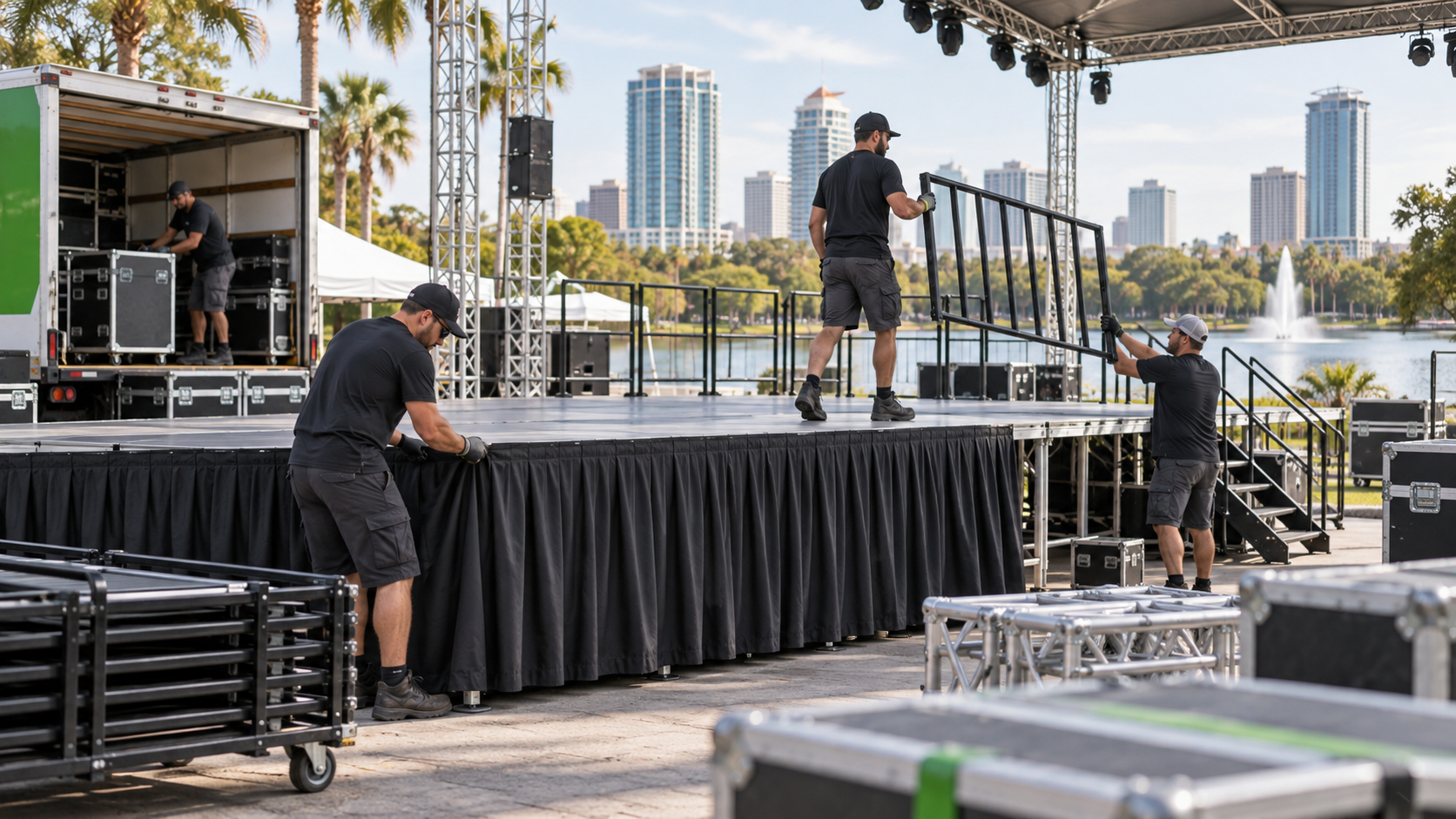
stage crew loading skirting and guard rail sections onto a stage platform before an Orlando event

Where bundled packages save real money

The biggest package savings come from eliminating duplicated delivery and labor fees, not from a discount on the stage itself. This is the part most comparison articles skip, because it's not about a coupon code, it's about how rental orders get structured behind the scenes.

We see this scenario constantly: a client needs a 16×16 speaking stage for a corporate event, plus a basic audio package for a podium mic, plus skirting to make it look finished. If that client books the stage and audio as one package, our crew shows up once, sets the whole thing up in one pass, and the quote reflects a single delivery and labor charge.

Split that same order in two instead: the stage gets booked through one quote, and the audio gets rented as a completely separate line item, sometimes even from a different vendor entirely. Each order carries its own delivery fee and its own labor charge, because each is treated as an independent job on the schedule. The stage itself might not cost more, but the client just paid for delivery and setup twice for equipment that could have arrived on the same truck with the same crew.

This duplication effect is exactly why we built our packages the way we did. It's also why hidden costs in event staging tend to show up more often in à la carte orders than bundled ones. Skirting, guard rails, and power distribution are easy to forget when you're assembling a rental order piece by piece, and each forgotten item becomes a change order with its own small fee attached.

When à la carte rental actually costs less

À la carte rental wins when your event needs exactly one category of equipment and nothing else, like a bare stage with no audio, lighting, or dance floor attached. Say a client's event is a short outdoor ceremony that just needs a 12×16 platform to stand on, with the couple's own portable speaker and no additional lighting. Paying for a full package there would mean paying for components that never get used.

We've had clients come to us wanting only a bare stage deck, no skirting, no rails (because the platform sits under 30 inches), no audio. In that situation, a package tier built around audio and lighting bundles would actually cost more than simply renting the stage deck on its own, because you'd be paying for gear that sits unused. That's the honest answer: a package only saves money when you'd otherwise be renting most of its components anyway.

The same logic applies to events where you already own or are sourcing your own AV. A church with its own sound system, or a school that already has a PA for graduation, doesn't need our audio bundled in. Renting just the stage platform and pairing it with our full stage rental packages only for the accessories you're missing (like stairs or a ramp) keeps the order lean and the cost down.

The rule of thumb: count how many separate equipment categories your event genuinely needs. One category, à la carte usually wins. Three or more categories, a package almost always wins.

Negotiating a custom package that beats a pre-built one

You can build a custom package that beats a standard tier by starting with the closest pre-built package and swapping out only what doesn't match your event. Pre-built packages exist to make quoting faster for common event types, but they're not the only option, and we'd rather quote you accurately than upsell you into a tier that doesn't fit.

If a standard package includes a lighting rig you don't need because your venue already has house lighting, say so during the quote call. Dropping that one component and keeping everything else bundled (stage, delivery, labor, skirting) usually still beats pricing the remaining items à la carte, because the delivery and labor consolidation stays intact even when the equipment list shrinks.

This is where current stage rental pricing conversations get the most value for planners. We'd honestly rather hear "we only need the stage and audio, skip the lighting" up front than quote you a package you'll ask to modify later. Custom-built packages take a little more back-and-forth during quoting, but they consistently land cheaper than forcing a mismatched standard tier or splitting everything into separate à la carte orders.
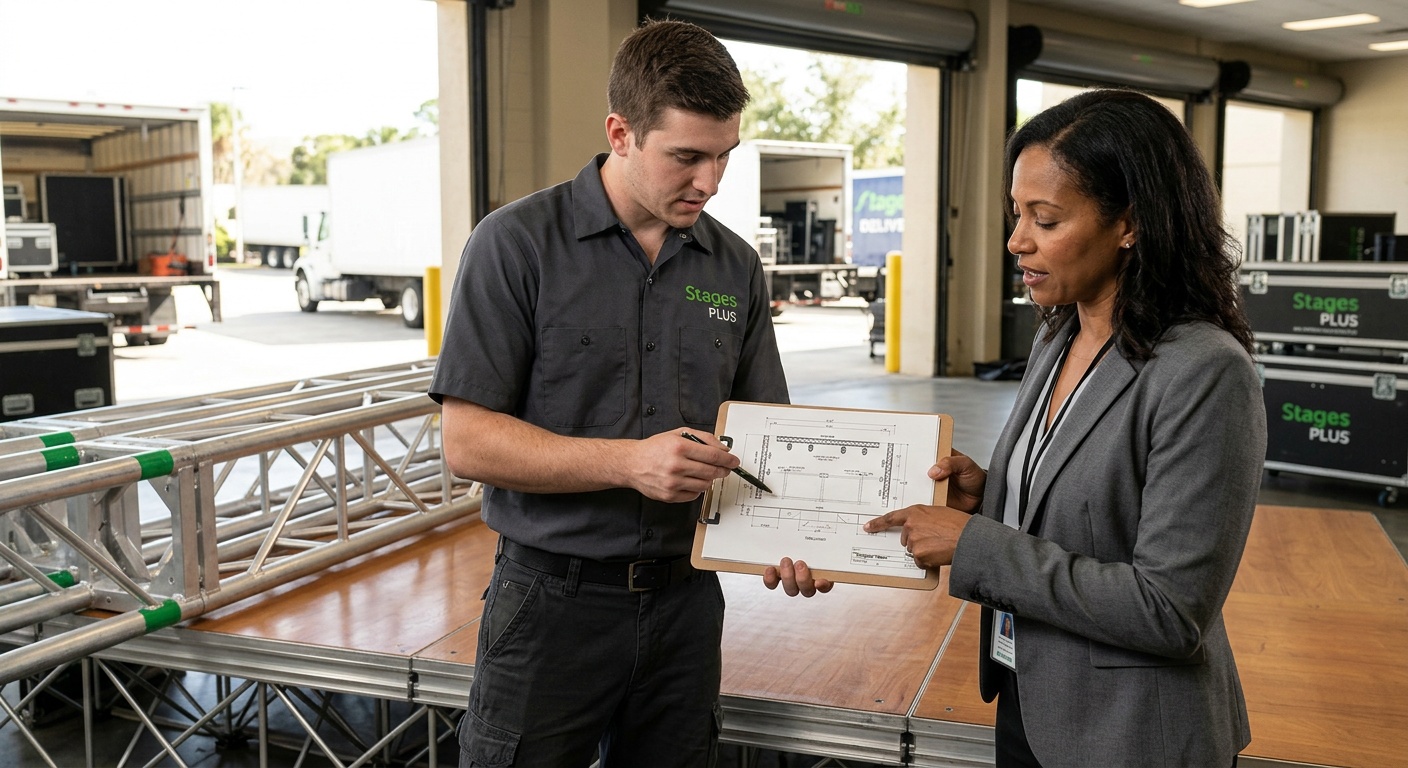
Stages Plus crew consulting with a client over a stage layout diagram before an Orlando corporate event

Booking timeline and how it affects your final price

Booking package pricing 6 to 8 weeks before your event date locks in both the rate and the crew availability, while last-minute à la carte orders almost always cost more per item. Timing affects more than price. Equipment availability tightens closer to an event date, especially during Central Florida's busy fall corporate season and the spring wedding window, and piecing together stage, audio, and lighting from separate last-minute orders often means paying rush fees on each one individually.

A package booked early gets quoted as one cohesive order, which means our team can schedule one crew, one truck, and one delivery window well in advance. À la carte orders assembled late, especially across multiple equipment categories, tend to run into availability gaps that push clients toward more expensive substitute equipment or expedited delivery charges.

If you're still estimating what your event actually needs, running the numbers through our stage rental cost calculator before you call is a good way to walk into that first quote conversation with realistic expectations.

Frequently asked questions

What's the most common budgeting mistake planners make between packages and à la carte?

The most common mistake is quoting the stage alone and forgetting accessories like skirting, guard rails, or power distribution, then adding them one at a time as separate change orders. Each addition carries its own small fee, and those add up to more than a bundled package would have cost from the start.

Does the savings math change for a wedding versus a corporate event versus a festival?

Yes. Weddings and corporate events usually need multiple categories (stage, audio, lighting, sometimes dance floor), so packages tend to win. Festivals with multiple stages often mix both, bundling each individual stage's core gear while renting festival-wide audio or lighting separately across the whole site.

Is there a minimum event size where à la carte stops making sense?

Once your event needs three or more equipment categories (stage, audio, lighting, dance floor, risers), à la carte starts costing more than a package almost every time, because you're paying duplicated delivery and labor fees across separate orders instead of one.

Can I customize a pre-built package instead of accepting it as-is?

Yes. We regularly start with the closest standard package and swap out components you don't need, like dropping a lighting rig if your venue already has house lighting. Custom packages usually still beat full à la carte pricing because delivery and labor stay consolidated.

What hidden costs show up in à la carte orders that packages already cover?

Delivery fees, labor crews, skirting, guard rails, and power distribution often get billed separately in à la carte orders, while packages typically fold these into one quote. These are the same items detailed further in our guide on hidden costs in event staging.

For most Orlando events needing more than just a bare stage, a package saves real money by consolidating delivery and labor into a single order, while à la carte only wins for simple, single-category setups. The best way to know which route fits your event is to get both quotes side by side before you book. Reach out through how to get a quote and we'll run the itemized and package numbers for your specific event so you can compare the real totals, not just the headline price.
Filed Under: Event Budget Planning

Stage Rental Cost Calculator: Estimating Your Orlando Event Budget by Stage Size

October 4, 2026

Stage rental costs in Central Florida scale mainly with two things: footprint (depth and width) and deck height, not a flat per-square-foot rate. An 8ft single-performer platform costs far less than a 24ft-deep concert stage, and extras like guardrails, stairs, skirting, lighting, and delivery distance can move your total as much as size does. The fastest way to get a real number is our Stage Size Calculator, with this guide explaining what actually drives that number up or down.

On this page

  • How stage rental pricing scales from 8ft to 24ft deep
  • What changes the price besides square footage
  • Add-on costs that stack onto your base stage rental
  • Indoor vs. outdoor setup costs
  • Delivery, setup, and strike fees across Central Florida
  • A worked example: itemizing a wedding stage budget
  • Minimum rental costs for small events
  • Frequently asked questions
  • Bottom line

Key takeaways

  • Stage cost scales with footprint and deck height together, not square footage alone. Once a platform reaches code-height thresholds, guardrails become mandatory and add to the price.
  • Add-ons like lighting, audio, pipe and drape, and dancefloor can add as much to your total as the bare stage platform does.
  • Outdoor setups generally cost more than indoor ones because of weighting, anchoring, and weather contingency gear.
  • Delivery fees in our Central Florida service area scale with distance from our Winter Park base, so Orlando metro events cost less to deliver than Lakeland or Melbourne.
  • Small events still carry a minimum cost floor because crew time and delivery don't shrink just because the stage does.

How stage rental pricing scales from 8ft to 24ft deep

A stage's depth and deck height drive cost more than any single factor. Each tier adds material, labor, and structural requirements that smaller stages don't need. An 8ft-deep stage, the kind we build for a single speaker, acoustic duo, or small podium setup, uses the least decking, the fewest legs, and the lightest skirting run. It's our most budget-friendly footprint.

Move up to 12ft or 16ft depth and you're typically looking at a wedding band, a DJ booth with a small dance space, or a corporate presenter with a podium and a couple of panelists. These sizes need more deck sections, more legs, and usually stairs on at least one side. Our 16ft Stage Sizes page breaks down exactly what fits at that depth, and our post comparing 12ft vs 16ft stages is worth a look if you're choosing between the two for a smaller venue.

Push to 20ft or 24ft deep and you're generally in full-band or multi-act territory, where you need room for a drum riser, backline, and multiple performers moving at once. Our concert stage rental page covers these larger configurations and the depth options that come with them. Each step up adds decking, legs, skirting footage, and often more crew time to assemble safely. That's why pricing climbs with size instead of staying flat.

Stages Plus crew assembling a modular stage deck section by section at a Central Florida outdoor event

What changes the price besides square footage

Deck height is the variable that surprises most first-time renters, because once a platform crosses a certain height, safety requirements kick in and the stage costs more to build correctly. OSHA's general industry standard requires guardrails once platforms reach a certain height, and that's not a Stages Plus policy, it's a federal workplace safety standard. It's exactly why a 24-inch-tall stage and a 48-inch-tall stage aren't priced the same way even if the deck footprint is identical.

Guardrails become a code requirement once a platform reaches 4 feet (48 inches) high, per OSHA's walking-working surfaces standard, which sets top rail height at 42 inches plus or minus 3 inches above the deck (OSHA 1910.29).

Beyond height, stairs are nearly always required once a deck sits above a comfortable step-up height, and most clients add stairs on both sides for performer flow. Skirting isn't required by code but it finishes the look and hides the leg structure, so most of our wedding and corporate clients include it. Every one of these items is a separate line, which is why two stages with the same footprint can land at very different totals once height, stairs, and skirting enter the picture.

Add-on costs that stack onto your base stage rental

The bare stage platform is often just the starting line, and the add-ons you layer on top can easily match or exceed the base rental cost. Lighting is the most common add, whether that's simple uplighting for a wedding reception or a full wash-and-spot package for a concert. Our Stage Lighting page walks through the tiers available.

Audio is the second most common addition, and it scales with guest count and stage use, from a basic speaker-and-mic setup for speeches to a full PA for a live band. Our Audio Packages page covers what's typically bundled at each level.

Pipe and drape backdrops are popular for weddings, corporate branding, and fashion presentations, and they're priced separately from the stage itself because they're a different structure entirely (our Pipe and Drape Rental page has specs). Dancefloors are their own line item too, since they're installed as a separate surface, often set directly in front of or integrated into the stage deck (see Dancefloor Rentals). None of these are required to rent a stage, but most events we build end up including at least one.

Indoor vs. outdoor setup costs

Outdoor stages generally cost more than indoor stages of the same size, mainly because outdoor builds need weighting, anchoring, and weather contingency gear that indoor venues don't require. A stage inside a ballroom or convention hall sits on a flat, stable floor with no wind load to account for. A stage on a lawn, in a park, or on a beach needs ballast or stakes to stay put, plus a plan for rain.

That's part of why we talk so often about hidden costs in event staging budget planning: clients budgeting purely off a base stage price are often surprised when outdoor anchoring, cover options, or power runs add to the final number. If you're planning an outdoor event during Florida's wetter months, building a weather contingency line into your budget from the start saves you from a scramble later.

Outdoor wedding stage with pipe and drape backdrop set up on a lawn in Central Florida

Delivery, setup, and strike fees across Central Florida

Delivery pricing in our service area scales with distance from our Winter Park home base, so the farther your venue sits from Winter Park, the more delivery adds to your total. We cover Orlando, Winter Park, Kissimmee, DeLand, Deltona, Sanford, Altamonte Springs, Apopka, Ocoee, Oviedo, St. Cloud, Winter Garden, Winter Springs, Titusville, Melbourne, Palm Bay, Winter Haven, and Lakeland, but a stage delivered to an event ten minutes from our shop costs less to move than one headed out to Lakeland or Melbourne.

That's simple logistics math: drive time, fuel, and crew hours all factor into the delivery and strike fee, and a round trip to the far edges of our service area takes a bigger bite out of a crew's day than a local Orlando metro run. If your venue sits toward the outer edge of our coverage area, it's worth asking about delivery pricing early in your planning, before you lock in a full budget.

A worked example: itemizing a wedding stage budget

A typical 16ft by 12ft wedding stage budget stacks several separate line items on top of the base platform, and seeing them listed out is the fastest way to understand where your total actually comes from. Here's how a build like this usually breaks down for a reception band or ceremony stage:

  • Base stage platform (16×12): the deck sections, legs, and structural frame for the footprint itself.
  • Skirting: fabric panels that wrap the stage edges and hide the leg structure for a finished look.
  • Stairs: one or two sets, depending on performer flow and whether the deck height requires them.
  • Uplighting or accent lighting: a lighting package to highlight the stage and backdrop during the reception.
  • Delivery, setup, and strike: crew time to deliver, assemble, and later disassemble and haul away the stage, priced by distance from Winter Park.

Each of those lines is priced separately, which is exactly why a single "stages starting at $X" number you'll see on some directory sites doesn't tell you much. The way to see your actual total is to run your specs through our Stage Size Calculator and then confirm it with our team through how to get a quote, which gives you an itemized breakdown instead of a vague starting figure.

Minimum rental costs for small events

Even a small stage carries a cost floor, because delivery, crew time, and setup don't shrink proportionally just because the stage does. A single-performer platform for a birthday party or a community gathering still needs a truck, a crew, assembly time, and a strike trip, so there's a practical minimum below which we can't price a rental, no matter how small the footprint. If you're planning a small event on a tight budget, it's worth checking our Orlando stage rental pricing page or running the calculator early so there are no surprises when you compare it to your overall event budget.

Frequently asked questions

Is there a minimum rental cost for small events like birthdays or community gatherings?

Yes. Even our smallest stages carry a baseline cost because delivery, crew labor, and assembly time apply regardless of footprint. A tiny single-performer platform won't cost nothing just because it's small. Check our Orlando stage rental pricing page or the calculator for a realistic minimum before setting your budget.

How far in advance should I lock in my budget during peak wedding or graduation season?

Peak wedding season runs February through May, and graduation season peaks May through June, when our Winter Park crew's calendar fills fastest. Locking in your stage budget and booking date several months ahead, rather than weeks, gives you the best shot at your preferred date and avoids last-minute pricing pressure.

What's a realistic budget range for a 100-150 guest wedding stage vs. a multi-act concert stage?

A wedding stage for 100-150 guests typically needs a smaller footprint (often 12-16ft deep) with skirting, maybe stairs, and light uplighting, so it sits well below a multi-act concert stage, which needs 20-24ft of depth, full guardrails, heavier audio, and often multiple load-ins. Request an itemized quote through how to get a quote for your specific guest count and format.

What do people typically forget to budget for?

Permits, dedicated power drops, and weather contingency gear are the three most commonly missed line items. Outdoor events especially need a rain or heat plan, and some venues require separate permitting for temporary structures. Our post on hidden costs in event staging budget planning walks through what's easy to overlook.

How is this cost guide different from your interactive Stage Size Calculator tool?

This guide explains the logic behind pricing, why depth, height, add-ons, and delivery distance each move your total. The Stage Size Calculator applies that logic to your actual event specs and gives you a ballpark number in under a minute, which you can then confirm with a formal itemized quote.

Bottom line

Stage rental cost in Central Florida comes down to footprint, deck height, the add-ons you layer on, and how far your venue sits from our Winter Park base, not a single flat rate. The clearest next step is to run your event specs through our Stage Size Calculator for a fast ballpark, then reach out through how to get a quote so our team can give you a real, itemized number before you finalize your event budget.

Filed Under: Event Budget Planning

Hidden Costs in Event Staging: Complete Budget Planning Guide for Orlando Events

July 27, 2026

Event staging in Orlando for a 150-200 person corporate event realistically runs an estimated $2,500-$6,000 total once you add delivery, setup and strike labor, guard rails, stairs, skirting, and permits on top of the base rental. These are illustrative planning estimates built by combining our itemized base rates with the delivery/labor markup and permit and insurance costs outlined below, not a fixed quote. A mid-size outdoor reception for 300-400 guests typically lands between $5,000-$12,000 using the same math, and a large outdoor concert or festival for 500+ can reach $20,000-$40,000 or more depending on stage size, roofing, audio, lighting, and venue surcharges. The base stage quote you receive is almost never the final number.

On this page

  • What does a base stage rental include in Orlando?
  • What delivery and labor fees get added to the stage price?
  • Do I need a permit for a stage in Orange County or the City of Orlando?
  • How much do guard rails, stairs, skirting, and ADA ramps add?
  • Is event liability insurance required, and how much should I budget?
  • How do venue surcharges affect the total staging budget?

Key takeaways

  • Base stage rental is only one piece. Delivery, setup labor, strike labor, guard rails, stairs, and skirting commonly add roughly 30% or more on top of the equipment line item.
  • Permits are required and vary by municipality. The City of Orlando requires a temporary stage permit with engineer-stamped drawings; Orange County and Osceola County each have their own outdoor assembly permit processes with separate fee schedules.
  • Labor is frequently underestimated. A typical single-day event involves 8 hours of setup and 4 hours of strike, and same-day strike scheduling carries a surcharge.
  • Venue-imposed fees are invisible until you ask. Hotel load-in windows, freight elevator fees, and Disney-area staging code requirements are real line items that rarely appear in a competitor's base quote.
  • Book early in peak season. Central Florida's wedding season (February-May) and holiday event season (October-December) drive price increases and limited crew availability for clients who wait.

What does a base stage rental include in Orlando?

A base stage rental from Stages Plus covers the deck, frame, and legs in your chosen configuration. Skirting, guard rails, stairs, and delivery are separate line items on most quotes.

Portable stage packages start in the $430-$1,250/day range for smaller configurations. A 12×16 stage with setup, strike, skirt, and steps came to $1,557.89 on a recent invoice from another Central Florida provider, according to Centric Events and Rentals, a useful reference point for smaller setups. Larger outdoor stage kits with roofing start considerably higher.

At Stages Plus, our quotes are itemized so you can see exactly what each component costs before you sign anything. That transparency is intentional. The number one complaint we hear from clients who have used other vendors is that the base quote looked great until the final invoice arrived.

Our Orlando stage rental pricing guide walks through the specific factors that move your quote up or down.

See our stage rental packages – what's included vs. add-on services for a full breakdown of what comes standard and what gets added on.

Stages Plus crew unloading stage components from a truck at an indoor Central Florida venue, daylight exterior shot

What delivery and labor fees get added to the stage price?

Delivery, setup, and strike labor typically add roughly 30% of the equipment cost to your total. That percentage climbs when the venue has restricted access, long walks from the truck to the setup area, or a same-day strike requirement.

According to Centric Events and Rentals, expect roughly 30% of equipment cost to cover delivery windows, setup, strike, and logistics – and that scales with distance, access, and crew size.

A hotel ballroom install shows how this plays out in practice. Hotel and resort properties often schedule vendor access in specific load-in windows, and missing that window means overtime. A same-day strike surcharge applies when the crew has to turn around immediately after the event ends, and guard rail requirements kick in whenever the stage height crosses the 30-inch threshold. We walk clients through each of these line items before the event so the final invoice never surprises them.

Distance from our Winter Park shop matters too. Any venue outside the immediate Orlando metro, from the Space Coast to Lakeland, should factor in an extended delivery fee for added mileage and drive time.

Plato Media Co. notes that a typical single event involves roughly 8 hours of "Set" and 4 hours of "Strike," and that these labor blocks, not just event hours, are what drive the labor line on your invoice.

Do I need a permit for a stage in Orange County or the City of Orlando?

Yes. Permits are required for temporary stages in both the City of Orlando and Orange County, and each municipality has its own application process, fee schedule, and timeline.

The City of Orlando requires a temporary stage permit for any structural stage, and that permit requires signed and sealed drawings from a licensed engineer and a general contractor before it will be issued.

Separately, a Special Events Permit from the City of Orlando is required for any event on city property with more than 100 attendees, or for smaller events that involve temporary structures, vending, or alcohol.

Orange County requires an Outdoor Public Assembly Permit by county ordinance, and separately a Special Outdoor Event Permit under the Florida Fire Prevention Code for outdoor events expected to draw 100 or more people, per the Orange County Outdoor Public Assembly application.

Osceola County (which covers Kissimmee and much of the theme park corridor) carries its own fire prevention fee schedule for special events, tents, and temporary structures, and requires fees paid before the permit issues. If your event needs off-duty law enforcement for traffic control, Osceola County passes that cost directly to the event operator.

Disney-adjacent venues carry their own staging code requirements that add line items most planners do not anticipate. Our Disney stage code requirements article covers exactly what those are and why they exist. Small-market venues outside Orlando, like those in Lake or Volusia counties, are not simpler on the permit side. They are just less familiar to planners.

Budget line item to include: permit application fees plus the cost of engineer-stamped drawings if your municipality requires them. In the City of Orlando, structural stages always require that engineering documentation.

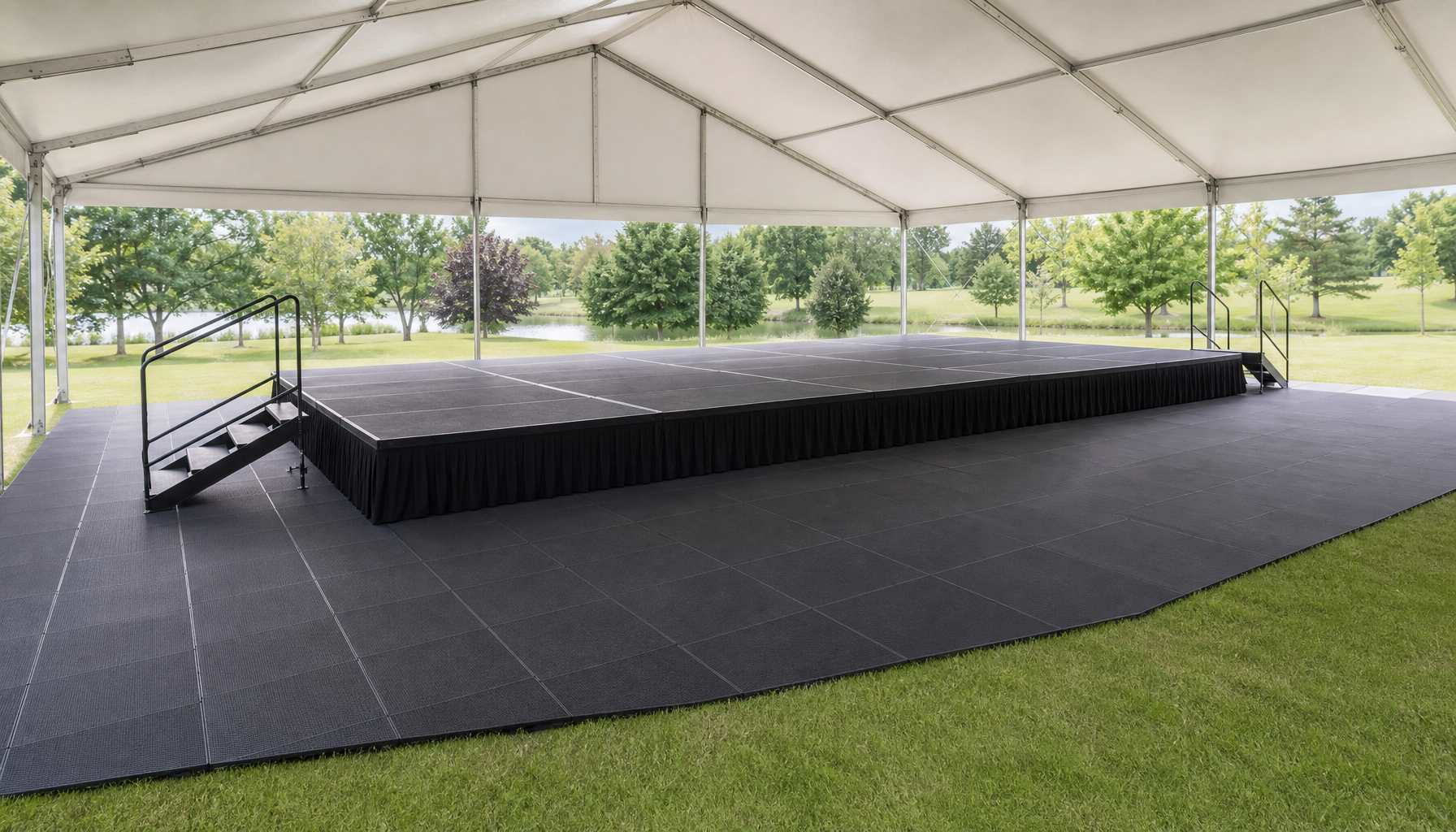
Stages Plus stage setup at an outdoor venue with tent flooring, showing the full footprint from a wide-angle perspective

How much do guard rails, stairs, skirting, and ADA ramps add?

Guard rails become a required, non-optional cost the moment your stage height exceeds 30 inches, and an ADA-compliant ramp adds even more depending on how high the stage sits.

Our post on ADA-compliant staging and accessibility requirements in Florida explains the full ramp-length math, but the short version is that ADA ramp slope requirements mean a taller stage needs a physically longer ramp, which takes more equipment and more setup time.

OSHA 29 CFR 1910.23 establishes guardrail requirements for elevated platforms in general industry settings. Guardrail best practices for temporary event stages commonly follow those same elevated-platform standards, even though the regulation is not written specifically for temporary staging.

Guard rails are not optional once a stage height crosses that 30-inch threshold, regardless of venue or event type. Stairs are similarly non-negotiable from a safety standpoint, and one or two sets are typically a line item separate from the stage deck.

Skirting is technically optional but almost universally recommended. The underside of a stage frame isn't something you want visible at a corporate event or wedding. At Stages Plus, skirting comes in black or white and finishes the look completely.

As a rough budgeting guide for add-ons on a mid-size stage:

  • Guard rails on all open sides of a 20×24 stage add meaningful cost, especially when a same-day install timeline compresses the setup window
  • Stairs (one or two sets) are typically priced separately from the stage deck
  • Skirting for a full perimeter adds a fabric and labor cost that varies with the stage footprint
  • ADA ramp length (and therefore cost) scales directly with stage height, so a 24-inch stage needs a shorter run than a 48-inch stage

Is event liability insurance required, and how much should I budget?

Most Central Florida venues require event liability insurance naming them as an additional insured. The policy itself typically costs $75-$285 for a single-day event depending on coverage limits and event type.

Insureon reports that its small business customers pay an average of $278 for one-day special event insurance coverage, while multi-day coverage averages $250.

For festivals, concerts, and stadium events with 500 or more attendees, coverage limits of $5M or higher may be required, per RVNA Special Event Insurance Florida.

The City of Orlando's Office of Special Events coordinates insurance requirements alongside permitting and public safety for the more than 1,200 permitted events the city handles each year. Many venues set a minimum of $1,000,000 per occurrence and $2,000,000 aggregate, with a certificate naming the venue as an additional insured submitted two weeks before the event.

Disney and Universal properties require specific Additional Insured policy language that differs from standard certificates. If your event is near any theme park property, confirm the exact wording requirement before you purchase coverage.

As BellKen Insurance notes, Florida's hurricane and tropical storm exposure makes event insurance in the state not just advisable but a practical necessity for outdoor events, particularly during the June through November hurricane season.

Budget line: $250-$350 for a small to mid-size single-day event, scaled up significantly for large outdoor festivals or theme-park-adjacent venues.

Completed Stages Plus stage setup at a hotel ballroom event, showing guard rails, skirting, and stairs from the audience perspective

How do venue surcharges affect the total staging budget?

Hotel and convention-center venues add load-in window restrictions, freight elevator fees, and sometimes union-labor minimums that can add hundreds to thousands of dollars to a staging budget that looks clean on paper.

Resort and convention-center venues are the clearest example we see in the field. Many resort properties control vendor access through scheduled load-in windows. If a truck arrives outside that window, or the strike crew needs to clear after a hard cutoff, overtime labor charges follow automatically.

Convention center events may trigger union-labor minimums depending on the facility and the type of work performed. This isn't universal in Orlando, but it's common enough at larger properties that any corporate event planner should ask the venue directly before finalizing the staging budget.

Parking for crew vehicles is a smaller but real cost that accumulates over a full setup and strike day. At urban venues or resort properties, crew parking is often metered, validated for a fee, or restricted to a remote lot that adds walk time.

For Disney-adjacent venues, specific staging code requirements add line items that a planner unfamiliar with that corridor would not anticipate.

Filed Under: Blog, Event Budget Planning

Get Quote / Contact

Popular Stage Sizes

  • 8ft Stage Sizes
  • 12ft Stage Sizes
  • 16ft Stage Sizes
  • 20ft Stage Sizes
  • 24ft Stage Sizes

Blog

  • Timeline Planning for Orlando Events: When to Schedule Stage Setup and Breakdown
  • Pool Stage Cover Rental: Protecting Performance Areas at Orlando Resort Events
  • Coordinating Stage Rentals with Other Orlando Event Vendors: A Planner’s Checklist

Search


Privacy Policy

Warehouse / Office

6848 Stapoint Ct.
Winter Park, FL 32792
407-442-0254

Located in the Eastpoint Industrial Park
Map

Delivery, Setup, Tear Down

Orlando, DeLand, Deltona, Kissimmee, Sanford, Altamonte Springs, Apopka, Ocoee, Oviedo, St. Cloud, Winter Garden, Winter Park, Winter Springs, Titusville, Melbourne, Palm Bay, Winter Haven, Lakeland, Seminole, Orange, Osceola, Lake, Polk, Volusia, Brevard.

Copyright © 2026 · Modern Portfolio Pro Theme on Genesis Framework · WordPress · Log in