Orlando Stage Rental

Bands, Runways, Speaking Engagements, Award Ceremonies, Schools

Call Now! 407-442-0254

  • About
    • Blog
  • Pricing
  • Packages
    • Audio Packages
    • Stage Lighting
  • Contact
  • Reserve
  • Stage Sizes
    • 8ft Stage Sizes
    • 12ft Stage Sizes
    • 16ft Stage Sizes
    • 20ft Stage Sizes
    • 24ft Stage Sizes
  • Stage Rentals
    • Speaking Stage Rental
    • Single Performer Stage Rental
    • Concert Stage Rental
    • Round Stage Rental
    • Performance Staging Rental
    • Graduation Stage Rental
    • Wedding Stages
  • Runway
  • Pipe / Drape
  • Audience Riser
  • Pool Cover
  • Tent Floor
  • Camera Riser
  • Stage Accessories
    • Stair Rental
    • Ramp Rental
    • Dancefloor Rentals
    • Barricade Crowd Control Rental
    • Podium Rental

Sound System Integration with Rental Stages: A Complete Guide for Orlando Events

May 25, 2026 by admin

Planning an event in Orlando means thinking about the stage and the sound together, not as two separate line items. We've seen too many well-built stages end up with muddy audio because speaker placement was an afterthought, and we've seen great PA systems underperform because nobody accounted for stage depth or room acoustics. This guide pulls together what our team has learned from hundreds of setups across Central Florida.

Whether you are booking a sound system rental in Orlando for a corporate keynote, a graduation ceremony, or a full concert, the way your audio integrates with your stage configuration makes a bigger difference than most planners expect.

Getting this right takes more than dropping speakers on either side of a stage and hoping for the best. Let us walk through what actually works, from stage depth and speaker placement to power requirements and venue-specific challenges.

Why Stage Size Directly Affects Your Audio Setup

The stage is not just a platform. It's a physical object that shapes how sound travels through your venue. A shallow 8-foot-deep stage in a hotel ballroom calls for a completely different audio approach than a 24-foot-deep concert stage at an outdoor festival site.

On shallower stages (8 to 12 feet of depth), performers and speakers are naturally closer together. The main tops can often be placed on stands at the front edges of the stage without creating feedback problems, and the shorter throw distance means you need less output power to fill the room evenly. An 8-foot-deep speaking stage in a corporate setting, for example, works well with a pair of 12-inch tops and a single subwoofer centered below the front lip.

Deeper stages (16 to 24 feet) change the math. When performers stand 12 to 20 feet back from the front edge, speaker placement needs to account for that distance. You either push the main tops further from the stage, use delay stacks, or deploy a front-fill system along the downstage edge to cover the gap. For our concert stage rental configurations, we always discuss speaker positioning early in the planning conversation, because it shapes where we position the deck framing, stairs, and power drops.

Practical takeaway: Tell your audio provider the exact stage dimensions before they quote you a system. A 16×24 stage and a 24×40 stage are not the same audio job.

wide concert stage setup outdoors with speaker arrays on both sides of the stage, Central Florida event venue

Hotel Ballrooms vs. Outdoor Sites: Two Very Different Audio Challenges

Two of our most instructive recent setups happened in very different environments, and the contrast shows exactly why venue type drives audio decisions as much as stage size does.

In early April 2026, our team installed a stage at the Gaylord Palms for the Patel event. The Gaylord Palms is a massive convention property, and its event spaces have the kind of high ceilings and hard reflective surfaces that can turn a clean PA signal into an echo chamber if the system isn't tuned properly. In large hotel convention spaces like this, cardioid subwoofer configurations (where the subs are arranged to reject sound toward the back of the room) and careful delay alignment between the main tops and any front fills make the difference between intelligible speech and a wall of reverb.

A few weeks earlier in February 2026, we ran a multi-day install and strike at the Celeste Hotel for the Mastoris event. Hotel ballrooms present their own wrinkles: ceiling height is often lower than a convention hall, the room shape may be irregular, and breakout walls can cause unexpected acoustic hotspots. On that setup, we paid close attention to how the stage height interacted with the first rows of the audience. A stage at 24 to 30 inches gets speaker tops closer to ear level for front-row attendees, which actually reduces the low-frequency build-up you sometimes get when tops are too high and angled too steeply down.

For outdoor sites, the entire equation flips. Sound disperses freely, which means you need more output to achieve the same perceived loudness, and wind becomes a real factor. In February 2026, our install for the Perry event in Apopka involved outdoor PA system setup, where we factored in the open-air environment when planning speaker coverage angles and gain structure. Florida weather also means thinking about moisture and sudden wind gusts, both of which affect how your crew secures speaker stands and cables.

The Ramjit corporate event in Lake Mary, also from February 2026, landed somewhere in between: a covered outdoor or semi-open venue where reflections from a roof or canopy can behave similarly to an indoor room. For those hybrid spaces, we recommend testing the system at low volume before the event starts to catch any frequency buildups early.

Practical takeaway: Share your venue type, ceiling height (if applicable), and whether the space is fully indoor, outdoor, or covered when you request a quote. It changes the recommended system significantly.

Speaker Placement on a Concert Stage: The Mechanics

Good speaker placement on a concert stage comes down to three things: coverage angle, height, and coupling with the subwoofers.

Most mid-size tops designed for live event use have horizontal coverage angles between 60 and 120 degrees depending on the cabinet design. If your stage is 24 feet wide and your tops are placed 10 feet above the stage deck on stands at each wing, the coverage fans out to cover the audience area evenly at mid-distance. The trouble starts when the tops are placed too close together (causing comb filtering in the center where coverage overlaps) or too far apart (leaving a dead zone in the middle of the room).

Subwoofer positioning deserves its own attention. A single sub placed asymmetrically creates uneven bass across the audience. For smaller setups on 16-foot-wide stages, we typically center a single sub below the front edge of the deck. For wider stages or higher-output requirements, a stereo-split subwoofer configuration (one sub per side) or a cardioid sub array delivers more even coverage. The stage deck itself can act as a boundary, reinforcing low-frequency output when the sub is coupled to the stage floor surface. That's actually a useful physics trick for outdoor events where you need more low-end from the same hardware.

Front-fill speakers (small format tops laid horizontally along the downstage edge) close the gap for the first few rows of the audience. On a deep concert stage, the main tops need to be angled to throw further back, which means the first 10 to 15 feet of audience in front of the stage can fall in a coverage gap. Front fills solve that problem cleanly, and they run at low levels so they don't cause feedback with the microphones on stage.

stage crew positioning speaker array beside a large rental stage, cables routed cleanly along the deck edge

Power Requirements and Cable Routing for Event Audio

This is the piece most event planners don't think about until they're on-site and the venue electrician is asking questions nobody prepared for.

A typical small-format PA for a speaking stage (two tops, one sub) draws somewhere between 15 and 30 amps at full output. Scale up to a full concert rig with multiple subwoofers and amplifier racks, and you can be looking at 60 to 100 amps or more. Power requirements for event audio at large venues like the Gaylord Palms or Celeste Hotel are usually handled through the venue's house power distribution, but you need to know in advance whether you're tapping 120V or 208V circuits and how many dedicated circuits are available.

For outdoor events in Apopka, Lake Mary, or similar locations without permanent venue infrastructure, a generator is often the right call. We coordinate with our clients on generator sizing when we know the audio package going in, because underpowering a rig causes amplifiers to clip and can damage speakers.

Cable routing matters both for safety and for audio quality. Long unbalanced cable runs introduce noise. On a 24×40 stage, the run from the stage to the front-of-house mixing position might be 100 feet or more, and that distance should always use balanced XLR or TRS connections. We also make sure all cables are dressed properly along the stage deck edges and taped down across any pedestrian paths, both because it looks professional and because it's a genuine trip hazard if ignored. Our post on the stage safety inspection checklist for Orlando events covers the ground-level hazard piece in more detail.

Practical takeaway: Ask your venue contact for a one-line diagram of available power or, at minimum, the total amperage available and whether circuits are shared with lighting. We can help you bridge that conversation.

Matching Audio Packages to Your Stage Configuration

Our audio packages are structured to match common stage configurations, but the right system always depends on the specific combination of stage size, venue, and event type.

For speaking stages used in corporate events, award ceremonies, or graduation setups, a clean two-top-plus-sub system with a digital mixer handles most rooms up to roughly 500 to 600 attendees. Add a second sub and front fills for rooms above that, or for high-ambient-noise outdoor environments.

For performance staging with live bands or DJ setups, the subwoofer count typically doubles, and the main tops move up to 15-inch drivers or line array elements depending on the throw distance required. Our performance staging rental page shows configurations that pair naturally with these larger audio packages.

One thing planners often forget to include in the quote conversation: stage monitors. These are the speakers that face the performers on stage, not the audience. Singers, speakers, and musicians need to hear themselves clearly, and skipping monitors is one of the most common oversights we see. On a 16×24 stage, two to four wedge monitors placed at the downstage edge cover most needs. In-ear monitor systems are an option for more controlled stage environments.

When you're also adding stage lighting to the mix, talk to us early about DMX cable routing and how the lighting truss or trees will interact with speaker stand placement. We've shown up to jobs where the lighting and PA rigs were planned completely independently, and the truss leg ended up exactly where the sub was supposed to go. It's an easy problem to avoid when everyone is coordinating from the start. Check out our stage lighting options for a sense of how these systems coexist on the same stage footprint.

corporate event stage setup inside hotel ballroom with PA speakers on stands and stage lighting active, Orlando venue

What to Do When You Are Sourcing Stage and Audio from Separate Vendors

Not every client books stage and sound through the same company, and that is completely fine. But if you're renting a stage from us and bringing in an outside audio vendor, there's a short list of information they'll need from you before they can plan their setup properly.

Give them the stage dimensions (length, width, and deck height), the location of any built-in power drops, and whether stairs are on the front, side, or rear of the platform. Deck height matters because it affects how speaker stands are rigged and whether sub placement at the front edge will work or create a sight-line problem. We're happy to share a spec sheet for any stage we're providing, so your audio company walks in knowing exactly what they're working with. Honestly, the more information that gets shared between vendors in advance, the smoother the day-of setup goes for everyone.

Audio Troubleshooting: What to Do Before It Becomes a Problem

Even a perfectly planned system runs into audio troubleshooting moments at live events. Most of the issues we see are preventable with a solid soundcheck protocol.

Run your soundcheck at least 90 minutes before doors open. The room sounds different when it's empty versus full, because human bodies absorb high frequencies and warm up the acoustic environment. Most mixers need a slight EQ adjustment once the audience is present, typically pulling a little brightness from the high-mid frequencies.

Feedback is almost always a placement or gain problem, not a broken speaker. Nine times out of ten when we see feedback during soundcheck, a mic has crept in front of a monitor. Reduce the gain on the offending mic first, then check whether it's positioned behind all the main tops when viewed from above. Those two steps fix the problem the vast majority of the time.

Wireless microphone frequency conflicts are a real issue in Orlando. The radio frequency environment near theme parks and large convention properties like the Gaylord Palms is dense. We coordinate frequencies in advance for wireless systems and recommend confirming frequency assignments with the venue's AV department if they have in-house systems running simultaneously.

If you need to figure out what stage size goes with your event format before getting into audio details, our how to choose the right stage size guide is a good starting point.

Practical takeaway: Build a 90-minute soundcheck window into your event timeline. It's the single biggest thing that separates events with great audio from events where people in the back can't understand the speaker.

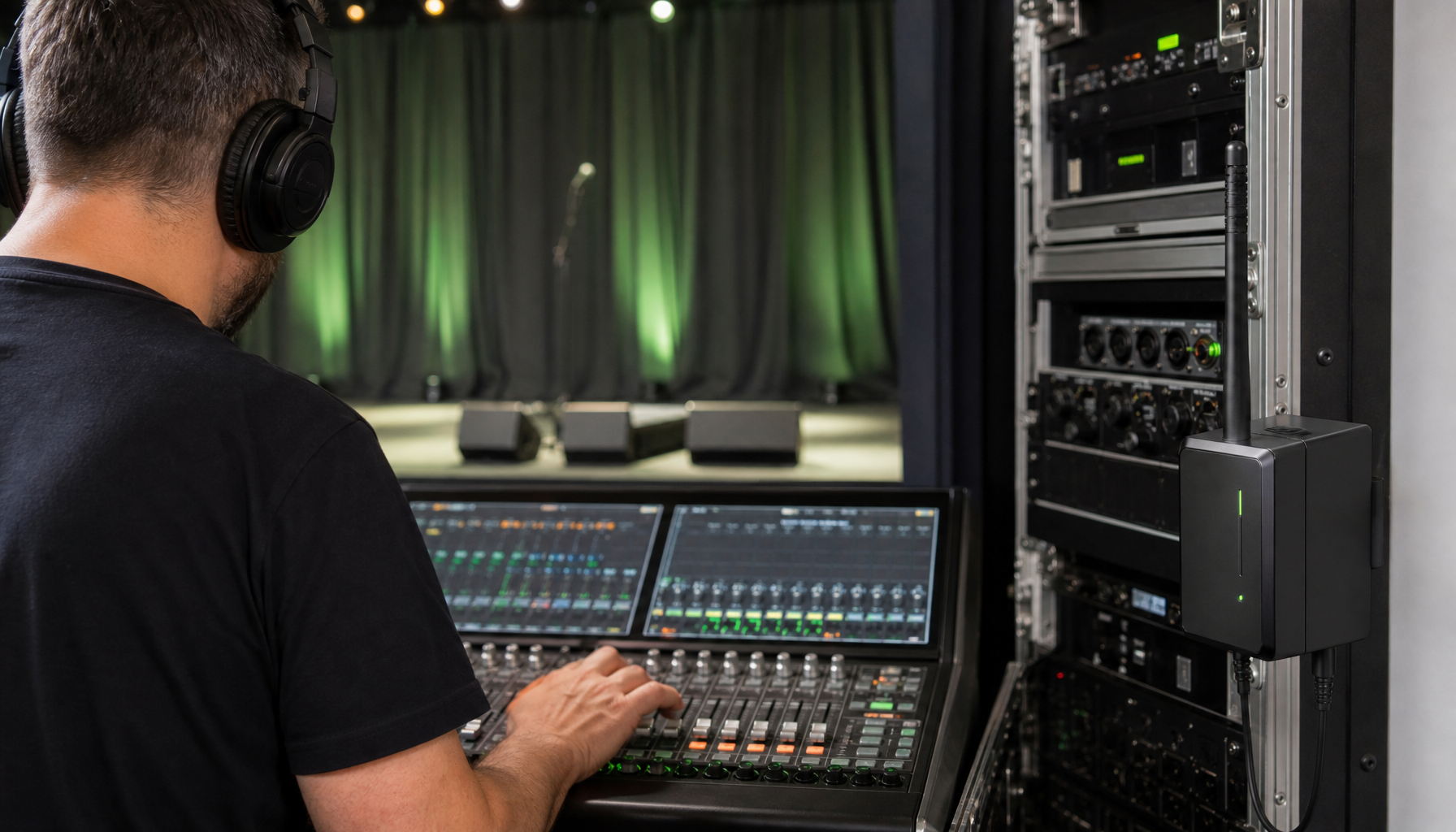
sound technician at mixing board during event soundcheck, stage visible in background with PA system active

Bringing It All Together

Pairing a sound system rental in Orlando with the right stage configuration is a logistics problem as much as it is a technical one.

Stage depth determines speaker placement strategy. Venue type shapes the acoustic approach. Power planning prevents on-site surprises. Cable routing and front fills are details that separate a professional setup from one that just barely works. When all of these pieces are coordinated from the start, the audio sounds the way it should, and the event runs smoothly from the first mic check to the final note.

At Stages Plus, we handle both the stage and the sound, which means none of these conversations happen in isolation. When we know the stage size, the venue, and the event type, we can match the right audio packages to the configuration and have everything ready to go when our crew arrives on site.

Ready to pair a sound system with your stage rental? Request a quote and tell us your stage size, venue type, and event date. We'll match the right setup to your space and take care of the rest.

Filed Under: Blog

Shade Solutions for Outdoor Stages: Beat the Florida Heat

May 21, 2026 by admin

Why Florida Sun Is a Staging Problem Nobody Talks About Enough

Most outdoor event checklists cover rain and wind. Fewer of them address the thing that will actually derail your summer event in Central Florida: the sun. We’ve clocked deck surface temps past 150°F on black aluminum by midmorning, and that’s before a performer steps onto it in dress clothes or a presenter grabs a mic that’s been baking in the open.

Shade stage covers are one of the most practical investments a planner can make for any outdoor event running between May and September in Florida, and honestly, even spring installs are starting to require serious sun planning.

We noticed the shift clearly across our 2026 spring install schedule. By late February, our crews working outdoor setups in Tampa and at large resort venues were already factoring sun exposure into setup positioning. By April, planners booking summer events were asking about shade options at the point of inquiry, not as an afterthought. This post covers what we’ve learned from those setups and what every outdoor event planner in Central Florida should know before booking a stage this summer.


What the Heat Actually Does to Your Stage and Your People

Shade is not just about comfort. It’s a safety and equipment issue.

A black aluminum stage deck sitting in direct Central Florida sun from 9 a.m. onward can reach temperatures that cause burns on contact. We’re talking about a surface that holds heat the way asphalt does, and performers standing on it for 30 to 45 minutes feel that heat radiating up through their shoes. Crew members setting up in those conditions face the same risk, plus longer exposure time during load-in.

Equipment takes a hit too. Wireless transmitters, battery packs, and audio processors left on an exposed stage deck can overheat and fail. Laptops and tablets used by presenters are rated for indoor ambient temperatures, not full Florida sun. Even stage skirting fades faster when it bakes for hours without any cover.

The audience comfort radius is worth thinking about as well. Guests standing near an uncovered stage feel radiant heat coming off the deck surface in addition to ambient air temperature. That narrows the comfortable viewing zone and pushes people back, which is exactly the opposite of what you want.

On Florida UV index days (which regularly hit 10 or 11 from June through August), unprotected performers and crew are looking at sunburn risk within 15 to 25 minutes, depending on skin type. If your event runs from noon to 4 p.m., that’s a real operational problem.


Shade Stage Covers vs. Canopies vs. Tent Integration

Not all overhead shade is the same, and the differences matter for load capacity, rigging, and aesthetics.

Purpose-Built Covers Integrate with the Stage Frame

Our shade stage cover rental is a purpose-built overhead structure that attaches to the stage frame itself. Because it integrates with the stage, it accounts for the stage’s load ratings and does not require separate anchoring into grass or pavers. It also means you’re not working around a separate structure during load-in.

This approach is similar to what we do with pool covers: the cover is engineered to handle the overhead load without compromising what’s happening on the deck below. For larger stages running truss or lighting overhead, we plan the shade cover integration early so there’s no conflict between the shade structure and rigging points.

Canopy Attachments Work Well for Smaller Setups but Need Careful Wind Planning

Some stages accommodate fabric canopy panels that attach to the stage uprights or to a separate lightweight frame. These work well for smaller setups where a full engineered cover is more than the footprint needs. The tradeoff is wind sensitivity. A canopy that isn’t properly secured becomes a liability in Central Florida’s afternoon storm windows, which start earlier in summer than most out-of-state planners expect.

Tent Integration Is a Good Option for Speaking Stages with a Smaller Footprint

When a client is already renting a tent for the surrounding event space, we can position the stage at or near the tent perimeter so the tent extends overhead coverage to part of the stage. This works best for speaking stages and presentation setups where the stage footprint is smaller. For concert stages running full PA wings and monitor setups, a tent integration usually can’t cover the full deck.

We’ve written more about how tents and stages work together in our guide to tent flooring and stage combinations for Florida outdoor venues.


Clearance, Rigging, and the Lighting Problem

One of the most common questions we get when clients start asking about shade stage covers is whether the cover interferes with overhead lighting. The short answer is: it depends on how you plan it.

Lighting rigs and truss need clearance. A shade cover that sits too low blocks beam angles and creates hotspots or dead zones in your light design. The solution is coordinating the shade cover height with your lighting vendor during the planning phase, not on install day. At Stages Plus, when a client books a shade cover alongside a lighting package, we work through the vertical clearance requirements before the crew arrives. That’s a conversation that takes ten minutes upfront and saves half a day of frustration on site.

For events that include video screens or projection, the shade cover actually helps. Reducing ambient light on the stage face improves screen visibility dramatically, especially for afternoon events where direct sun washes out displays. So a cover does double duty there.

Audio equipment generally benefits from shade too. Amplifiers and signal processors in direct sun run hotter than their rated operating temperatures, which shortens their lifespan and increases failure risk mid-event. Keeping those components shaded or inside a covered front-of-house position is good practice regardless of stage size.


Cooling Strategies Beyond the Cover

A shade cover handles overhead sun, but there are additional steps that make a real difference for performer comfort and equipment reliability in Florida heat.

Schedule load-in early. Our team often arrives at 5 or 6 a.m. for outdoor summer events. The difference in air temperature between 6 a.m. and 10 a.m. in Orlando can be 15 to 20 degrees. Stage hardware set in the early morning is starting cool. That gap matters more than people expect.

Deck surface color is something most planners overlook. White or light-colored Marley flooring over a black deck dramatically reduces surface temperature for performers. The difference in how long performers can stand comfortably in one spot is noticeable when the deck has a light-colored surface rather than bare black aluminum.

Our concert stage rental configurations can include Marley flooring, skirting, and shade covers as part of a full package. Planning these together from the start is always easier than adding them as afterthoughts.

Airflow behind the stage matters too. Pipe and drape backdrops installed in direct sun trap heat in the performance area. If the stage has a backdrop, leaving a gap between the bottom of the drape and the stage deck surface allows air to move through. It’s a small adjustment, but performers notice it during multi-act events.

And provide water access at stage level. This sounds obvious, but when performers have to walk off stage and 30 feet to a water station between sets, they often skip it. A small cooler at the base of the stairs keeps everyone hydrated without requiring a special trip.


What Our 2026 Spring Install Schedule Taught Us

The spring season gave our team a clear preview of what summer will look like, and the heat conversation came up on nearly every outdoor install.

In late February, our crew handled an outdoor stage setup in Tampa where the open southern exposure of the site meant that by late morning, the deck was already warm enough to affect setup sequence. Hardware staging on the deck got moved to shaded staging areas until it was needed. It’s the kind of small operational adjustment that adds up over a full day.

Around the same time, our team set up at the Celeste Hotel for an outdoor event on a layout that put the stage in a position with minimal natural shade from the building or surrounding trees. That kind of open-sky positioning is common at hotel outdoor spaces throughout Central Florida, and it’s exactly where a purpose-built shade structure earns its value. No trees, no adjacent building overhang, nothing except clear sky above the deck from 10 a.m. on.

The Gaylord Palms install was one of the larger outdoor setups of the spring. Large resort venues often have expansive outdoor event lawns with little overhead protection, and with a bigger stage footprint, getting shade coverage right requires planning the structure alongside the stage dimensions from the start. Sizing a cover for a stage that was already specced independently creates problems. The two need to be designed together.

By April, it was clear that Central Florida’s heat season ramp-up is well underway before summer officially arrives. Spring events in April and May are already operating in conditions that warrant the same shade and cooling planning we apply to July events. If you’re booking for May or June, treat it like August.

Outdoor professional stage setup at a waterfront venue on a clear daytime with partial cloud cover, showing black stage frame with banners and white dance floor in foreground


Booking Checklist for Outdoor Summer Events in Central Florida

Before you finalize an outdoor event contract, run through these shade and heat planning items.

Site assessment: Where does the sun track across your stage position from load-in through the end of the event? A site that’s shaded at 8 a.m. may be in full sun by 2 p.m.

Stage footprint and cover sizing: Your shade cover needs to match your actual stage dimensions. Use the Stage Size Calculator to confirm your stage footprint before requesting a shade cover quote.

Rigging coordination: Confirm overhead clearance needs with your lighting vendor before booking a shade structure. This is a 10-minute conversation that prevents a half-day problem on install day.

Load-in timing: Plan for early morning arrival. If your venue has access restrictions that prevent pre-dawn setup, discuss that with your rental provider before booking.

Deck surface treatment: Ask about Marley or light-colored deck options if performers will be on stage for extended periods.

Shade cover lead time: Shade covers for peak summer weekends (late June through August) book out quickly. We recommend confirming your shade package at least 4 to 6 weeks out.

Weather window: Florida’s afternoon storm pattern runs roughly 2 to 5 p.m. from June through September. Plan your event timeline around it. A shade cover addresses sun, but it’s not a substitute for a full weather plan. Our post on hurricane season stage planning covers the full picture on storm readiness.

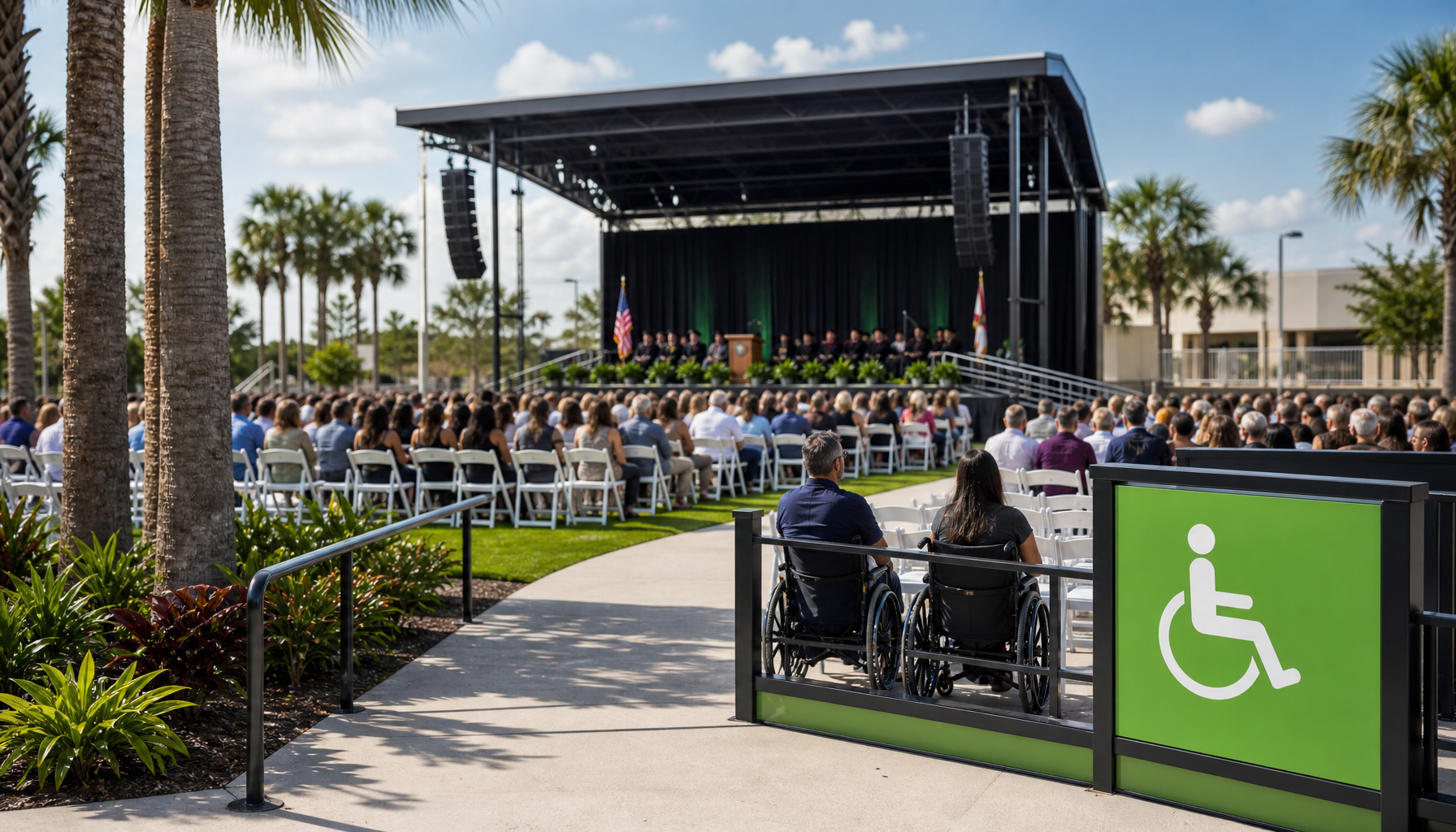
Outdoor graduation ceremony stage setup with elevated platform on a well-maintained grass field under partly cloudy skies, showing open-air exposure without shade structure


Plan the Shade Before the Stage Gets Hot

Florida outdoor events are worth it. The venues are beautiful, the open-air atmosphere is hard to replicate indoors, and our clients keep booking them because guests love them. But the heat is real, and the planning has to match the conditions.

Shade stage covers are a straightforward solution to a problem that derails more outdoor events than most planners want to admit, and the earlier you build them into your package, the smoother the whole setup goes.

If you’re planning an outdoor event in Central Florida this summer, reach out to us and we’ll size the right shade solution for your stage footprint and venue layout. Start with the Stage Size Calculator to get your dimensions, then contact us and we’ll build out the full package from there.

Filed Under: Blog

Negotiating Stage Rental Contracts: Getting the Best Deal in Orlando

May 18, 2026 by admin

You have a quote in hand, the venue is booked, and the event is real. Then you open the contract and hit a wall of terms you've never had to think about before. This happens to planners at every experience level, and it happens most often right now, in May, when wedding season and graduation season converge and everyone is signing agreements under time pressure.

Stage rental negotiation is not about squeezing a vendor. It is about understanding which terms are fixed, which ones have flexibility, and what questions to ask before you sign anything.

This post walks through the actual components of a stage rental agreement in the Orlando market, where the real leverage points are, and what to watch out for so you're not caught off guard on event day.

What a Stage Rental Contract Actually Covers

A solid stage rental contract is more than a price and a date. It should spell out the scope of work in specific detail: the stage dimensions, configuration, height, and any add-ons like guard rails, stairs, skirting, or pipe and drape. If those details are vague, the contract leaves too much room for misunderstanding.

Delivery and pickup windows, setup times, and strike times are equally important. We learned this firsthand during a multi-day install at the Celeste Hotel in Winter Park for the Mastoris wedding. The install ran on the 23rd and the strike wasn't until the 25th, which required specific language in the agreement about when our crew had access, how the stage would be secured between those dates, and who held responsibility for the space during that period. Without clear scheduling terms, a two-day gap like that creates real liability questions for both sides.

If you want to understand what drives the numbers on your quote before you get to the contract stage, our Orlando stage rental pricing guide walks through every factor that affects what you pay.

Access requirements and liability language are the other pieces that round out a well-written contract. Who's responsible if venue access is delayed? Who handles permits? What does the liability split look like if something goes wrong on setup day? Those questions should all have written answers before you sign.

Black platform stage being set up in an elegant banquet room with decorative patterned wallpaper and a sponsor banner visible on the right side

Payment Schedules and Deposit Terms

The most common structure we see in Orlando event rental agreements is 50% at booking and the remaining 50% due before delivery. That split works well for most events, but it's worth asking about before you sign.

For larger builds, the deposit timeline can shift. Our install at Gaylord Palms for the Patel event is a good example. Hotel venues like Gaylord Palms have their own vendor access protocols, and confirming those access windows early isn't optional. That kind of coordination often means the rental company needs earlier confirmation from you, which can move the second payment earlier as well. Knowing that up front prevents surprises.

One genuine leverage point here is bundling. When you add audio, lighting, or pipe and drape to a single contract rather than sourcing them separately, you eliminate vendor coordination complexity on our end. That matters, and most vendors know it.

Our stage rental packages page shows what bundled options look like and which combinations planners use most often.

Ask whether bundling affects the payment schedule, because sometimes it does. And always ask whether the deposit is refundable, partially refundable, or non-refundable outright. Those three answers mean very different things.

Cancellation Policies: Know the Difference Between Cancel and Reschedule

Most clients skim the cancellation clause and assume it covers everything. It usually doesn't. There's a meaningful difference between a cancellation and a reschedule, and the contract should treat them differently.

A cancellation typically means you're forfeiting the event entirely. Depending on how close to the event date you cancel, that often means losing part or all of your deposit. A reschedule means you're moving the date and want your deposit to transfer. Many vendors allow this within certain windows, but only if the contract language specifically permits it.

Florida weather adds a layer that planners in other markets don't have to think about. If you're running an outdoor event and a storm system forces a date change, you want the contract to treat that as a reschedule rather than a cancellation. Ask your vendor directly: does a weather-related date change trigger the cancellation clause or the reschedule clause? Get the answer in writing. Seriously.

Our post on hurricane season stage planning goes deeper on how to build weather contingency into your event logistics.

The distinction matters most during Florida's June through November weather window, but spring events face afternoon storms too. Don't wait until a weather app shows 60% chance of rain to find out what your contract actually says.

A large conference or ballroom space mid-setup featuring a black stage platform with stairs, professional audio and visual equipment, and green accent walls

The Real Leverage Points When Negotiating

Understanding where you have negotiating room changes the whole conversation. Here are four levers that actually work, along with an honest note about where vendors won't budge.

Booking lead time. Locking in your date 8 to 12 weeks out gives you more flexibility on add-ons. When our schedule has breathing room, we have more ability to work with clients on the details. A last-minute booking in a busy season leaves less room for either side to move. Most vendors won't discount the base rental rate during peak weeks in May and June, so this is the window where your best leverage is on scheduling flexibility and add-on terms, not the bottom-line rate.

Bundling services. Adding audio, lighting, or pipe and drape in a single contract reduces our coordination overhead. That simplification has real value. If you're planning to source those items from multiple vendors anyway, consider whether consolidating with one provider changes your total cost and your contract complexity. It often does.

Multi-event relationships. If you're a recurring planner who books multiple events per year, say so up front. Vendors who know they're working with someone who'll be back are more likely to build a relationship rather than treat each event as a one-time transaction.

Flexible delivery windows. This one is underused. Our Perry install in Apopka is a good example. Regional events outside the core Orlando market involve real mileage and routing logistics. When a client can offer early venue access the evening before setup, it lets us schedule the crew run more efficiently and reduces our labor cost. That kind of flexibility creates natural room to have a conversation about pricing. Ask your venue what early access looks like, then bring that window to your rental vendor.

And if a vendor won't move on anything? That's useful information too. A second quote from a comparable provider will tell you quickly whether you're dealing with a firm market rate or just a firm vendor.

Venue-Specific Contract Clauses to Watch For

Hotels and managed venues in Orlando operate on their own rules, and those rules have to show up in your rental contract. Certificate of insurance requirements, approved vendor lists, load-in procedures, elevator access restrictions, and union labor rules are all venue-driven terms that affect how a stage rental is scheduled and priced.

Our Gaylord Palms install required close coordination with the hotel's event operations team before our crew arrived on site. Properties at that scale have specific windows for vendor access, and if your rental contract doesn't explicitly name the approved access window and assign responsibility when the venue delays access, you've got a gap that could cost you on event day.

Our scheduling details page explains how we coordinate access and timing on venue-specific installs.

Ask your rental vendor if they've worked at your venue before. If they have, they likely know the access procedures already. If they haven't, confirm the contract names the venue access window and specifies what happens if the venue delays access. That single clause has saved more than one event we've been part of.

Professional conference stage setup with elevated black platform, stairs with handrails, black curtain backdrop, and branded signage with attendees visible in business attire

Red Flags in Event Rental Agreements

A few contract issues come up often enough that they're worth flagging directly.

Vague scope. If the contract doesn't specify stage dimensions, height, and configuration, you have no way to hold the vendor to what you discussed.

Missing delivery window. "Day of event" is not a delivery window. The contract should name a specific arrival time range.

No force majeure or weather clause. In Central Florida, this isn't optional language. Any outdoor event contract should address weather-driven date changes explicitly.

Deposit forfeiture on any date change. A contract that treats a reschedule the same as a cancellation is worth pushing back on. Vendors who care about the relationship usually distinguish between the two.

No itemized breakdown of add-ons. If audio, lighting, stairs, and skirting are bundled into a single line item, you can't verify what you're actually getting. Ask for itemization.

Know Your Terms Before You Sign

The planner who understands their contract walks into a negotiation knowing exactly where the flexibility is and where it isn't. That knowledge saves time, prevents disputes, and almost always leads to a better outcome for both sides.

We work with planners at all stages of the process, from first quote to final strike, and we're happy to walk through contract terms before you commit. Use our stage size calculator to get your specs dialed in, then reach out to get a quote and we'll review the terms together. If you're ready to lock in a date, you can reserve your stage rental directly.

No hidden terms. Just a straight conversation about what your event needs.

Filed Under: Blog

ADA Compliance for Stage Rentals: Accessibility Requirements in Florida

May 11, 2026 by admin

We've seen it happen more times than we'd like: a planner calls us two days before an event because they just realized the ramp they planned won't actually fit in the room. Or worse, they didn't plan one at all. When a speaker, honoree, or performer uses a wheelchair, that oversight becomes a real problem on event day, and it's not just a logistics issue.

ADA compliant staging is not optional for most public and semi-public events in Florida, and understanding the specific requirements before you book saves you from expensive last-minute changes on setup day.

We work with event planners across Central Florida year-round, and accessibility questions come up constantly, especially during graduation season when honorees or speakers with mobility needs are part of the program. Here's what you need to know before finalizing your stage setup.

Why ADA Compliance Matters for Staged Events in Florida

The Americans with Disabilities Act Title III covers places of public accommodation, and that coverage extends to temporary structures at public and semi-public events. A stage you rent for a corporate presentation, a school graduation, or a community ceremony qualifies. The Department of Justice has consistently held that event organizers can't exempt themselves from ADA requirements simply because the structure is temporary.

Florida adds another layer through the Florida ADA Accessibility Implementation Act (Sections 553.501 through 553.513 of Florida Statutes). This state law mirrors federal ADA Standards for Accessible Design but is enforced at the county permit level. If your event in Orange, Seminole, or Osceola County requires a temporary structure permit, an accessibility review is often part of that process, though the specifics vary by county and event scale, so check directly with the relevant building department when your permit is filed. One thing most organizers miss: the event organizer, not just the venue owner, carries responsibility for any temporary structures brought in for the event.

The Core ADA Requirements That Apply to Temporary Stages

Four areas of the ADA Standards for Accessible Design (Section 4.8) apply directly to temporary stages. Get all four right, and you've got a compliant setup. Miss one, and you've got liability.

Ramp Slope and Minimum Width Requirements

The maximum ramp slope is 1:12, meaning 1 inch of rise for every 12 inches of run. A stage set at 24 inches tall requires a minimum ramp run of 24 feet.

The minimum clear width is 36 inches, and edge protection is required for every 6 inches of rise. Our modular deck systems let us keep stage height as low as practical for the event type, which directly reduces the ramp footprint required. A stage at 16 inches instead of 24 inches cuts the minimum ramp run from 24 feet to 16 feet. In a tight venue, that 8-foot difference can determine whether the ramp plan actually works.

Platform Surface and Gap Specifications

The deck surface must be stable, firm, and slip-resistant. Gaps in the surface can't exceed 0.5 inch measured perpendicular to the direction of travel. Our stage decks lock together with tight tolerances, and the surface texture provides the slip resistance the standard requires. This is one area where modular rental equipment generally outperforms DIY staging built from plywood and sawhorses. No guesswork on the gap dimension.

Guard Rail Height on Accessible Routes

Guard rails are required when the stage surface is more than 30 inches above grade. When rails are present on an accessible route, the top rail must sit between 34 and 38 inches above the deck surface.

At Stages Plus, we require guard rails on all stages above 30 inches regardless of ADA compliance status, because it's the right call for safety. For accessible stages, we configure the rails to meet that 34 to 38 inch window on the routes where wheelchair users and others will be traveling.

Turning Space at the Top of the Ramp

A power wheelchair needs a minimum 60-inch diameter clear floor space to complete a pivot turn. That 60-inch turning radius requirement is one of the most frequently overlooked specs in temporary stage planning. If your ramp delivers a performer or honoree onto a platform without enough clear space to turn and face the audience, the accessible route fails even if the ramp itself is perfect. We account for this when we configure the landing zone at the top of every ramp we spec. It sounds like a small detail until it isn't.

Black elevated stage platform with gray surface and stepped access set up in an indoor venue, with white vertical curtain backdrop and overhead lighting, showing platform dimensions and approach area

Ramp Specifications: Getting the Numbers Right

This is where accessible stage rental Orlando planners tend to hit the most questions. Let's walk through the math with real examples.

A 24-inch stage height requires a minimum 24-foot ramp run at the 1:12 slope maximum. Ramp runs over 30 feet require an intermediate landing of at least 60 inches. At the top and bottom of every ramp, you need a 60×60 inch level landing area so the person using the ramp can stop, orient themselves, and move onto the stage or off the ramp safely.

Our approach is to configure the stage height first based on sightlines and the event type, then spec the ramp to match. For a speaking stage or graduation setup, we often find that 16 to 20 inches of platform height gives good visibility from the audience while keeping the ramp to a manageable length. Honestly, that's the tradeoff most planners don't think about until we bring it up.

When a ramp must coexist alongside standard stairs, the two access points need to be clearly separated so neither path blocks the other. Check out our stair rental options for your stage setup to see how we configure multi-access stage entries when both stairs and a ramp are part of the plan.

Guard Rails and Edge Protection

Guard rails serve two separate functions on an accessible stage. The first is fall prevention for anyone on the elevated platform. The second, specific to ADA, is edge protection along any accessible route where the surface drops more than 0.5 inch at the edge, regardless of total platform height.

That second rule catches people off guard. A 12-inch stage doesn't require guard rails for fall prevention under most safety standards, but if wheelchair users are accessing it and the edge drops off sharply, edge protection is still required along the accessible portion of that stage. Low platform height doesn't mean you're off the hook.

We configure our guard rails to sit at the correct height for the accessible route, and we can position skirting to cover the structural frame cleanly without blocking the accessible path or the ramp landing. The goal is a setup that looks polished and meets the standard at the same time.

Professional conference or corporate event stage setup featuring elevated black platform with stairs and handrails, black curtain backdrop, and attendees visible on and around the stage in a ballroom venue

Florida-Specific Enforcement Context

The Florida ADA Accessibility Implementation Act doesn't create new technical requirements beyond the federal standard, but it formalizes how enforcement works at the local level. County building departments in Orange, Seminole, and Osceola counties each issue temporary structure permits, and those permits can involve an accessibility review before the event. That said, the process varies meaningfully by county and event scale, so check directly with the relevant building department when your permit is filed rather than assuming the review will happen automatically.

For events at high-profile venues like convention centers, hotels, and campus facilities, the venue itself often has an accessibility coordinator who will review your stage setup plan. Coming to that conversation with specific ramp dimensions, landing specs, and guard rail configurations already figured out makes the permitting and venue approval process much smoother. It also signals to the venue that you've done your homework.

And the broader point on Florida accessibility requirements for staging: the liability for a non-compliant temporary structure sits with the event organizer. Venue owners generally carry responsibility for the permanent structure and fixed elements. The rental equipment you bring in is your responsibility.

Real-World Setup: What It Looks Like in Practice

In February 2026, our team installed a stage at the Celeste Hotel for the Mastoris event. The hotel ballroom setup required us to plan a dedicated accessible approach path alongside the main stair entry, keeping both routes clear of each other. We ran an 18-foot ramp to meet the platform height, with 60×60 landings at the top and bottom, which left the ballroom floor plan cleaner than the client expected going in. Both access points stayed open throughout the event.

Large ballroom or conference space being set up with black stage platform and stairs, multiple chairs arranged in front, professional audio/visual equipment visible, and green accent walls in the background

That same month, we completed a setup at a community venue in Apopka for the Perry event. Community venues often have more flexible floor plans, but they also mean we're working without the built-in infrastructure a large hotel provides. The room had a narrower doorway than the drawings showed, so we adjusted the ramp approach angle on-site to keep the 36-inch clear width intact. Good advance planning on the landing dimensions made the rest of the day straightforward.

In April 2026, we worked at Gaylord Palms for the Patel event. Convention-center-scale setups like Gaylord require especially careful attention to approach paths because the room layouts are large and the distances from the accessible parking and entry points to the stage can be significant. We mapped the full accessible route before the crew arrived and built multiple access points into the configuration so nothing funneled into a single path.

For more context on how we approach setup planning at different venues and event types, our post on how to choose the right stage size for your event covers the decision framework we use, which applies directly to accessible staging configurations.

Planning Checklist: Accessible Stage Rental

Before your event day, work through these seven items:

  • Confirm stage height before finalizing ramp length (1 inch of height = 1 foot of minimum ramp run at 1:12 slope)
  • Verify ramp width is at least 36 inches clear (wider if the venue expects high foot traffic on the accessible route)
  • Check that landing space at the top and bottom of the ramp is at least 60×60 inches
  • Confirm the deck surface is firm, stable, and slip-resistant with no gaps wider than 0.5 inch (our stage decks meet this standard)
  • Position the ramp away from the main pedestrian path so foot traffic and the accessible route don't conflict
  • Communicate the accessible entrance location to guests in advance, including in any pre-event communications
  • Have a crew member present at load-in to confirm all deck connections are flush and the ramp is seated correctly before guests arrive

Our stage safety inspection checklist for Orlando events covers the broader safety review process, and accessibility verification fits naturally into that same pre-event walkthrough.

Empty school gymnasium with polished wooden floor featuring a portable black stage with stairs positioned in the center, bleachers along the back wall, set up for an upcoming event or ceremony

How to Request an ADA-Configured Stage Rental

When you reach out to us for a quote, give us two things: your desired stage height and whether you need a ramp included. From there, we calculate the ramp run, confirm the landing dimensions at both ends, and spec the guard rail configuration before anything ships to your venue. No surprises on delivery day because we resolve the measurements in advance.

If you're looking at speaking stage rental configurations for a graduation, award ceremony, or corporate event, accessible setup planning is part of how we approach every quote request. You can also use our Stage Size Calculator to get a starting point on platform dimensions, then bring that to us when you request your accessible configuration.

Planning an accessible event in Central Florida this graduation season or beyond? Tell us your stage height and we'll spec the ramp, landings, and guard rails to meet ADA requirements before your event day. Get a quote for your accessible stage setup and our team will take it from there.

Filed Under: Blog

Audience Risers and Bleacher Staging: Maximizing Event Visibility

April 20, 2026 by admin

Audience risers and bleacher staging are one of the most effective ways to improve visibility at live events, presentations, and performances. Whether you’re hosting a conference, corporate meeting, graduation, or live show, proper tiered seating ensures every attendee has a clear line of sight to the stage.

Without elevated seating, guests in the back rows often struggle to see, leading to a less engaging experience. Audience risers solve this by creating a structured layout where each row is slightly higher than the one in front, improving visibility across the entire space.

In this guide, we’ll break down how audience risers and bleacher staging work, when to use them, and how to choose the right setup for your event in Orlando and surrounding areas.

How Audience Risers Actually Work: Configurations and Capacities

Audience risers are modular tiered platforms that elevate rows of seating progressively higher. Each tier typically rises 8 to 12 inches above the previous one, creating stair-step seating where every row has a clear view over the row in front. We build these configurations in sections that interlock, allowing us to create custom layouts for any venue size or shape.

The most common riser configurations we install fall into three categories. Single-tier setups work well for smaller events (50 to 100 attendees) where you need modest elevation, usually one or two levels at 8 inches each. Multi-tier configurations handle larger audiences, 100 to 300-plus people, with three to five tiers, each progressively taller. Custom layouts combine risers with flat floor seating or wrap around stages for 360-degree visibility at concerts and performances.

Each riser section supports specific weight capacities based on its construction. Our standard 4-foot-deep risers handle approximately 125 pounds per square foot, which translates to comfortable seating density without overloading the structure. When we configure risers for an event, we calculate total capacity based on the number of tiers, the depth of each platform, and whether attendees will sit in chairs or stand.

At the Perry event in Apopka in late February 2026, we installed a five-tier configuration that accommodated about 200 attendees. The venue had relatively low ceilings, so we kept tier heights at 8 inches to maintain comfortable head clearance on the back row. Even with that conservative approach, every seat had an unobstructed view of the stage. The event planner told us afterward that audience engagement was noticeably higher than previous years when they used flat floor seating, likely because attendees could actually see the speakers’ faces and presentation screens clearly.

Event Applications: Where Risers Make the Biggest Impact

Some events genuinely need tiered seating to function properly. Dance competitions top that list. At recent setups for Valencia and UCF venues, we configured risers so parents and judges could see dancers’ footwork and formations from elevated positions. When you’re watching 30 dancers execute synchronized choreography, being able to see the back row matters. Flat floor seating turns half the audience into neck-crane victims who miss details.

Graduation ceremonies run a close second. We’ve set up audience riser rental packages for high schools and colleges throughout Central Florida, and the pattern holds: families want to see their graduate walk across the stage, not just the back of someone’s head. Risers let us fit more attendees in venues with limited space while improving visibility for everyone. The alternative is overflow rooms with video feeds, and nobody prefers that.

Corporate presentations and speaking events benefit from risers in different ways. When you have 100-plus attendees watching a keynote or panel discussion, tiered seating creates an amphitheater effect that focuses attention on the stage. At the Ralph event in Tampa in February 2026, we configured risers for a business conference with breakout sessions. The client specifically requested layouts that would allow attendees in back rows to see presentation slides clearly without digital zoom. Three tiers at 10 inches each solved that problem completely.

Indoor conference stage setup showing professional presentation area with tiered audience seating and audio equipment visible

Church services and worship events use risers for choir seating and congregation overflow. Award ceremonies need them so guests can see award recipients on stage. Concert festivals use them to create VIP viewing areas with better sight lines than general admission. Fashion shows sometimes incorporate risers as audience seating that wraps around runway perimeters.

The common thread across all these applications is simple: when it matters that people see clearly, risers deliver. When it doesn’t matter much (cocktail receptions, networking mixers, open houses), flat floor seating works fine and costs less. Know what you actually need before you book.

The Science of Sight Lines: How Riser Height Affects Visibility

Here’s what most event planners don’t think about until it’s too late. The relationship between stage height, riser tier height, and audience distance determines whether your sight lines work or fail. We learned this the hard way years ago when a client insisted on 6-inch tier risers for an event with a 24-inch stage. The math didn’t work. The back rows couldn’t see over the front rows clearly, even with the elevation.

The rule of thumb we follow now: for every foot of distance from the stage, you need approximately one inch of tier height to maintain clear sight lines over previous rows. So if your first row sits 10 feet from the stage and your second row sits 14 feet back, you need at least 4 inches of elevation on the second tier. This assumes standard chair seating heights and average adult sight lines.

Venue ceiling height complicates this calculation. Indoor spaces with 10-foot ceilings limit how high you can build back-row tiers before attendees on the top tier hit their heads on ductwork or light fixtures. We typically cap riser configurations at 48 inches total height for venues with standard ceilings. Outdoor events or venues with vaulted ceilings give us more flexibility to build higher tiers for stadium-style seating.

Theater workshop or performance space with black audience seating arranged in tiered configuration facing stage with red and black set pieces

At the Mastoris event at the Celeste Hotel in February 2026, we dealt with a unique sight line challenge. The venue had pillars scattered throughout the space that would’ve blocked views for flat floor seating. By configuring risers with deliberate gaps and angles, we routed sight lines around the pillars so every seat maintained a clear view of the stage. The client appreciated that we measured the pillar positions during our site visit and planned the layout accordingly. That kind of pre-planning is the difference between a smooth install and a day-of headache.

Outdoor bleacher rental in Central Florida introduces additional variables. Sunlight angle matters for afternoon events, so we orient risers so attendees don’t stare directly into the sun during key moments. Wind load becomes a factor for tall riser configurations at open-air venues, requiring additional ballast or anchoring. Rain drainage is another consideration, so we slope outdoor riser platforms slightly to prevent water pooling.

Safety, Accessibility, and Code Compliance in 2026

Any riser configuration taller than 30 inches requires guard rails on exposed edges. This isn’t a suggestion. It’s code. We install guard rails that meet or exceed local safety standards, typically 42 inches tall with intermediate rails to prevent falls. For events with children, we sometimes add infill panels to close gaps that small kids might slip through.

ADA compliance for audience seating means providing accessible viewing positions that don’t isolate guests with mobility challenges. We achieve this by designating flat areas adjacent to risers for wheelchair seating at the same elevation as the first tier. This gives wheelchair users the same sight line advantages as seated guests on the first riser level. For larger events, we create multiple ADA positions throughout the seating area rather than clustering all accessible seating in one location.

Load capacity calculations matter more than most planners realize. When we say a riser section supports 125 pounds per square foot, that includes the weight of chairs, attendees, and any movement or impact loading when people sit down or shift position. We never max out capacity ratings. For a 4×8 riser section rated at 125 PSF, we plan for about 80 to 85 percent of theoretical capacity to maintain safety margins. That buffer is there for a reason.

Stair rental integrates with riser setups to provide safe access to elevated tiers. We install stairs with handrails on at least one side, and for taller configurations, we add stairs at multiple points so attendees don’t have to navigate around the entire riser bank to reach their seats. This also speeds up egress if attendees need to exit quickly.

At the Perry event in Apopka, the venue required us to submit engineering drawings showing load paths and structural integrity before they approved the install. This happens occasionally at higher-end venues or when configurations exceed standard heights. We keep licensed engineers on call who can stamp drawings when venues or insurance requirements demand it.

Combining Risers with Other Staging Elements for a Complete Setup

Risers rarely work alone. Most events pair them with performance stages, presentation platforms, or runway setups. The key is coordinating heights and positions so the entire system creates a cohesive viewing experience. For a dance competition, we typically install risers facing a stage that sits 24 to 36 inches high. This gives judges and parents elevated views without making performers feel like they’re in a pit.

Pipe and drape rental integrates with risers to create defined seating sections or hide backstage areas from audience view. At corporate events, we often run pipe and drape along the sides of riser banks to create VIP sections or separate general admission from reserved seating. For graduations, pipe and drape conceals the processional staging area until the ceremony begins.

Performance staging rental works hand-in-hand with audience risers. When we plan both elements together, we can optimize sight lines by adjusting stage height relative to riser tiers. A 36-inch stage with five-tier risers creates different sight lines than a 24-inch stage with the same risers. We run those calculations during the quote phase to recommend the combination that maximizes visibility for your specific venue.

Lighting packages benefit from tiered seating layouts because elevated audience positions give lighting designers clearer throw paths. When attendees sit at varying heights, we can position lights to illuminate the stage without blinding the audience or creating harsh shadows. At concert events, we sometimes mount lights on riser support structures to achieve specific effects.

Audio equipment positioning changes with riser configurations too. Speaker arrays need to cover a larger vertical range when you have five tiers of seating versus flat floor seating. We work with audio techs to position speakers so sound reaches back-row attendees clearly without overpowering the front rows.

Orlando Venue Considerations: What Changes Between Indoor and Outdoor Setups

Central Florida venues present unique challenges for riser installations. Indoor hotel ballrooms often have low ceilings with chandeliers or decorative fixtures that limit vertical clearance. Convention centers give us more headroom but may have concrete floors that require special anchoring for tall riser banks. Outdoor venues at parks or amphitheaters deal with uneven ground that needs leveling before we can build stable riser platforms.

The Celeste Hotel venue where we did the Mastoris event had patterned carpet that created optical illusions under certain lighting. We placed solid-color carpet runners under riser feet to eliminate visual distractions and provide stable footing. Small details like that separate a professional install from something that just looks off.

Weather contingencies matter for outdoor events. Florida thunderstorms roll in fast during summer months. We secure outdoor riser configurations with additional tie-downs and ballast so sudden wind gusts don’t shift platforms. For multi-day outdoor events, we inspect and re-level risers each morning because ground settling overnight can affect stability.

Some Orlando-area venues we work with regularly have specific requirements worth knowing about. The Rosen Centre enforces strict floor protection rules. Valencia’s theater spaces have existing fixed seating that limits where we can place portable risers. UCF venues often require proof of insurance beyond standard coverage. Knowing these venue-specific details helps us plan accurate timelines and avoid surprise delays on the day of the install.

Pricing and Planning Timeline for 2026 Events

Audience riser rental pricing in Central Florida varies based on configuration complexity, total tier count, venue location, and event duration. A basic single-tier setup for 50 attendees costs considerably less than a five-tier stadium configuration for 300 people. We quote projects individually after discussing your venue, expected attendance, and sight line requirements.

Lead time for booking risers depends on the season and event size. Graduation season (April through June) and holiday events (November through December) book out earliest. For 2026 spring graduations, we recommend securing riser rentals at least eight weeks in advance. Summer and fall events often have shorter lead times, sometimes as little as two to three weeks for standard configurations.

Setup and strike timelines vary by complexity. A three-tier riser bank for 100 attendees takes our crew about two to three hours to install, assuming clear access and level flooring. Larger configurations with five or more tiers, multiple stair units, and guard rails can take four to six hours. We factor those timelines into delivery schedules so your venue is ready when you need it.

Delivery logistics matter more than many planners expect. Riser components are heavy and bulky. Venues with loading dock access speed up delivery considerably. Sites that require hand-carrying components up stairs or through narrow hallways add time and labor costs. During your quote consultation, we ask about venue access so we can plan realistic delivery windows.

Choosing the Right Riser Configuration for Your Specific Event

Start with your audience size and venue dimensions. Measure the available floor space for riser placement and the distance from that space to your stage or presentation area. Count expected attendees and allow approximately 24 inches of width per person for comfortable seating. If you expect 200 attendees and have 40 feet of width available, you need about five rows of seating, which translates to a four or five-tier riser configuration.

Consider ceiling height next. Measure from floor to the lowest ceiling obstruction (ducts, lights, sprinklers) in the area where you plan to place risers. Subtract 7 feet to allow adequate head clearance for attendees on the tallest tier. The remaining height tells you your maximum total riser elevation.

Think about your event type and how it affects viewing priorities. Graduations need clear views of the stage where diplomas are handed out. Dance competitions require visibility of floor-level choreography. Corporate presentations focus attention on speaker faces and projection screens. Each scenario creates a different optimal sight line angle, and honestly, getting that angle right upfront is a lot easier than trying to fix it after the crew is already on-site.

Budget realistically for the configuration you actually need. Starting with a minimal riser setup to save money often backfires when half your attendees complain about blocked views. We’ve seen clients add tiers mid-event, which costs more and disrupts attendees. Better to plan properly upfront.

During your consultation with us, we ask about all these factors. We have photos and diagrams showing different riser configurations in venues similar to yours. Most clients find it helpful to see real examples rather than trying to visualize abstract tier counts and heights. Visit our how to get a quote page to start that conversation.

Planning an event in Orlando where audience visibility matters? Proper tiered seating makes the difference between frustrated attendees and engaged participants who can actually see what’s happening on stage.

Contact Stages Plus at 407-442-0254 or visit our audience riser rental page to discuss riser configurations that maximize sight lines for your 2026 event. Our team has installed audience seating systems at hundreds of venues across Orlando, Winter Park, Tampa, and surrounding areas. We know how to configure risers for your specific venue, audience size, and sight line requirements.

Filed Under: Blog

  • « Previous Page
  • 1
  • 2
  • 3
  • 4
  • 5
  • Next Page »

Get Quote / Contact

Popular Stage Sizes

  • 8ft Stage Sizes
  • 12ft Stage Sizes
  • 16ft Stage Sizes
  • 20ft Stage Sizes
  • 24ft Stage Sizes

Blog

  • Concert Stage Rental Packages: What’s Included vs. Add-On Services in Orlando
  • Florida’s Rainy Season: Why a Covered Stage Rental Is Non-Negotiable
  • Why Orlando Businesses Choose Mobile Stages for Product Launches in 2026

Search


Privacy Policy

Warehouse / Office

6848 Stapoint Ct.
Winter Park, FL 32792
407-442-0254

Located in the Eastpoint Industrial Park
Map

Delivery, Setup, Tear Down

Orlando, DeLand, Deltona, Kissimmee, Sanford, Altamonte Springs, Apopka, Ocoee, Oviedo, St. Cloud, Winter Garden, Winter Park, Winter Springs, Titusville, Melbourne, Palm Bay, Winter Haven, Lakeland, Seminole, Orange, Osceola, Lake, Polk, Volusia, Brevard.

Copyright © 2026 · Modern Portfolio Pro Theme on Genesis Framework · WordPress · Log in